

Welcome To My School Study
Do You Know
1. Best Soil for Growing Lentils and Pulses
The correct answer is: Loamy Soil
Loamy soil is considered the best type of soil for growing lentils, pulses, and many agricultural crops. This soil contains a balanced mixture of sand, silt, clay, and humus. Because of this balanced composition, loamy soil has excellent fertility and water-holding capacity.

Farmers prefer loamy soil because:
- It contains enough nutrients for crops.
- It holds moisture properly.
- It allows air circulation around roots.
- It supports healthy plant growth.
- It is easy to cultivate.
Lentils and pulses require soil that can retain enough water without becoming too sticky or too dry. Loamy soil fulfills these conditions perfectly.
Characteristics of Loamy Soil
Balanced Composition
Loamy soil contains:
- Sand particles
- Clay particles
- Silt particles
- Organic matter or humus
This balance gives the soil good texture and fertility.
Good Water Retention
Loamy soil can store water for plant roots while also allowing extra water to drain away. This prevents waterlogging.
Rich in Nutrients
Humus present in loamy soil provides nutrients required for healthy crop growth.
Good Aeration
The spaces between soil particles allow oxygen to reach plant roots.
Importance in Agriculture
Loamy soil is suitable for:
- Wheat
- Pulses
- Vegetables
- Sugarcane
- Fruits
Farmers often add compost and manure to improve soil fertility further.
Other Soil Types
Sandy Soil
- Drains water very quickly
- Contains large particles
- Less fertile
- Poor water retention
Clayey Soil
- Holds large amounts of water
- Sticky in nature
- Poor drainage
Desert Soil
- Dry and sandy
- Low fertility
- Limited water availability
Compared to these soils, loamy soil provides the best environment for crop growth.
2. Weathering – Breaking Down of Rocks
The correct answer is: Weathering
Weathering is the natural process in which rocks break down into smaller particles due to the action of wind, water, temperature changes, and climate.
This process takes place slowly over many years and plays an important role in soil formation.

Importance of Weathering
Weathering helps in:
- Formation of soil
- Release of minerals
- Development of landscapes
- Supporting plant growth
Without weathering, soil would not form naturally.
Types of Weathering
Physical Weathering
In this process, rocks break into smaller pieces without changing their chemical composition.
Causes:
- Temperature changes
- Wind
- Flowing water
- Ice formation
Example:
Rocks crack during hot days and cold nights due to expansion and contraction.
Chemical Weathering
Chemical reactions change the composition of rocks.
Causes:
- Rainwater
- Oxygen
- Carbon dioxide
Example:
Iron-containing rocks rust over time.
Biological Weathering
Living organisms help break rocks.
Examples:
- Roots growing inside rock cracks
- Burrowing animals
- Microorganisms
Difference Between Weathering and Erosion
Students often confuse weathering with erosion.
Weathering
- Rocks break down at the same place.
Erosion
- Broken particles are carried away by wind or water.
Both processes work together in shaping Earth’s surface.
Importance in Nature
Weathering:
- Produces soil
- Releases minerals
- Helps plant roots grow
- Forms sediments
It is an essential natural process for maintaining ecosystems.
3. Percolation Rate in Soil
The correct answer is: Sandy Soil
Percolation refers to the movement of water through soil. The percolation rate tells us how quickly water passes through soil layers.
Sandy soil has the highest percolation rate because it contains large particles with large spaces between them.

Why Sandy Soil Has High Percolation
Large Soil Particles
Water can move easily through the large gaps between sand particles.
Low Water Retention
Sandy soil cannot hold water for a long time.
Fast Drainage
Water quickly passes downward through sandy soil.
Characteristics of Sandy Soil
- Light texture
- Loose particles
- Low fertility
- Poor moisture retention
- Easy air circulation
Advantages of Sandy Soil
- Good drainage
- Easy root penetration
- Useful for some crops
Disadvantages
- Nutrients wash away easily
- Requires frequent watering
- Poor water retention
Comparison with Other Soils
Clayey Soil
- Very slow percolation
- Holds too much water
Loamy Soil
- Moderate percolation
- Best balance for farming
Black Soil
- Good moisture retention
- Suitable for cotton crops
Importance of Percolation
Percolation helps:
- Recharge groundwater
- Supply water to plant roots
- Prevent waterlogging
Farmers study soil percolation before irrigation planning.
4. Soil Profile
The correct answer is: Soil Profile
A soil profile is a vertical section through different layers of soil. It helps scientists study soil composition and structure.
Each layer of the soil is called a horizon.
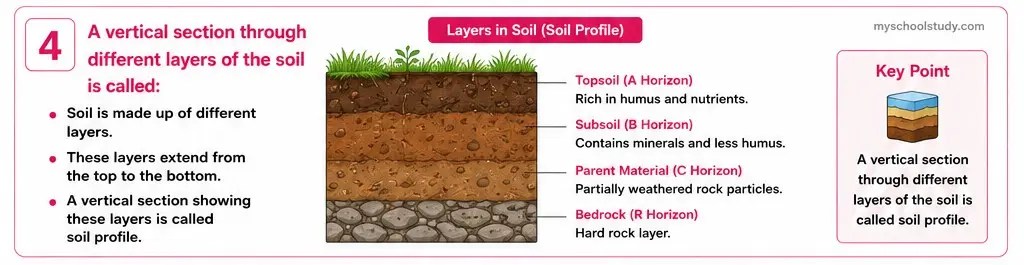
Layers of Soil Profile
A-Horizon (Topsoil)
This is the uppermost layer.
Features:
- Rich in humus
- Contains minerals
- Supports plant growth
- Dark in color
Most plant roots grow in this layer.
B-Horizon (Subsoil)
Located below topsoil.
Features:
- Contains minerals
- Less humus
- Harder texture
This layer stores minerals washed down from the topsoil.
C-Horizon
Contains:
- Weathered rocks
- Large rock fragments
This layer is less fertile.
Bedrock
The lowest solid rock layer.
Soil gradually forms from this rock through weathering.
Importance of Soil Profile
Soil profile helps in:
- Studying soil fertility
- Understanding water movement
- Agricultural planning
- Construction work
Scientists and farmers use soil profiles to determine which crops can grow best in an area.
Importance in Agriculture
Different crops require different soil conditions. Soil profile studies help farmers:
- Select suitable crops
- Plan irrigation
- Improve soil fertility
Formation of Soil Layers
Soil layers form slowly over thousands of years due to:
- Weathering
- Organic matter accumulation
- Water movement
- Climate conditions
5. Soil Pollution
The correct answer is: Polythene Bags and Plastics
Soil pollution occurs when harmful substances mix with soil and reduce its fertility and quality.
Plastic and polythene are major causes of soil pollution because they do not decompose easily.

Causes of Soil Pollution
Plastic Waste
Polythene bags remain in soil for many years.
Industrial Waste
Chemicals released from factories contaminate soil.
Excess Fertilizers
Overuse of chemical fertilizers harms soil organisms.
Pesticides
These chemicals reduce soil fertility.
Garbage Dumping
Waste materials pollute land and groundwater.
Effects of Soil Pollution
Reduced Fertility
Polluted soil becomes less productive.
Harm to Plants
Plants cannot grow properly in polluted soil.
Water Contamination
Pollutants may reach groundwater.
Harm to Animals
Animals eating polluted plants may become sick.
Environmental Damage
Soil pollution disturbs ecosystems.
Why Plastic is Harmful
Plastic:
- Does not decompose quickly
- Blocks water movement
- Reduces soil aeration
- Harms microorganisms
Burning plastic also releases toxic gases.
Prevention of Soil Pollution
Reduce Plastic Use
Use cloth or paper bags instead of polythene.
Recycling
Recycle plastic materials properly.
Organic Farming
Use natural fertilizers and compost.
Proper Waste Disposal
Avoid dumping garbage openly.
Tree Plantation
Plants help maintain soil quality.
Importance of Soil Conservation
Healthy soil is necessary for:
- Food production
- Environmental balance
- Water conservation
- Biodiversity
Soil conservation helps future generations maintain agricultural productivity.

