

Welcome To My School Study
Do You Know
Q1. Who discovered the cell for the first time?
Correct Answer: Robert Hooke
The discovery of the cell is considered one of the most important events in the history of science. Before the invention of the microscope, people had no idea that living organisms were made up of tiny units called cells. In the year 1665, an English scientist named Robert Hooke observed a thin slice of cork under a microscope. Cork is the outer bark of a tree.
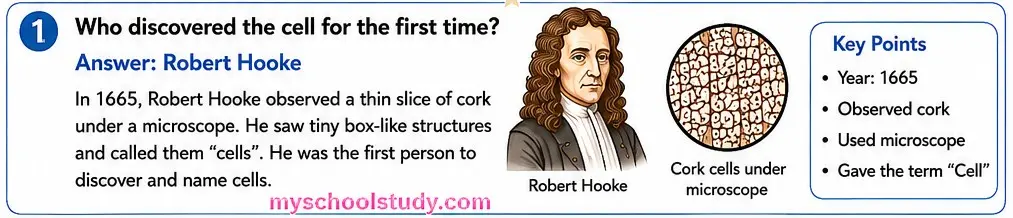
While observing the cork, Hooke noticed many tiny box-like compartments. These compartments looked similar to small rooms or cells in a monastery. Because of this appearance, he named them “cells.” Although the cells he observed were dead cells, his discovery became the foundation of modern biology.
Later, many scientists improved microscopes and studied living cells. Antonie van Leeuwenhoek became the first scientist to observe living microorganisms. Due to these discoveries, scientists understood that all plants and animals are made of cells.
The discovery of the cell completely changed the field of biology. Today, the study of cells helps scientists understand diseases, human growth, genetics, and many life processes.
Important Points:
- Cell was discovered by Robert Hooke
- Discovery year: 1665
- Cork slice was used for observation
- He used a microscope
- He gave the term “Cell”
Easy Memory Trick:
Hooke = Hooked the first cell discovery.
Real Life Connection:
Just like bricks are the basic units of a building, cells are the basic units of living organisms.
Q2. Which part of the cell is known as the “Powerhouse of the Cell”?
Correct Answer: Mitochondria
Mitochondria are very important cell organelles responsible for producing energy. Every living organism requires energy to perform activities such as movement, growth, breathing, digestion, and reproduction. The mitochondria provide this energy, which is why they are called the “Powerhouse of the Cell.”
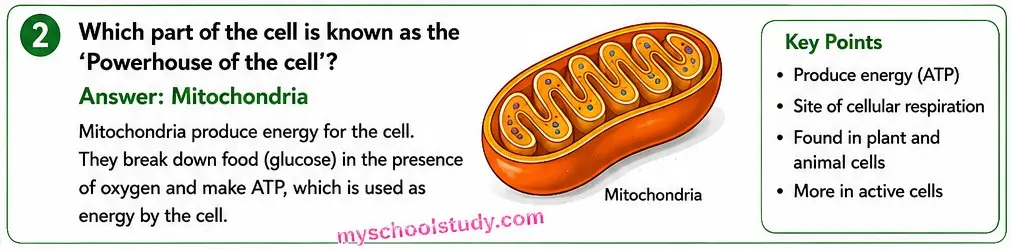
Inside mitochondria, food substances like glucose are broken down in the presence of oxygen. This process is called cellular respiration. During respiration, energy is released and stored in the form of ATP (Adenosine Triphosphate). ATP acts like an energy currency for the cell.
Cells that require more energy usually contain more mitochondria. For example, muscle cells and heart cells have a large number of mitochondria because they need constant energy.
Mitochondria have their own DNA and can reproduce independently inside the cell. Scientists believe that mitochondria may once have been independent organisms.
Functions of Mitochondria:
- Produce energy for the cell
- Carry out cellular respiration
- Store energy in ATP form
- Support cell metabolism
Important Facts:
- Known as the “Powerhouse of the Cell”
- Found in both plant and animal cells
- Double membrane structure
- More in active cells
Daily Life Example:
When you run, exercise, or play sports, your body needs extra energy. Mitochondria help produce that energy.
Easy Trick:
Mito = Might or Power → Mitochondria gives power.
Q3. The control centre of all the activities of a cell is?
Correct Answer: Nucleus
The nucleus is one of the most important parts of a cell. It controls all activities happening inside the cell. Because of this controlling function, the nucleus is often called the “Brain of the Cell.”
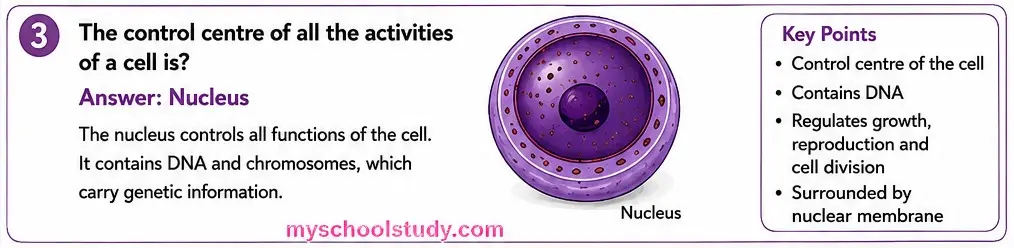
The nucleus contains chromosomes and DNA. DNA carries hereditary information from parents to children. Traits such as eye color, hair type, height, and many inherited characteristics are controlled by genes present in DNA.
The nucleus controls:
- Growth of the cell
- Reproduction
- Protein synthesis
- Cell division
- Metabolism
Without the nucleus, a cell cannot survive for long because it loses control over its functions.
The nucleus is surrounded by a nuclear membrane. Inside the nucleus, there is a dense structure called the nucleolus, which helps in ribosome formation.
Main Functions of Nucleus:
- Controls all cell activities
- Stores genetic information
- Helps in reproduction
- Regulates cell division
Important Facts:
- Called the control center of the cell
- Contains DNA and chromosomes
- Present in eukaryotic cells
- Essential for survival
Real Life Example:
Just like a school principal controls school activities, the nucleus controls all activities of the cell.
Easy Memory Trick:
Nucleus = Nuclear control center.
Q4. Plant cells differ from animal cells in having?
Correct Answer: Cell Wall
Plant cells and animal cells are similar in many ways, but they also have several differences. One major difference is the presence of the cell wall in plant cells.
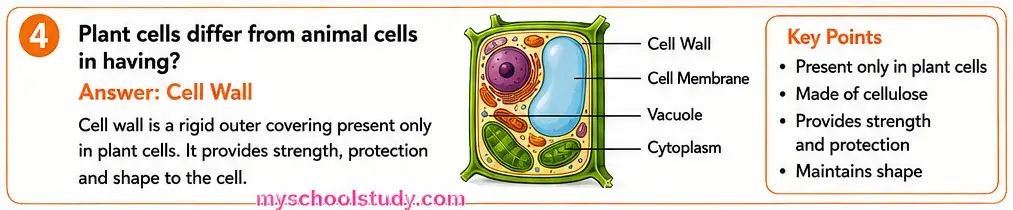
The cell wall is a rigid outer covering found outside the cell membrane in plant cells. It is mainly made of cellulose. The cell wall provides strength, protection, and shape to the plant cell.
Animal cells do not have a cell wall. Because of this, animal cells are flexible and can change shape more easily.
Functions of Cell Wall:
- Provides protection
- Gives shape to the cell
- Prevents bursting of the cell
- Provides mechanical support
The cell wall helps plants remain upright and strong. Without cell walls, plants would not be able to stand properly.
Differences Between Plant and Animal Cells:
| Plant Cell | Animal Cell |
|---|---|
| Cell wall present | Cell wall absent |
| Chloroplast present | Chloroplast absent |
| Fixed shape | Irregular shape |
| Large vacuole | Small vacuoles |
Important Facts:
- Present only in plant cells
- Made of cellulose
- Protects the cell
- Gives rigidity
Easy Example:
A cell wall works like the outer wall of a house that protects everything inside.
Memory Trick:
Plant = Protective wall.
Q5. The green coloured organelles found in plant cells are?
Correct Answer: Chloroplasts
Chloroplasts are green-colored organelles present in plant cells. They contain a pigment called chlorophyll, which gives plants their green color.

The main function of chloroplasts is to perform photosynthesis. During photosynthesis, plants prepare their own food using sunlight, water, and carbon dioxide.
The process of photosynthesis can be represented as:
Carbon dioxide + Water + Sunlight → Glucose + Oxygen
This process is extremely important because:
- Plants make food for themselves
- Oxygen is released into the atmosphere
- It supports life on Earth
Chloroplasts are found only in green plants and some algae. Animal cells do not contain chloroplasts because animals cannot make their own food.
Functions of Chloroplast:
- Carry out photosynthesis
- Contain chlorophyll
- Prepare food for plants
- Release oxygen
Important Facts:
- Green organelles in plant cells
- Contain chlorophyll pigment
- Found only in plants
- Help in food production
Real Life Example:
Chloroplasts are like solar panels because they capture sunlight energy and convert it into useful food energy.
Easy Trick:
Chloro = Green
Plast = Body
Chloroplast = Green food-making body.
Additional Information About Cells
What is a Cell?
A cell is the smallest living and functional unit of life. Every living organism is made up of cells. Some organisms are made of only one cell, while others are made of millions of cells.
Types of Organisms:
- Unicellular organisms
- Multicellular organisms
Examples of Unicellular Organisms:
- Amoeba
- Paramecium
- Bacteria
Examples of Multicellular Organisms:
- Humans
- Animals
- Plants
Main Parts of a Cell
1. Cell Membrane
The cell membrane is a thin outer covering of the cell. It controls the movement of substances in and out of the cell.
Functions:
- Protects the cell
- Controls transport of materials
- Maintains shape
2. Cytoplasm
Cytoplasm is a jelly-like substance present inside the cell membrane. Cell organelles float in the cytoplasm.
Functions:
- Supports organelles
- Site of many chemical reactions
3. Nucleus
The nucleus controls all activities of the cell.
Important Cell Organelles and Their Functions
| Organelle | Function |
|---|---|
| Mitochondria | Energy production |
| Nucleus | Control center |
| Chloroplast | Photosynthesis |
| Ribosome | Protein synthesis |
| Vacuole | Storage |
| Golgi Body | Packaging and transport |
Cell Theory
The Cell Theory states:
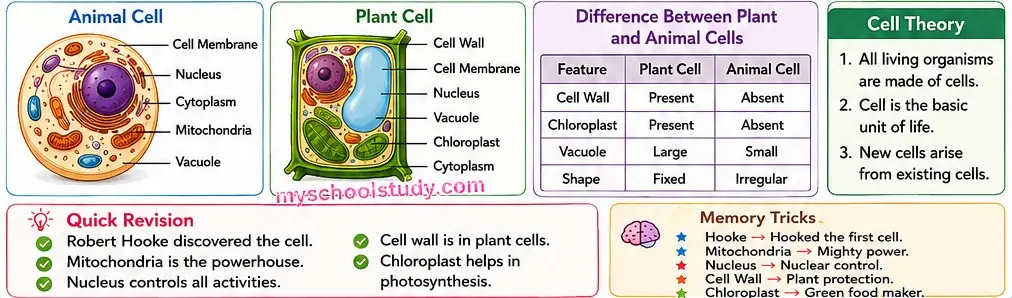
- All living organisms are made of cells.
- The cell is the basic unit of life.
- New cells arise from existing cells.
This theory became the basis of modern biology.
Why is the Study of Cells Important?
Studying cells helps scientists understand:
- Human body functions
- Diseases and treatments
- Genetics
- Growth and reproduction
- Development of medicines
Cell biology is important in medical science, biotechnology, and genetics.
Easy Revision Notes
- Robert Hooke discovered the cell
- Mitochondria produce energy
- Nucleus controls the cell
- Cell wall is present in plant cells
- Chloroplast performs photosynthesis
Quick Learning Tricks
| Topic | Trick |
|---|---|
| Robert Hooke | Hooked the first cell |
| Mitochondria | Mighty power |
| Nucleus | Nuclear control |
| Chloroplast | Green food maker |
| Cell Wall | Plant protection |
Practice Questions for Revision
- Who discovered the cell?
Answer: Robert Hooke - Which organelle is called the powerhouse?
Answer: Mitochondria - Which organelle controls all activities?
Answer: Nucleus - Which structure is found only in plant cells?
Answer: Cell Wall - Which organelle performs photosynthesis?
Answer: Chloroplast
Summary
Cells are the building blocks of life. Every living organism is made up of cells. Different cell organelles perform different functions to keep the organism alive. Mitochondria provide energy, the nucleus controls activities, chloroplasts help plants make food, and the cell wall provides protection and strength. Understanding cells helps students learn biology in a simple and scientific way.
