

Welcome To My School Study
Do You Know
Q1. Which is the fastest way of transport?
Comprehensive Description
Airways are considered the fastest mode of transport in the world. Air transport uses airplanes and helicopters to move passengers and goods quickly over long distances.
Modern air transportation has revolutionized global connectivity by reducing travel time between cities, countries, and continents.
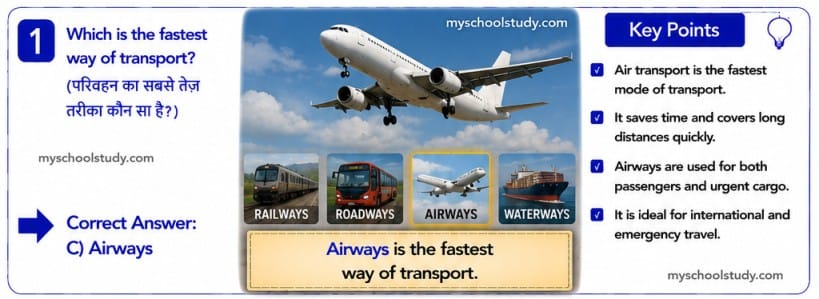
Air transport is especially useful for:
• Long-distance travel
• Emergency services
• International transportation
• Tourism and business travel
• Transport of perishable goods
Major components of air transport include:
• Airports
• Aircraft
• Air traffic control systems
• Cargo terminals
Advantages of airways:
• Highest speed among transport modes
• Saves time
• Connects remote regions
• Supports international trade
Limitations:
• Expensive compared to other modes
• Weather can affect flights
• Limited cargo capacity compared to ships
Despite higher costs, airways remain the preferred choice when speed is the most important factor.
Features of Airways
• Fastest mode of transport
• Suitable for long distances
• Connects countries and continents
• Important for emergency services
Importance of Airways
• Promotes global connectivity
• Supports tourism
• Facilitates international trade
• Reduces travel time significantly
Options Analysis
A) Railways
Fast but slower than air transport.
B) Roadways
Useful for short and medium distances.
C) Airways
The Correct Answer. Fastest means of transport.
D) Waterways
Generally the slowest mode of transport.
Key Points to Remember
• Airways are the fastest transport system.
• Ideal for long-distance travel.
• Important for global trade and tourism.
• Saves significant travel time.
• Widely used for international transportation.
Real-Life Importance
Air transport helps people travel across countries within hours and supports emergency medical and disaster-relief operations.
Learning Enrichment
Students should understand:
• Different transport systems
• Advantages of air transport
• Global transportation networks
• Role of aviation in development
Q2. What are the roads built underground called?
Comprehensive Description
Roads or passageways built below the surface of the ground are called Subways.
Subways are designed to:
• Reduce traffic congestion
• Improve urban transportation
• Provide safe movement in crowded areas
• Save surface space in cities

In many cities, subways may refer to:
• Underground roads
• Underground pedestrian passages
• Underground railway systems
Subways are commonly found in:
• Large metropolitan cities
• Highly populated urban areas
• Busy commercial zones
Benefits of subways include:
• Faster movement of people
• Reduced traffic jams
• Improved safety
• Efficient use of urban land
Modern cities increasingly use underground transportation systems to manage growing populations and transportation demands.
Features of Subways
• Built underground
• Reduce surface congestion
• Improve transportation efficiency
• Common in large cities
Importance of Subways
• Save travel time
• Improve urban mobility
• Reduce traffic pressure
• Enhance public convenience
Options Analysis
A) Expressways
High-speed roads built above ground.
B) Subways
The Correct Answer. Roads or passages built underground.
C) Flyovers
Elevated roads above ground.
D) Highways
Major roads connecting regions.
Key Points to Remember
• Subways are underground transport routes.
• Common in large cities.
• Help reduce congestion.
• Improve transportation efficiency.
• Support urban development.
Real-Life Importance
Subways help millions of people commute efficiently while reducing traffic congestion in busy cities.
Learning Enrichment
Students should understand:
• Urban transportation systems
• Underground infrastructure
• Traffic management strategies
• Sustainable city planning
Q3. Which is the cheapest mode of transport for bulky goods over long distances?
Comprehensive Description
Waterways are considered the cheapest mode of transport for carrying bulky and heavy goods over long distances.
Water transport includes:
• Rivers
• Canals
• Lakes
• Seas
• Oceans
Large quantities of goods can be transported at relatively low cost through ships and barges.
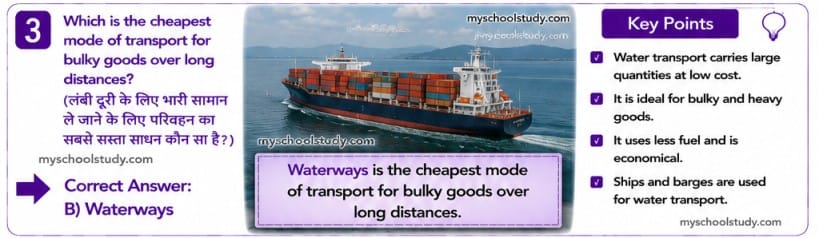
Goods commonly transported by waterways include:
• Coal
• Iron ore
• Petroleum products
• Fertilizers
• Food grains
• Machinery
Advantages of waterways:
• Economical transportation
• High carrying capacity
• Energy efficient
• Environmentally friendly
Limitations:
• Slower than air and road transport
• Dependent on navigable waterways
• Weather conditions may affect operations
Because of their low transportation cost, waterways are widely used in international trade and bulk cargo movement.
Features of Waterways
• Lowest transportation cost
• High carrying capacity
• Suitable for heavy goods
• Environmentally efficient
Importance of Waterways
• Supports international trade
• Reduces transport expenses
• Conserves energy
• Moves large cargo efficiently
Options Analysis
A) Airways
Fastest but most expensive.
B) Waterways
The Correct Answer. Cheapest for bulky goods.
C) Roadways
Suitable for shorter distances.
D) Helicopters
Very expensive transportation method.
Key Points to Remember
• Waterways are the cheapest transport mode.
• Best for bulky goods.
• Important for international trade.
• High cargo-carrying capacity.
• Environmentally efficient.
Real-Life Importance
Many essential commodities reach industries and markets through water transport because of its low cost.
Learning Enrichment
Students should understand:
• Bulk transportation systems
• International trade routes
• Economic advantages of waterways
• Sustainable transportation methods
Q4. The Trans-Siberian Railway connects St. Petersburg with?
Comprehensive Description
The Trans-Siberian Railway is one of the longest railway networks in the world. It connects St. Petersburg in western Russia with Vladivostok in the far eastern part of the country.
The railway passes through:
• Vast plains
• Forest regions
• Mountain areas
• Numerous cities and towns
Key characteristics include:
• Extremely long route
• Major transportation corridor
• Connects European and Asian Russia
• Supports passenger and freight movement
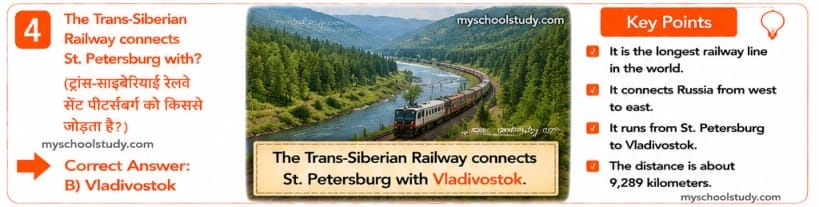
The railway plays an important role in:
• Trade
• Economic development
• Regional connectivity
• Tourism
The Trans-Siberian Railway is often studied as an example of how transportation can unite vast geographical regions.
Features of the Trans-Siberian Railway
• One of the world’s longest railways
• Connects western and eastern Russia
• Supports freight and passenger transport
• Important economic corridor
Importance of the Railway
• Promotes national integration
• Facilitates trade
• Supports regional development
• Enhances connectivity
Options Analysis
A) Moscow
Major city but not the final eastern endpoint.
B) Vladivostok
The Correct Answer. Connected through the Trans-Siberian Railway.
C) Beijing
Located in China.
D) Tokyo
Located in Japan.
Key Points to Remember
• Connects St. Petersburg and Vladivostok.
• One of the longest railway routes.
• Important transportation corridor.
• Supports economic development.
• Links European and Asian Russia.
Real-Life Importance
The railway demonstrates how transportation infrastructure supports trade, mobility, and national development.
Learning Enrichment
Students should understand:
• Global transport networks
• Importance of railways
• Economic geography
• Regional connectivity
Q5. Which state in India has the densest railway network?
Comprehensive Description
Uttar Pradesh is considered the state with the densest railway network in India.
Railways are one of the most important modes of transportation in the country and play a significant role in connecting cities, towns, and villages.
Uttar Pradesh has:
• Large population
• Numerous cities and towns
• Major industrial and agricultural centers
• Strategic geographical location
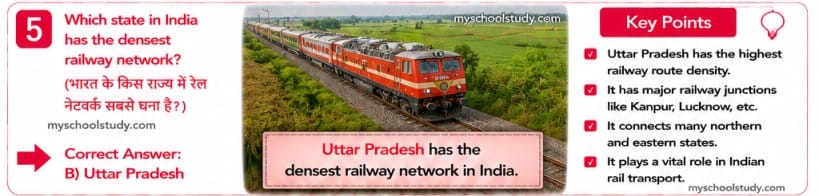
The railway network supports:
• Passenger movement
• Freight transportation
• Economic development
• Tourism
Major railway routes passing through Uttar Pradesh connect:
• Northern India
• Eastern India
• Western India
• Central India
The dense railway system helps facilitate:
• Trade and commerce
• Agricultural distribution
• Industrial growth
• Employment opportunities
Indian Railways remains one of the largest railway systems in the world and Uttar Pradesh serves as one of its most important regions.
Features of Railway Network in Uttar Pradesh
• Extensive connectivity
• High passenger traffic
• Major railway junctions
• Supports economic activities
Importance of Railways
• Affordable transportation
• Connects regions efficiently
• Supports trade and industry
• Promotes national integration
Options Analysis
A) Rajasthan
Large railway network but less dense.
B) Uttar Pradesh
The Correct Answer. Densest railway network in India.
C) Sikkim
Limited railway connectivity.
D) Arunachal Pradesh
Rail network is comparatively smaller.
Key Points to Remember
• Uttar Pradesh has the densest railway network.
• Railways are vital for economic growth.
• Important railway junctions are located in the state.
• Supports passenger and freight movement.
• Enhances regional connectivity.
Real-Life Importance
A strong railway network helps people travel affordably and enables businesses to transport goods efficiently across the country.
Related links
- Quiz Class 7th Social Science 26-05-2026
- Class 7th Social Science Quiz with MCQs 17-05-2026
- Quiz Class 7th Science 11-05-2026
- Quiz Class 7th Science 12-05-2026
- Quiz Class 7th Science 13-05-2026
- Quiz Class 7th Science 14-05-2026
Latesh Posts
- Class 8 MCQ Questions Answers– History, Civics, Geography
- Class 9 MCQ Questions Answers– History, Geography, Civics
- Class 7 MCQ Questions Answers– Markets Around Us 10-6-26
- Class 10 SST MCQs with Detailed Black Soil, Sri Lanka
- Class 10 SST MCQs with Detailed Explanations 9-6-26