

Welcome To My School Study
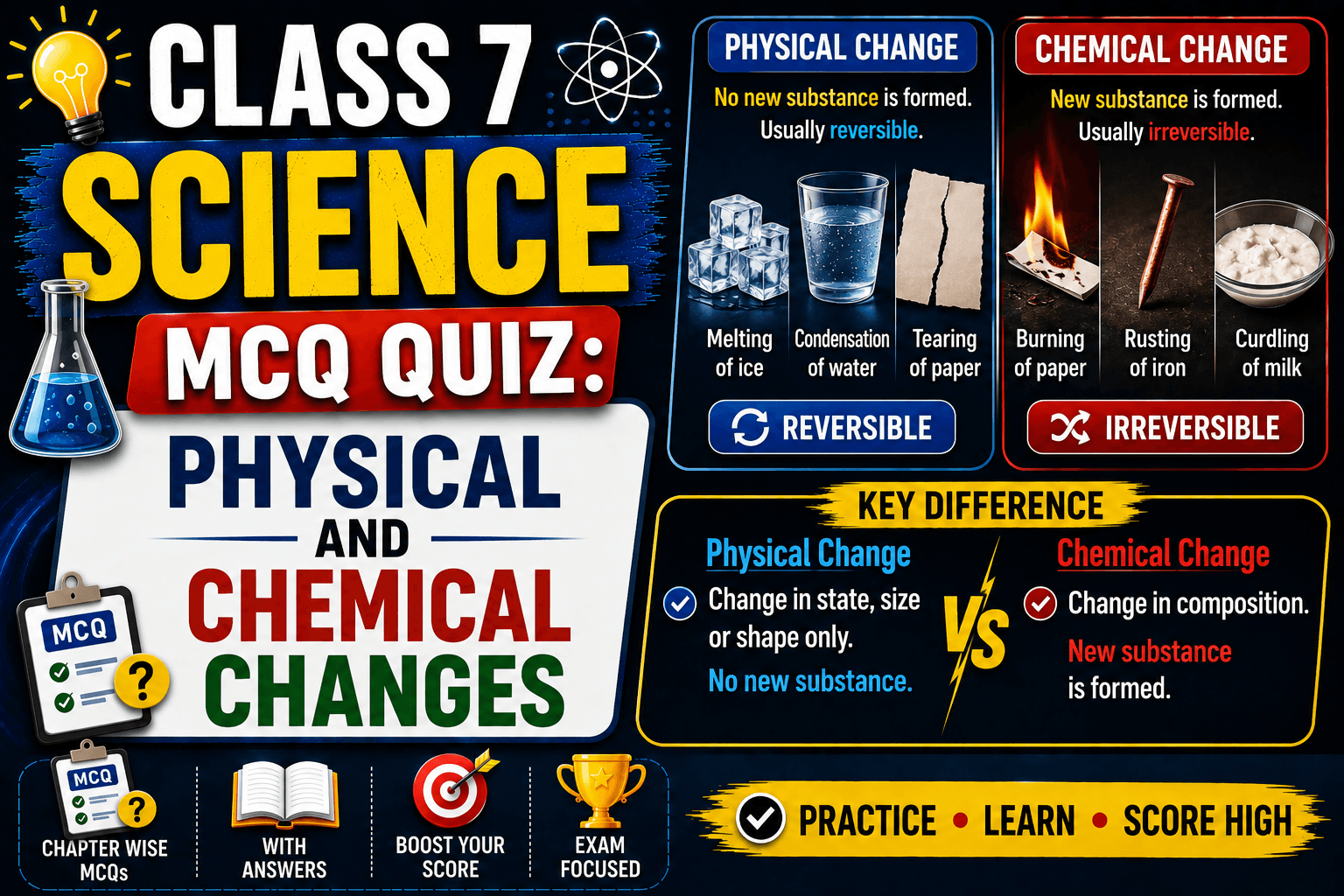
Practice Class 7 Science MCQs on physical change, chemical change, rusting, galvanization, burning, carbon dioxide, lime water test, oxidation, and NCERT science concepts with detailed explanations.
Do You Know
Q1. Which gas turns lime water milky?
Correct Answer: Carbon dioxide
Detailed Explanation:
Carbon dioxide (CO₂) is a colorless and odorless gas that is naturally present in the atmosphere. One of its most important chemical properties is that it turns lime water milky. This test is commonly used in laboratories to identify the presence of carbon dioxide gas.
Lime water is a clear solution of calcium hydroxide. When carbon dioxide gas is passed through lime water, a chemical reaction takes place. During this reaction, calcium carbonate is formed, which appears as a white precipitate. This white precipitate makes the lime water look milky.
The reaction can be represented as:
Carbon dioxide + Lime water → Calcium carbonate + Water
This experiment is often performed in schools to demonstrate the presence of carbon dioxide in exhaled air. When we blow air through a straw into lime water, it gradually turns milky because the air we exhale contains carbon dioxide.
Carbon dioxide is produced during respiration, combustion, and decomposition of organic matter. Plants absorb carbon dioxide during photosynthesis and use it to prepare food.
The lime water test is one of the simplest and most reliable methods for detecting carbon dioxide gas. This concept is important in Class 7 Science because it demonstrates how chemical reactions can be used to identify substances.
Real-Life Examples:
- Exhaled air turns lime water milky.
- Burning fuels release carbon dioxide.
- Carbon dioxide is used by plants during photosynthesis.
Important NCERT Points:
- Carbon dioxide turns lime water milky.
- Calcium carbonate is formed during the reaction.
- The change is a chemical change.
- Carbon dioxide is produced during respiration.
Exam-Oriented Fact:
The lime water test is commonly used to identify carbon dioxide gas.
Quick Revision Line:
Carbon dioxide turns lime water milky by forming calcium carbonate.
Q2. Cutting of a log of wood into pieces is a:
Correct Answer: Physical change
Detailed Explanation:
A physical change is a change in which only the shape, size, or appearance of a substance changes, while its chemical composition remains the same. Cutting a log of wood into smaller pieces is a classic example of a physical change.
When wood is cut, no new substance is formed. The wood remains wood before and after cutting. Only its size and shape change. Since the chemical properties of the wood remain unchanged, the process is classified as a physical change.
Physical changes are usually temporary and do not alter the internal composition of a substance. Examples include melting ice, tearing paper, breaking glass, and dissolving sugar in water.
Understanding the difference between physical and chemical changes is important in science. In a chemical change, new substances are formed with different properties, whereas in a physical change, the substance remains chemically unchanged.
Cutting wood is done for various purposes such as making furniture, firewood, and construction materials. Although the appearance of the wood changes significantly, its basic composition remains the same.
This topic helps students understand how everyday activities can be classified scientifically.
Real-Life Examples:
- Cutting vegetables into pieces.
- Breaking a chalk stick.
- Cutting wood for furniture making.
Important NCERT Points:
- No new substance is formed.
- Only size and shape change.
- The chemical composition remains unchanged.
- It is a physical change.
Exam-Oriented Fact:
Physical changes affect appearance but not chemical composition.
Quick Revision Line:
Cutting wood changes only its size and shape, making it a physical change.
Q3. Brown color of a cut apple slice is due to a:
Correct Answer: Chemical change
Detailed Explanation:
When an apple is cut and exposed to air, its surface gradually turns brown. This browning occurs because of a chemical reaction known as oxidation.
Inside the apple, certain enzymes react with oxygen present in the air. This reaction produces brown-colored compounds on the surface of the fruit. Since new substances are formed during the process, it is considered a chemical change.
Unlike physical changes, chemical changes result in the formation of substances with different properties. The brown color cannot be easily reversed, which is another characteristic of a chemical change.
The rate of browning can be reduced by applying lemon juice to the cut surface. Lemon juice contains citric acid and vitamin C, which slow down the oxidation process.
This phenomenon is not limited to apples. Similar browning can occur in bananas, potatoes, pears, and other fruits when exposed to air.
Understanding oxidation helps students learn about many important chemical processes occurring in daily life, including rusting and combustion.
Real-Life Examples:
- Cut apples turning brown.
- Sliced potatoes becoming darker.
- Bananas changing color after peeling.
Important NCERT Points:
- Browning occurs due to oxidation.
- Oxygen reacts with substances in the apple.
- New substances are formed.
- It is a chemical change.
Exam-Oriented Fact:
The browning of a cut apple is caused by oxidation in the presence of oxygen.
Quick Revision Line:
A cut apple turns brown due to a chemical change called oxidation.
Q4. Which of the following is a way to prevent rusting?
Correct Answer: All of these
Detailed Explanation:
Rusting is a chemical process in which iron reacts with oxygen and moisture present in the air to form iron oxide, commonly known as rust. Rust weakens iron objects and reduces their lifespan.
Several methods are used to prevent rusting by stopping iron from coming into contact with air and moisture.
Painting: A layer of paint acts as a protective barrier that prevents oxygen and water from reaching the iron surface.
Greasing or Oiling: Grease and oil form a protective coating that blocks moisture and air.
Galvanization: In this process, iron is coated with a layer of zinc. Zinc protects the iron from rust even if the coating is scratched slightly.
Other methods include electroplating and alloy formation, such as making stainless steel.
Preventing rust is important because rusted structures can become weak and unsafe. Engineers and manufacturers use different anti-rust techniques to protect bridges, vehicles, machinery, and household items.
This topic demonstrates how scientific knowledge can help solve practical problems in daily life.
Real-Life Examples:
- Painting iron gates.
- Applying grease to bicycle chains.
- Galvanized water pipes.
Important NCERT Points:
- Rusting requires oxygen and moisture.
- Painting prevents contact with air.
- Greasing forms a protective layer.
- Galvanization uses zinc coating.
Exam-Oriented Fact:
Galvanization is one of the most effective methods of preventing rusting.
Quick Revision Line:
Painting, greasing, and galvanization all help prevent rusting.
Q5. Burning of any substance is always a:
Correct Answer: Chemical change
Detailed Explanation:
Burning, also known as combustion, is a chemical reaction in which a substance reacts with oxygen and releases heat and light energy. During burning, new substances are produced, making it a chemical change.
For example, when wood burns, it produces ash, carbon dioxide, water vapor, heat, and light. The original wood cannot be recovered from these products, showing that a permanent chemical change has occurred.
Chemical changes often involve energy changes. Burning is an example of an exothermic reaction because it releases energy into the surroundings.
Combustion is used in many daily activities such as cooking food, operating vehicles, generating electricity, and industrial manufacturing. However, uncontrolled burning can lead to fires and environmental pollution.
The process requires three things: fuel, oxygen, and heat. Removing any one of these components can stop combustion. This principle is used in firefighting.
Understanding combustion helps students learn about energy production, fuel usage, and environmental issues.
Real-Life Examples:
- Burning wood in a fireplace.
- Cooking food using LPG gas.
- Fuel combustion in vehicle engines.
Important NCERT Points:
- Burning is a chemical change.
- New substances are formed.
- Heat and light are released.
- Combustion requires oxygen.
Exam-Oriented Fact:
Combustion is an irreversible chemical change that releases energy.
Quick Revision Line:
Burning always produces new substances, so it is a chemical change.
Chapter Summary:
Carbon dioxide turns lime water milky due to the formation of calcium carbonate. Cutting wood is a physical change because no new substance is formed. The browning of a cut apple is a chemical change caused by oxidation. Rusting can be prevented by painting, greasing, and galvanization. Burning is always a chemical change because it produces new substances and releases energy. These concepts are important for understanding physical and chemical changes in everyday life and are frequently asked in Class 7 Science examinations.
Related links
Latest Posts
- NCERT Class 7 Maths Chapter 1 Integers,addition, subtraction
- Class 10 Maths Chapter-1 Real Numbers-Rational numbers-MCQ
- Class9 Maths- Number Systems, decimal expansion, exponents
- Class 8 Maths Chapter 1 Rational Numbers, multiplicative
- Class 10 Maths Chapter 1 Real Numbers MCQ Questions with Solutions
Join Our Other Communities