

Welcome To My School Study
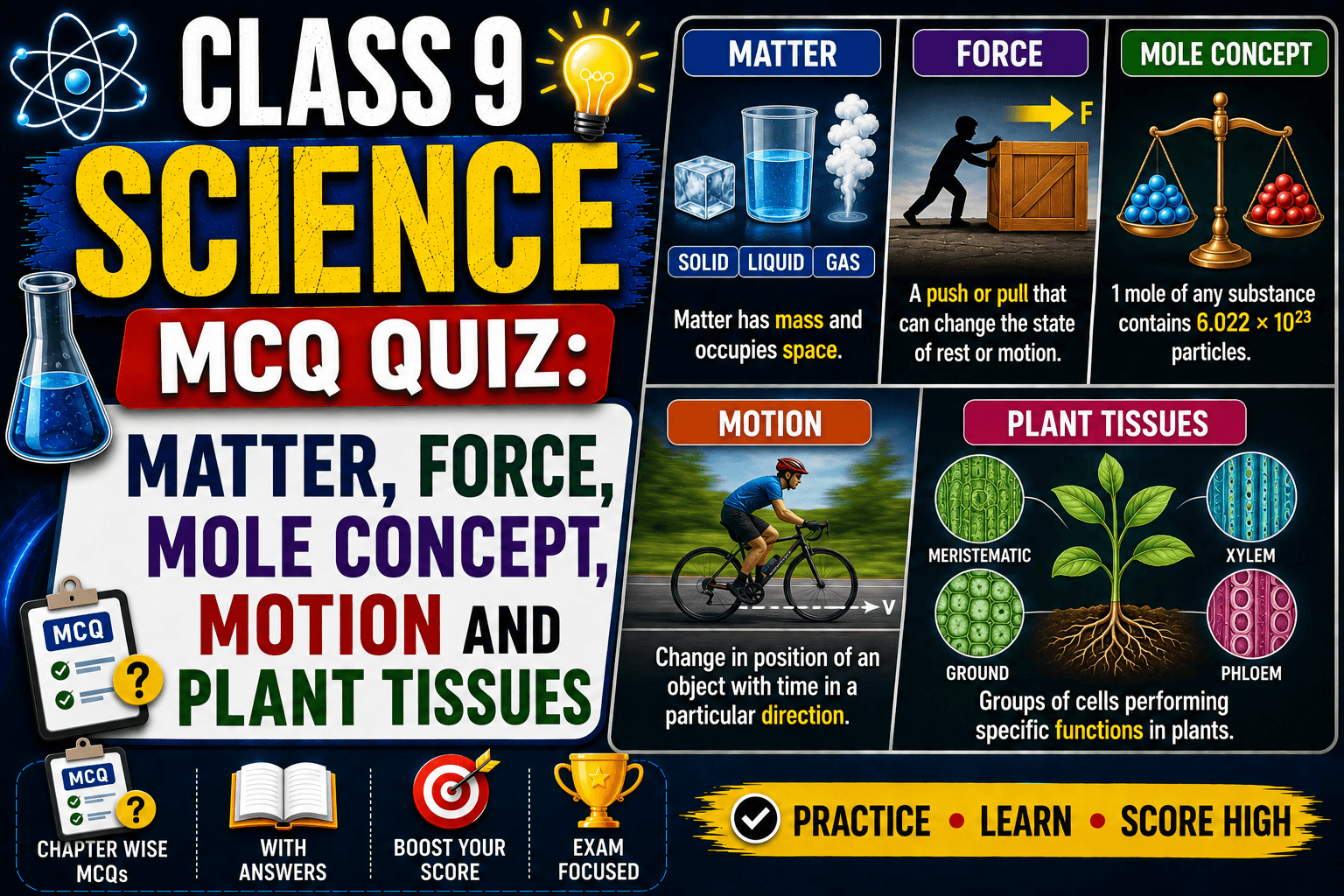
Practice Class 9 Science MCQs on solids, balanced forces, mole concept, acceleration, meristematic tissue, matter, motion, force, and plant tissues with detailed explanations.
Do You Know
Q1. Solid has:
Correct Answer: Fixed Shape
Detailed Explanation:
Matter exists in three common states: solid, liquid, and gas. A solid is a state of matter that has both a definite shape and a definite volume. The particles in a solid are packed very closely together and are held by strong intermolecular forces. Because of these strong forces, the particles cannot move freely and can only vibrate about their fixed positions.
This close arrangement of particles gives solids their characteristic properties. Unlike liquids and gases, solids do not flow and generally maintain their shape unless an external force is applied. For example, a wooden table, a brick, a book, and an iron rod all retain their shape because they are solids.
The fixed shape of solids is one of the most important concepts in Class 9 Science. The particles have very little space between them, making solids rigid and difficult to compress. This explains why objects such as buildings, furniture, and vehicles are made from solid materials.
Different solids may have different levels of hardness and strength. For instance, rubber is softer than iron, but both are solids because they possess a definite shape and volume. Solids also have a high density compared to liquids and gases because their particles are closely packed.
Understanding the properties of solids helps explain many everyday observations. When you place a book on a table, it retains its shape. When you pick up a stone, it does not change its form. These examples demonstrate the fixed shape property of solids.
This concept forms the foundation for understanding the behavior of matter and its different states.
Real-Life Examples:
- A brick maintains its shape regardless of where it is placed.
- A steel spoon retains its form during normal use.
- A wooden chair remains rigid and stable.
Important NCERT Points:
- Solids have definite shape and volume.
- Particles are closely packed.
- Strong intermolecular forces exist between particles.
- Solids are generally rigid and incompressible.
Exam-Oriented Fact:
A solid retains its shape because its particles are fixed in position.
Quick Revision Line:
A solid has a definite shape and a definite volume.
Q2. Balanced forces cause:
Correct Answer: No change in motion
Detailed Explanation:
Force is a push or pull that can change the state of motion, shape, or direction of an object. However, when two or more forces act on an object in such a way that their effects cancel each other, they are called balanced forces.
Balanced forces have equal magnitude but act in opposite directions. Since the net force acting on the object becomes zero, the object’s state of motion does not change. If the object is at rest, it remains at rest. If it is moving with a constant velocity, it continues moving with the same velocity.
For example, imagine a book resting on a table. The gravitational force pulls the book downward, while the table exerts an equal upward force. These two forces balance each other, so the book remains stationary.
Balanced forces are explained by Newton’s First Law of Motion, which states that an object remains at rest or continues moving uniformly unless acted upon by an unbalanced external force.
Many daily-life situations involve balanced forces. A person standing on the ground, a picture hanging on a wall, or a vehicle moving at constant speed on a straight road are examples where balanced forces are present.
Students often confuse balanced forces with the absence of force. In reality, balanced forces may still be acting on an object, but their net effect is zero.
Understanding balanced forces helps explain stability, equilibrium, and motion in the physical world.
Real-Life Examples:
- A book resting on a table.
- A person standing still on the ground.
- A tug-of-war match where both teams pull equally.
Important NCERT Points:
- Balanced forces produce zero net force.
- They do not change the state of motion.
- Equal and opposite forces balance each other.
- Related to Newton’s First Law of Motion.
Exam-Oriented Fact:
Balanced forces cannot produce acceleration.
Quick Revision Line:
Balanced forces cause no change in the motion of an object.
Q3. Mole concept relates to:
Correct Answer: Number of particles
Detailed Explanation:
The mole concept is one of the most important concepts in chemistry. It provides a convenient way to count extremely small particles such as atoms, molecules, and ions.
Just as we use a dozen to represent 12 objects, chemists use a mole to represent a fixed number of particles. One mole contains:
This number is known as Avogadro’s Number.
Atoms and molecules are too small to count individually. Therefore, scientists use the mole concept to express large quantities of particles in a simple manner. It allows chemists to calculate masses, chemical reactions, and quantities of substances accurately.
For example, one mole of carbon atoms contains 6.022 × 10²³ carbon atoms, while one mole of water molecules contains 6.022 × 10²³ water molecules.
The mole concept forms the basis of stoichiometry, which deals with quantitative relationships in chemical reactions. It helps scientists determine how much reactant is needed and how much product will be formed.
In laboratories and industries, the mole concept is used regularly for preparing chemical solutions, conducting experiments, and manufacturing products.
Understanding this concept is essential because it connects the microscopic world of atoms and molecules with measurable quantities used in daily life and scientific work.
Real-Life Examples:
- Measuring chemicals in laboratories.
- Pharmaceutical industries preparing medicines.
- Calculating reactants in chemical manufacturing.
Important NCERT Points:
- Mole is a counting unit in chemistry.
- One mole contains Avogadro’s number of particles.
- It relates to atoms, molecules, and ions.
- Used in chemical calculations.
Exam-Oriented Fact:
One mole always contains 6.022 × 10²³ particles.
Quick Revision Line:
The mole concept is related to the number of particles present in a substance.
Q4. Unit of acceleration:
Correct Answer: m/s²
Detailed Explanation:
Acceleration is defined as the rate of change of velocity with respect to time. Whenever an object’s speed or direction changes, it experiences acceleration.
Mathematically,
where:
- a = acceleration
- u = initial velocity
- v = final velocity
- t = time taken
Since velocity is measured in meters per second (m/s) and time is measured in seconds (s), the SI unit of acceleration becomes:
meter per second squared (m/s²)
Acceleration can be positive, negative, or zero. Positive acceleration occurs when speed increases. Negative acceleration (retardation) occurs when speed decreases. Zero acceleration means velocity remains constant.
For example, when a car starts moving from rest and gains speed, it accelerates. When a cyclist applies brakes, negative acceleration occurs.
Acceleration plays a major role in transportation, sports, engineering, and space science. Vehicles are designed based on acceleration characteristics, while athletes train to improve acceleration during races.
Understanding acceleration helps explain many real-life situations involving moving objects.
Real-Life Examples:
- A car speeding up after a traffic signal.
- A train leaving a station.
- A runner increasing speed during a race.
Important NCERT Points:
- Acceleration is the rate of change of velocity.
- SI unit is m/s².
- Positive acceleration increases speed.
- Negative acceleration decreases speed.
Exam-Oriented Fact:
Acceleration is a vector quantity because it has both magnitude and direction.
Quick Revision Line:
The SI unit of acceleration is meter per second squared (m/s²).
Q5. Meristematic tissue helps in:
Correct Answer: Growth
Detailed Explanation:
Meristematic tissue is a special plant tissue responsible for growth. It consists of actively dividing cells that continuously produce new cells. These newly formed cells later develop into different plant tissues and organs.
Meristematic tissues are found in regions where plant growth occurs. Depending on their location, they are classified into apical meristem, intercalary meristem, and lateral meristem.
The apical meristem is located at the tips of roots and shoots and helps increase the length of the plant. Intercalary meristem helps in rapid growth of grasses and certain plants. Lateral meristem increases the thickness or girth of stems and roots.
The cells of meristematic tissue are small, thin-walled, and densely packed. They have large nuclei and actively divide throughout the plant’s life.
Plant growth occurs because meristematic cells continuously produce new cells. Without these tissues, plants would not be able to increase in height, produce new leaves, branches, flowers, or roots.
Meristematic tissue plays a crucial role in agriculture and horticulture. Farmers and gardeners depend on plant growth processes controlled by these tissues to increase crop production.
The study of meristematic tissue helps students understand how plants grow, repair damage, and develop throughout their life cycle.
Real-Life Examples:
- Growth of root tips in plants.
- Increase in height of young trees.
- Growth of new leaves and branches.
Important NCERT Points:
- Meristematic tissue consists of dividing cells.
- Responsible for plant growth.
- Found at root and shoot tips.
- Produces new plant cells continuously.
Exam-Oriented Fact:
Meristematic tissue is known as the growth tissue of plants.
Quick Revision Line:
Meristematic tissue helps plants grow by producing new cells continuously.
Chapter Summary:
Solids have a fixed shape because their particles are closely packed. Balanced forces do not change an object’s state of motion because the net force is zero. The mole concept helps count extremely large numbers of atoms and molecules using Avogadro’s number. Acceleration measures the rate of change of velocity and has the SI unit m/s². Meristematic tissue is responsible for plant growth through continuous cell division. These concepts form an important foundation of Class 9 Science and are frequently asked in school examinations.
Related Links
- Class 9 MCQ Questions Answers– History, Geography, Civics
- Class 9 SST MCQs with Detailed Explanations
Latest Posts
- NCERT Class 7 Maths Chapter 1 Integers,addition, subtraction
- Class 10 Maths Chapter-1 Real Numbers-Rational numbers-MCQ
- Class9 Maths- Number Systems, decimal expansion, exponents
- Class 8 Maths Chapter 1 Rational Numbers, multiplicative
- Class 10 Maths Chapter 1 Real Numbers MCQ Questions with Solutions
Join Our Other Communities