

Welcome To My School Study
Do You Know
Q1. Who was the ruler of France during the Revolution of 1789?
Comprehensive Description
Louis XVI was the ruler of France during the French Revolution of 1789. He belonged to the Bourbon dynasty and became king at a time when France was facing serious political, social, and economic problems.
Before the revolution, French society was divided into three estates:
- First Estate – Clergy
- Second Estate – Nobility
- Third Estate – Common people
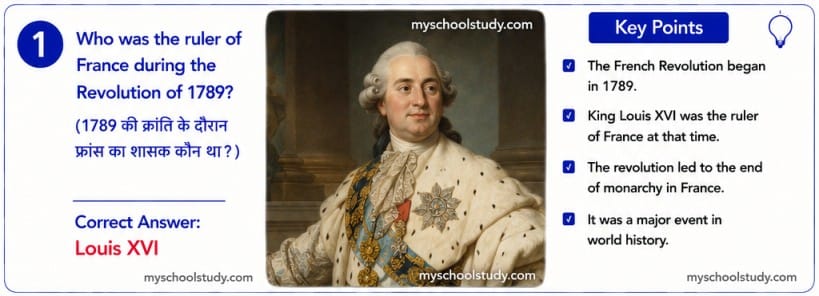
The Third Estate formed the majority of the population but carried most of the tax burden. Economic difficulties, rising food prices, and dissatisfaction with the monarchy increased public anger.
Several factors contributed to the revolution:
- Financial crisis
- Heavy taxation on common people
- Social inequality
- Influence of Enlightenment ideas
- Weak economic conditions
In 1789, the revolution began and gradually challenged the authority of the monarchy. Major events included:
- Formation of the National Assembly
- Storming of the Bastille
- Declaration of the Rights of Man and Citizen
- Abolition of feudal privileges
As revolutionary activities intensified, the power of the king declined. Eventually, the monarchy was abolished and France became a republic.
Importance of the French Revolution
- Promoted ideas of liberty and equality
- Challenged absolute monarchy
- Encouraged democratic movements
- Influenced political changes worldwide
Options Analysis
A) Louis XIV
Ruled France much earlier and was known as the “Sun King.”
B) Louis XVI
Correct Answer. He was the ruler of France during the Revolution of 1789.
C) Napoleon
Came to power after the revolution.
D) Tsar Nicholas
Was associated with Russia, not France.
Key Points to Remember
- Louis XVI ruled France in 1789.
- France faced economic and social crises.
- The French Revolution began during his reign.
- The monarchy was eventually abolished.
- The revolution influenced modern democracy.
Real-Life Importance
The French Revolution remains one of history’s most important events because it promoted ideas of freedom, equality, and popular participation in government.
Q2. Which state of India has the longest coastline?
Comprehensive Description
Gujarat has the longest coastline among all Indian states. The state’s coastline stretches along the Arabian Sea and plays a significant role in India’s maritime economy.
India has a long coastline that supports:
- Trade and commerce
- Fishing activities
- Port development
- Tourism
- Maritime transportation
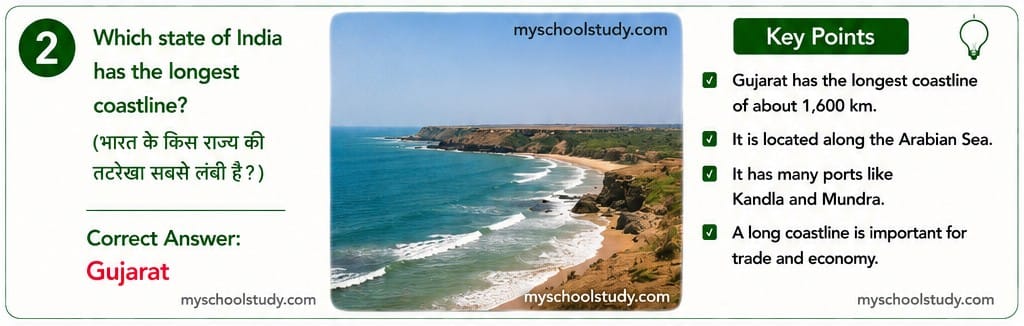
Gujarat’s coastal region contains numerous ports that contribute to national and international trade.
Important features of Gujarat’s coastline include:
- Extensive coastal length
- Major commercial ports
- Fishing centers
- Industrial development
- Coastal biodiversity
The state’s coastal economy supports industries such as:
- Petrochemicals
- Salt production
- Shipping
- Fisheries
Coastal areas also contain ecosystems such as mangroves, which help protect the environment and support wildlife.
Importance of Coastlines
- Facilitate international trade
- Support fishing industries
- Encourage tourism
- Promote economic growth
Features of Gujarat’s Coastline
- Longest coastline in India
- Located along the Arabian Sea
- Home to major ports
- Supports maritime industries
Options Analysis
A) Maharashtra
Has an important coastline but not the longest.
B) Tamil Nadu
Has a long eastern coastline.
C) Gujarat
Correct Answer. Gujarat has the longest coastline among Indian states.
D) Andhra Pradesh
Has a significant coastline on the Bay of Bengal.
Key Points to Remember
- Gujarat has India’s longest coastline.
- Located on the Arabian Sea.
- Important for trade and fisheries.
- Supports major ports.
- Contributes significantly to the economy.
Real-Life Importance
The coastline of Gujarat helps strengthen India’s trade network and supports employment in several sectors.
Q3. What is the minimum age to contest elections for the Lok Sabha in India?
Comprehensive Description
The minimum age required to contest elections for the Lok Sabha is 25 years.
The Lok Sabha is the lower house of the Parliament of India and represents the people of the country. Members are elected directly by citizens through democratic elections.
To become a candidate for the Lok Sabha, a person must satisfy certain constitutional requirements, including:
- Being a citizen of India
- Meeting age requirements
- Fulfilling legal qualifications
- Not being disqualified under law
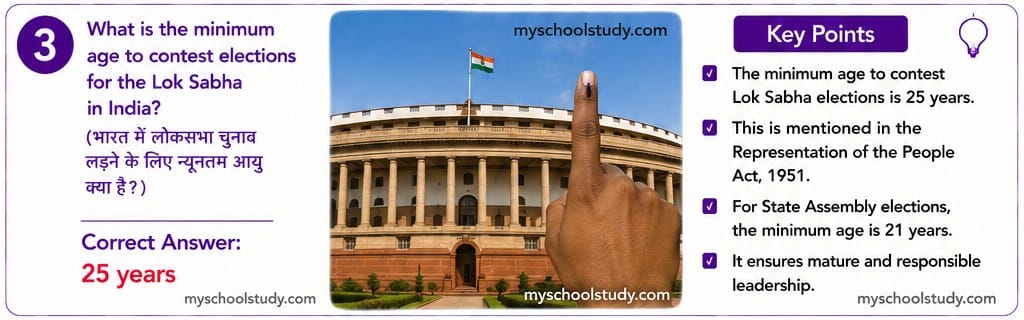
The age requirement is intended to ensure that candidates possess a reasonable level of maturity and public understanding before entering national politics.
The Lok Sabha plays a vital role in:
- Making laws
- Discussing national issues
- Approving budgets
- Representing citizens
India’s democratic system allows eligible citizens to participate in elections and contribute to governance.
Functions of the Lok Sabha
- Law-making
- Budget approval
- Public representation
- Government accountability
Importance of Age Requirements
- Encourages responsible leadership
- Ensures maturity
- Supports effective governance
- Maintains constitutional standards
Options Analysis
A) 18 years
Minimum voting age, not election age for Lok Sabha.
B) 21 years
Required for some local-level positions but not Lok Sabha membership.
C) 25 years
Correct Answer. Minimum age to contest Lok Sabha elections.
D) 30 years
Required for membership of some higher constitutional positions, not Lok Sabha.
Key Points to Remember
- Minimum age is 25 years.
- Candidate must be an Indian citizen.
- Lok Sabha is the lower house of Parliament.
- Members are directly elected.
- Plays a major role in democracy.
Real-Life Importance
Age qualifications help ensure that elected representatives can effectively participate in national decision-making.
Q4. The ‘Mid-Day Meal Scheme’ was launched to improve which of the following?
Comprehensive Description
The Mid-Day Meal Scheme was introduced to improve the attendance and nutritional status of school children.
The scheme provides cooked meals to students studying in government and government-aided schools. It is one of the largest school nutrition programs in the world.
Major objectives include:
- Improving nutrition
- Increasing school attendance
- Reducing classroom hunger
- Encouraging enrollment
- Supporting educational development
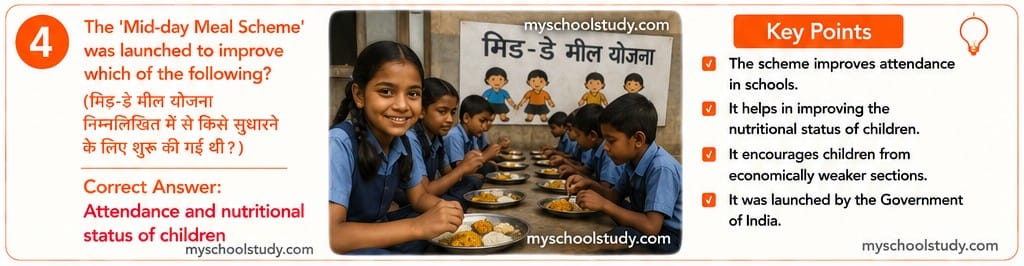
Many children come from economically weaker families where access to nutritious food may be limited. The program helps address nutritional needs while encouraging regular school participation.
Benefits of the scheme include:
- Better health among students
- Improved concentration in classrooms
- Higher enrollment rates
- Reduced dropout rates
- Enhanced learning opportunities
The scheme contributes to both education and child welfare.
Objectives of the Scheme
- Improve child nutrition
- Increase attendance
- Promote education
- Reduce hunger
Benefits
- Better health outcomes
- Increased enrollment
- Improved learning
- Greater social inclusion
Options Analysis
A) Attendance and nutritional status of children
Correct Answer. This is the primary objective of the scheme.
B) Agricultural production
Not the main purpose.
C) Industrial growth
Unrelated to the scheme.
D) Transport system
Not connected with the program.
Key Points to Remember
- Provides meals to school children.
- Improves nutrition.
- Encourages attendance.
- Reduces dropout rates.
- Supports educational development.
Real-Life Importance
The scheme helps children receive education in a healthier environment and supports overall social development.
Q5. When did the Second World War end?
Comprehensive Description
The Second World War ended in 1945 after six years of global conflict.
The war began in 1939 and involved many countries across Europe, Asia, Africa, and other regions. It became one of the largest and most significant conflicts in world history.
The war had major participants divided into two groups:
- Allied Powers
- Axis Powers
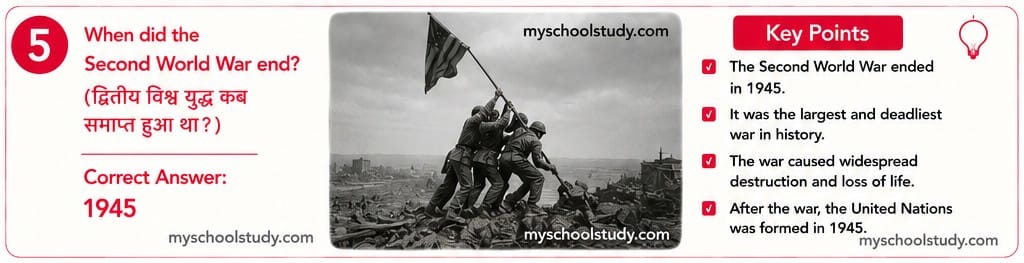
Important consequences of the war included:
- Large-scale destruction
- Economic disruption
- Political changes
- Humanitarian crises
- Formation of international organizations
Several major events marked the closing stages of the war:
- Defeat of Axis powers in Europe
- End of military conflict in Asia
- Surrender of participating Axis nations
After the war, efforts were made to promote international peace and cooperation. One significant outcome was the establishment of the United Nations.
The conflict greatly influenced modern international relations, politics, economics, and diplomacy.
Major Effects of World War II
- Global political changes
- Economic reconstruction
- Growth of international cooperation
- Creation of new institutions
Importance in History
- Reshaped world politics
- Influenced international relations
- Encouraged peace-building efforts
- Led to global cooperation initiatives
Options Analysis
A) 1918
Year associated with the end of World War I.
B) 1939
Year World War II began.
C) 1945
Correct Answer. The Second World War ended in 1945.
D) 1950
Incorrect.
Key Points to Remember
- World War II lasted from 1939 to 1945.
- Ended in 1945.
- Involved countries from multiple continents.
- Had major global consequences.
- Led to the creation of the United Nations.
Real-Life Importance
The end of World War II marked the beginning of a new phase in global history focused on reconstruction, diplomacy, and international cooperation.
Related Links
- Quiz Class 9th Social Science 01-06-2026
- Quiz Class 9th Social Science 29-05-2026
- Quiz Class 9th Social Science 26-05-2026
- Quiz Class 9th Social Science NCERT MCQs 22-05-2026
- Quiz Class 9th Social Science NCERT MCQs 21-05-2026
- Quiz Class 9th Social Science NCERT MCQs 20-05-2026
Latest Posts
- Class 8 MCQ Questions Answers– History, Civics, Geography
- Class 9 MCQ Questions Answers– History, Geography, Civics
- Class 7 MCQ Questions Answers– Markets Around Us 10-6-26
- Class 10 SST MCQs with Detailed Black Soil, Sri Lanka
- Class 10 SST MCQs with Detailed Explanations 9-6-26