

Welcome To My School Study
DoYou Know
Q1. Which is the world’s largest producer of Diamonds?
Comprehensive Description
Russia is widely recognized as the world’s largest producer of diamonds by volume. Diamonds are valuable minerals formed deep inside the Earth’s crust under extremely high temperature and pressure over millions of years.
Diamonds are known for:
- Exceptional hardness
- Brilliant shine
- Industrial applications
- Use in jewelry
Russia possesses vast diamond reserves, particularly in the Siberian region. The country’s diamond industry plays an important role in its economy and global mineral trade.
Major uses of diamonds include:
- Jewelry manufacturing
- Cutting and drilling tools
- Industrial machinery
- Scientific instruments
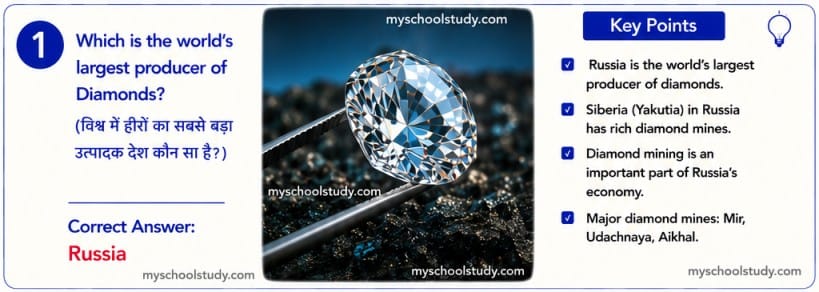
Diamond mining requires advanced technology and careful resource management. Many countries produce diamonds, but Russia consistently ranks among the leading producers due to its large reserves and production capacity.
Importance of Diamonds
- Valuable mineral resource
- Used in jewelry industry
- Important for industrial cutting tools
- Contribute to export earnings
Features of Diamond Mining
- Requires advanced technology
- Found deep underground
- High economic value
- Supports employment and trade
Options Analysis
A) Russia
Correct Answer. Russia is the world’s leading producer of diamonds by volume.
B) South Africa
Historically important in diamond mining but not the largest producer today.
C) Australia
Produces diamonds but at a lower level than Russia.
D) Canada
A significant producer, but not the largest.
Key Points to Remember
- Russia is a leading diamond-producing country.
- Diamonds are formed under high pressure and temperature.
- Used in jewelry and industries.
- Diamond mining contributes to economic development.
- Siberia contains major diamond reserves.
Real-Life Importance
Diamonds are important for both industrial development and global trade, making them one of the world’s most valuable mineral resources.
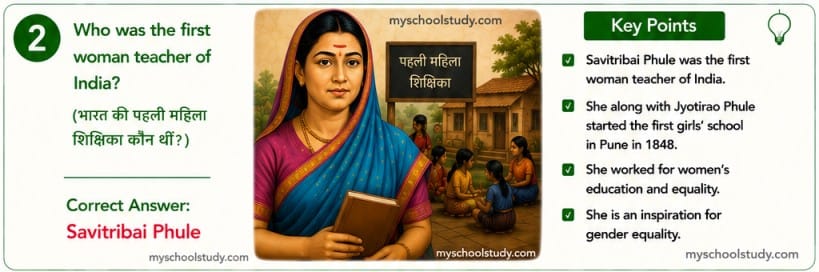
Q2. Who was the first woman teacher of India?
Comprehensive Description
Savitribai Phule is regarded as the first woman teacher of modern India and one of the most important pioneers of women’s education.
She worked during the nineteenth century, a period when educational opportunities for girls were extremely limited. Along with her husband, Jyotirao Phule, she dedicated her life to spreading education and social reform.
Savitribai Phule made significant contributions by:
- Promoting girls’ education
- Supporting social equality
- Establishing schools for girls
- Encouraging education among marginalized communities
She faced many challenges and social opposition while pursuing her mission. Despite these difficulties, she continued her efforts with determination and courage.
Her work helped lay the foundation for:
- Women’s education
- Social reform movements
- Equal learning opportunities
- Educational awareness
Today, she is remembered as a symbol of education, empowerment, and social progress.
Contributions of Savitribai Phule
- Opened schools for girls
- Promoted social equality
- Encouraged literacy
- Supported educational reforms
Importance of Her Work
- Improved access to education
- Empowered women
- Challenged social barriers
- Inspired future reformers
Options Analysis
A) Sarojini Naidu
A freedom fighter and poet, but not the first woman teacher.
B) Savitribai Phule
Correct Answer. She is recognized as the first woman teacher of modern India.
C) Annie Besant
A social reformer and educationist, but not the first woman teacher.
D) Kamala Nehru
Known for her role in the freedom movement.
Key Points to Remember
- Savitribai Phule was a pioneer of women’s education.
- Considered India’s first woman teacher.
- Worked for social equality.
- Opened schools for girls.
- Inspired educational reforms.
Real-Life Importance
Her life demonstrates how education can transform society and create opportunities for future generations.
Q3. Which Fundamental Right allows citizens to move the court if they feel their rights have been violated?
Comprehensive Description
The Right to Constitutional Remedies allows citizens to approach courts when they believe their Fundamental Rights have been violated.
This right is considered one of the most important Fundamental Rights because it helps protect all other rights guaranteed by the Constitution.
Under this right, citizens may seek legal protection through courts if they face violations related to:
- Equality
- Freedom
- Religious rights
- Cultural rights
- Educational rights

The Supreme Court and High Courts have the authority to protect constitutional rights and provide remedies when necessary.
This right strengthens:
- Rule of law
- Justice
- Democratic governance
- Protection of citizens
It ensures that constitutional rights remain meaningful and enforceable rather than merely symbolic.
Importance of Constitutional Remedies
- Protects Fundamental Rights
- Strengthens democracy
- Ensures justice
- Promotes accountability
Role of Courts
- Interpret constitutional provisions
- Protect rights of citizens
- Resolve disputes
- Uphold the rule of law
Options Analysis
A) Right to Liberty
Provides personal freedoms but is not specifically meant for constitutional remedies.
B) Right to Constitutional Remedies
Correct Answer. Enables citizens to approach courts for protection of their rights.
C) Right to Equality
Ensures equal treatment before law.
D) Right to Education
Provides educational rights.
Key Points to Remember
- Called the guardian of Fundamental Rights.
- Allows citizens to seek legal remedies.
- Protects constitutional guarantees.
- Strengthens democratic institutions.
- Involves Supreme Court and High Courts.
Real-Life Importance
This right empowers citizens to seek justice whenever their constitutional protections are threatened.
Q4. Intensive subsistence agriculture is prevalent in which type of areas?
Comprehensive Description
Intensive subsistence agriculture is commonly practiced in thickly populated areas where agricultural land is limited but population pressure is high.
In this system, farmers cultivate small plots of land intensively to produce enough food for their families and local communities.
Characteristics include:
- Small land holdings
- High labor input
- Multiple cropping
- Efficient land use
- Dependence on family labor
This form of agriculture is common in regions where:
- Population density is high
- Land resources are limited
- Agriculture is a primary occupation
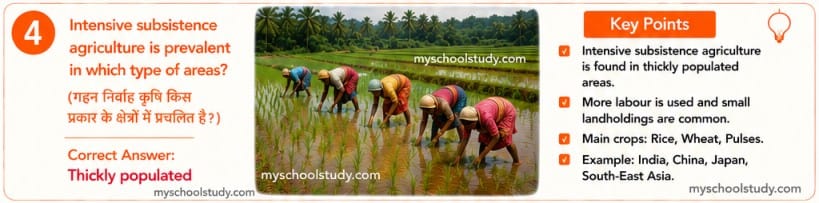
Farmers often use traditional methods along with modern techniques to maximize production from available land.
Major crops grown may include:
- Rice
- Wheat
- Vegetables
- Pulses
The system plays an important role in food security for millions of people.
Features of Intensive Subsistence Agriculture
- Small farms
- High labor requirement
- Intensive cultivation
- High productivity per unit area
Importance
- Supports large populations
- Enhances food production
- Maximizes land utilization
- Provides rural employment
Options Analysis
A) Sparsely populated
Usually associated with extensive farming.
B) Thickly populated
Correct Answer. Intensive subsistence agriculture is common in densely populated regions.
C) Deserts
Agriculture is generally limited due to lack of water.
D) Mountains
Not the primary region for this farming system.
Key Points to Remember
- Practiced in densely populated areas.
- Small land holdings are common.
- Requires intensive labor.
- Supports food security.
- Maximizes agricultural output.
Real-Life Importance
This farming system helps feed large populations and remains important in many developing agricultural regions.
Q5. When did the ‘Non-Cooperation Movement’ end?
Comprehensive Description
The Non-Cooperation Movement, one of the major movements of India’s freedom struggle, ended in 1922.
The movement was launched under the leadership of Mahatma Gandhi with the objective of promoting peaceful resistance against colonial rule.
The movement encouraged people to:
- Boycott foreign goods
- Avoid government institutions
- Promote indigenous products
- Support national unity
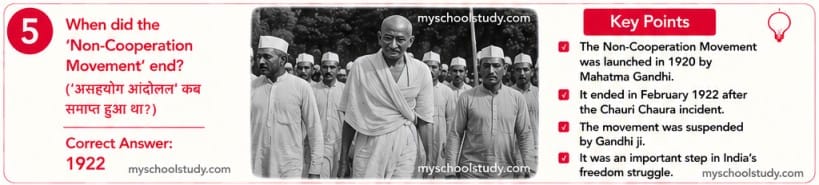
Large numbers of people from different sections of society participated in the movement.
In 1922, an incident of violence occurred at the historic Chauri Chaura Incident. Since the movement was based on non-violence, Gandhi decided to withdraw it.
Although the movement ended, it had a lasting impact by:
- Increasing political awareness
- Encouraging mass participation
- Strengthening nationalism
- Expanding the freedom struggle
The movement demonstrated the power of collective action and peaceful resistance.
Objectives of the Movement
- Peaceful resistance
- Promotion of self-reliance
- National unity
- Opposition to colonial policies
Impact of the Movement
- Increased political participation
- Strengthened nationalist sentiments
- Inspired future movements
- Expanded public involvement
Options Analysis
A) 1920
The movement began around this period but did not end then.
B) 1922
Correct Answer. The movement was withdrawn in 1922.
C) 1924
Incorrect.
D) 1930
Associated with later phases of the freedom struggle.
Key Points to Remember
- Non-Cooperation Movement ended in 1922.
- Led by Mahatma Gandhi.
- Based on non-violence.
- Withdrawn after the Chauri Chaura Incident.
- Important milestone in India’s freedom struggle.
Real-Life Importance
The movement showed how peaceful mass participation can influence political change and inspire national movements.
Related Links
- Quiz Class 8th Social Science 01-06-2026
- Quiz Class 8th Social Science 29-05-2026
- Quiz Class 8th Social Science ncert MCQs 24-05-2026
- Quiz Class 8th Social Science ncert MCQs 23-05-2026
- Quiz Class 8th Social Science ncert MCQs 22-05-2026
- Quiz Class 8th Social Science ncert MCQs 21-05-2026
Latest Posts
- Class 8 MCQ Questions Answers– History, Civics, Geography
- Class 9 MCQ Questions Answers– History, Geography, Civics
- Class 7 MCQ Questions Answers– Markets Around Us 10-6-26
- Class 10 SST MCQs with Detailed Black Soil, Sri Lanka
- Class 10 SST MCQs with Detailed Explanations 9-6-26