

Welcome To My School Study
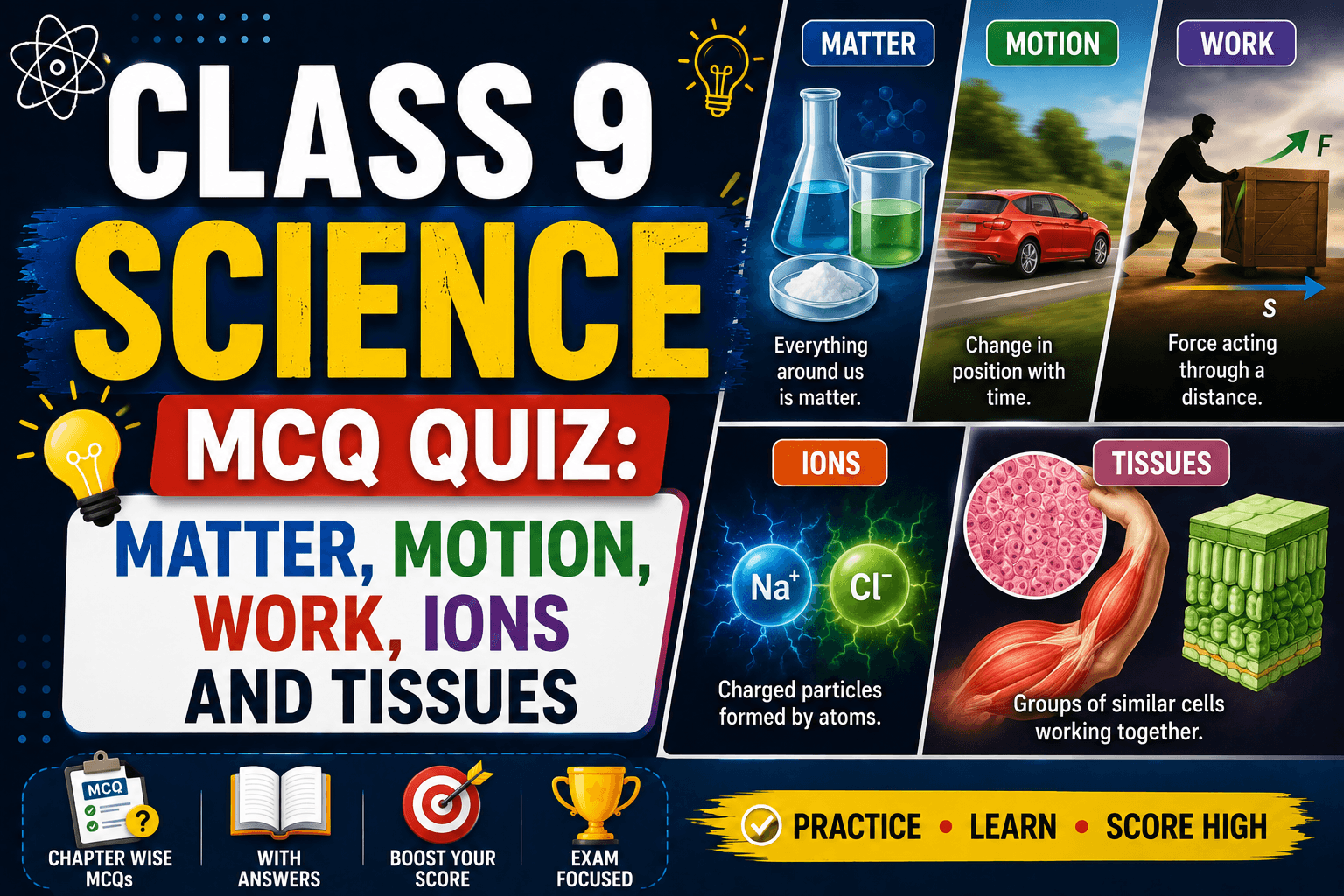
Practice Class 9 Science MCQs on diffusion, work and energy, ions, uniform motion, connective tissue, matter in our surroundings, atoms and molecules, and NCERT science concepts with detailed explanations, real-life examples, and exam-oriented facts.
Do You Know
Q1. Diffusion is fastest in:
Correct Answer: Gas
Detailed Explanation:
Diffusion is the process by which particles move from a region of higher concentration to a region of lower concentration until they become evenly distributed. This natural process occurs in solids, liquids, and gases, but the rate of diffusion is different in each state of matter.
Diffusion is fastest in gases because gas particles have the highest kinetic energy and move very freely in all directions. The spaces between gas particles are much larger compared to solids and liquids. As a result, gas particles can move rapidly and mix with other gases within a short period of time.
In liquids, diffusion also occurs, but it is slower because the particles are closer together and experience greater intermolecular forces. In solids, diffusion is extremely slow because the particles are tightly packed and can only vibrate about their fixed positions.
A common example of diffusion in gases is the spreading of the smell of perfume throughout a room. When perfume is sprayed in one corner, its particles quickly mix with air and spread across the room. This demonstrates the rapid diffusion of gases.
Diffusion plays an important role in many biological and environmental processes. In the human body, oxygen diffuses from the lungs into the bloodstream, while carbon dioxide diffuses from the blood into the lungs for exhalation. Plants also rely on diffusion for the exchange of gases during photosynthesis and respiration.
Temperature affects the rate of diffusion. As temperature increases, particles gain more kinetic energy and move faster, increasing the rate of diffusion. This is why the smell of hot food spreads more quickly than that of cold food.
Understanding diffusion helps students learn how particles behave in different states of matter and explains many everyday phenomena observed in nature and daily life.
Real-Life Examples:
- Perfume smell spreading throughout a room.
- Aroma of food reaching different parts of a house.
- Oxygen moving from the lungs into the bloodstream.
Important NCERT Points:
- Diffusion occurs due to particle movement.
- Gas particles diffuse faster than liquids and solids.
- Higher temperature increases diffusion rate.
- Diffusion helps in the exchange of gases in living organisms.
Exam-Oriented Fact:
The rate of diffusion is maximum in gases because their particles move freely and rapidly.
Quick Revision Line:
Diffusion is fastest in gases due to their high kinetic energy and large intermolecular spaces.
Q2. Work =
Correct Answer: Force × Distance
Detailed Explanation:
In physics, work is said to be done when a force applied on an object causes displacement in the direction of the force. Work is one of the most important concepts in mechanics and helps explain how energy is transferred from one object to another.
Mathematically, work is calculated using the formula:
Work = Force × Distance
where force is measured in newtons (N) and distance or displacement is measured in meters (m). The SI unit of work is the joule (J).
For work to be done, two conditions must be satisfied. First, a force must act on an object. Second, the object must move in the direction of the applied force. If either condition is not met, no work is done in the scientific sense.
For example, if a student pushes a box and the box moves forward, work is done because the applied force causes displacement. However, if a person pushes a wall and the wall does not move, no work is done even though effort is applied because there is no displacement.
Work can be positive, negative, or zero. Positive work occurs when force and displacement are in the same direction. Negative work occurs when force acts opposite to displacement, such as friction. Zero work occurs when displacement is absent or when force acts perpendicular to displacement.
The concept of work is closely related to energy. Whenever work is done, energy is transferred from one system to another. Machines, vehicles, and living organisms perform work by using energy from different sources.
Understanding work helps students analyze motion, energy transformations, and mechanical systems. It forms the foundation for later topics such as power, kinetic energy, and potential energy.
Real-Life Examples:
- Lifting a school bag from the floor.
- Pushing a trolley in a supermarket.
- Pulling a bucket of water from a well.
Important NCERT Points:
- Work is done only when displacement occurs.
- Formula: Work = Force × Distance.
- SI unit of work is joule.
- Work involves energy transfer.
Exam-Oriented Fact:
One joule of work is done when a force of one newton moves an object by one meter.
Quick Revision Line:
Work is equal to force multiplied by displacement in the direction of the force.
Q3. Ion is:
Correct Answer: Charged particle
Detailed Explanation:
An ion is an atom or a group of atoms that carries a net electric charge due to the loss or gain of electrons. Under normal conditions, atoms are electrically neutral because they contain equal numbers of protons and electrons. However, when electrons are transferred, the balance of charge changes and ions are formed.
If an atom loses one or more electrons, it becomes positively charged and is called a cation. For example, sodium loses one electron to form a sodium ion (Na⁺). If an atom gains electrons, it becomes negatively charged and is called an anion. For example, chlorine gains one electron to form a chloride ion (Cl⁻).
Ions are important in chemistry because they participate in many chemical reactions and help form ionic compounds. Common compounds such as sodium chloride (table salt) are formed through the attraction between positively and negatively charged ions.
Ions also play essential roles in biological systems. In the human body, ions such as sodium, potassium, calcium, and chloride help regulate nerve impulses, muscle contractions, and fluid balance. Without these ions, many vital body functions would not occur properly.
Electricity can also flow through solutions containing ions because charged particles are able to move freely. This property is used in batteries, electrolysis, and many industrial processes.
The formation of ions helps atoms achieve a more stable electronic configuration. Understanding ions is important for studying atomic structure, chemical bonding, and reactions.
The concept connects physics, chemistry, and biology, making it one of the fundamental ideas in science education.
Real-Life Examples:
- Common salt contains sodium and chloride ions.
- Electrolyte drinks contain important ions.
- Batteries operate through the movement of ions.
Important NCERT Points:
- Ions are charged particles.
- Loss of electrons forms cations.
- Gain of electrons forms anions.
- Ions are essential for chemical bonding.
Exam-Oriented Fact:
A neutral atom becomes an ion only after gaining or losing electrons.
Quick Revision Line:
An ion is a charged particle formed by the gain or loss of electrons.
Q4. Uniform motion means:
Correct Answer: Constant speed
Detailed Explanation:
Uniform motion refers to the motion of an object that covers equal distances in equal intervals of time, regardless of how small those intervals may be. In such motion, the speed of the object remains constant throughout the journey.
When an object moves with uniform motion, there is no change in speed. This means the object travels the same distance every second, minute, or hour. Since the speed remains constant, the acceleration of the object is zero.
Uniform motion is one of the simplest types of motion studied in physics. It helps scientists and students understand how objects move under ideal conditions. Graphs representing uniform motion usually show a straight line on a distance-time graph because distance increases uniformly with time.
In real life, perfectly uniform motion is rare because friction, air resistance, and changing road conditions often affect speed. However, some situations closely resemble uniform motion. For example, a train moving at a constant speed on a straight track or a conveyor belt moving at a fixed rate can be considered examples of nearly uniform motion.
Uniform motion differs from non-uniform motion, where speed changes with time. Most vehicles on roads experience non-uniform motion because they accelerate, decelerate, or stop frequently.
The study of uniform motion helps students understand displacement, speed, velocity, and graphical representations of motion. It also serves as a foundation for learning more advanced concepts such as acceleration and Newton’s laws of motion.
Understanding this concept allows students to interpret motion accurately and solve numerical problems involving speed and distance.
Real-Life Examples:
- A train moving at a constant speed.
- A conveyor belt operating continuously.
- An escalator moving at a fixed rate.
Important NCERT Points:
- Equal distances are covered in equal time intervals.
- Speed remains constant.
- Acceleration is zero.
- Distance-time graph is a straight line.
Exam-Oriented Fact:
Uniform motion occurs when speed does not change with time.
Quick Revision Line:
Uniform motion means moving with a constant speed throughout the journey.
Q5. Blood is:
Correct Answer: Connective tissue
Detailed Explanation:
Blood is a specialized connective tissue that circulates throughout the body and performs several essential functions. Unlike other connective tissues, blood has a fluid matrix called plasma in which various cells are suspended.
The main components of blood are plasma, red blood cells (RBCs), white blood cells (WBCs), and platelets. Plasma transports nutrients, hormones, waste products, and dissolved gases. Red blood cells carry oxygen from the lungs to body tissues and transport carbon dioxide back to the lungs. White blood cells help protect the body against infections, while platelets play an important role in blood clotting.
Blood is classified as a connective tissue because it connects different parts of the body by transporting substances between organs and tissues. It serves as the body’s transportation system, ensuring that cells receive oxygen and nutrients while waste products are removed efficiently.
Blood also helps regulate body temperature, maintain pH balance, and support the immune system. Without blood circulation, body cells would not receive the materials necessary for survival.
The heart continuously pumps blood through arteries, veins, and capillaries, forming the circulatory system. This system ensures that every cell in the body receives the resources it needs for proper functioning.
Blood donation and blood transfusion are important medical applications related to this connective tissue. Scientists and doctors study blood to diagnose diseases and monitor health conditions.
Understanding blood as a connective tissue helps students appreciate its critical role in maintaining life and supporting overall body functions.
Real-Life Examples:
- Blood carries oxygen to all body organs.
- Blood clotting helps stop bleeding after an injury.
- Blood tests help diagnose diseases.
Important NCERT Points:
- Blood is a connective tissue.
- Plasma is the fluid matrix of blood.
- RBCs carry oxygen.
- WBCs help fight infections.
Exam-Oriented Fact:
Blood is the only connective tissue with a liquid matrix.
Quick Revision Line:
Blood is a connective tissue that transports substances throughout the body.
Related Links
- Class 9 MCQ Questions Answers– History, Geography, Civics
- Class 9 SST MCQs with Detailed Explanations
Latest Posts
- Class 10 Science MCQs with Answers | Light & Electricity
- Class 7 Science: Heat, Temperature, Conductors
- Class 9 Science MCQ Quiz: Matter, Motion, Work, Ions and Tissues
- Class 8 Science MCQ: Friction, Fluid Friction
- Class 8 Science MCQ Quiz: Reproduction & Hormones
Join Our Other Communities