

Welcome To My School Study
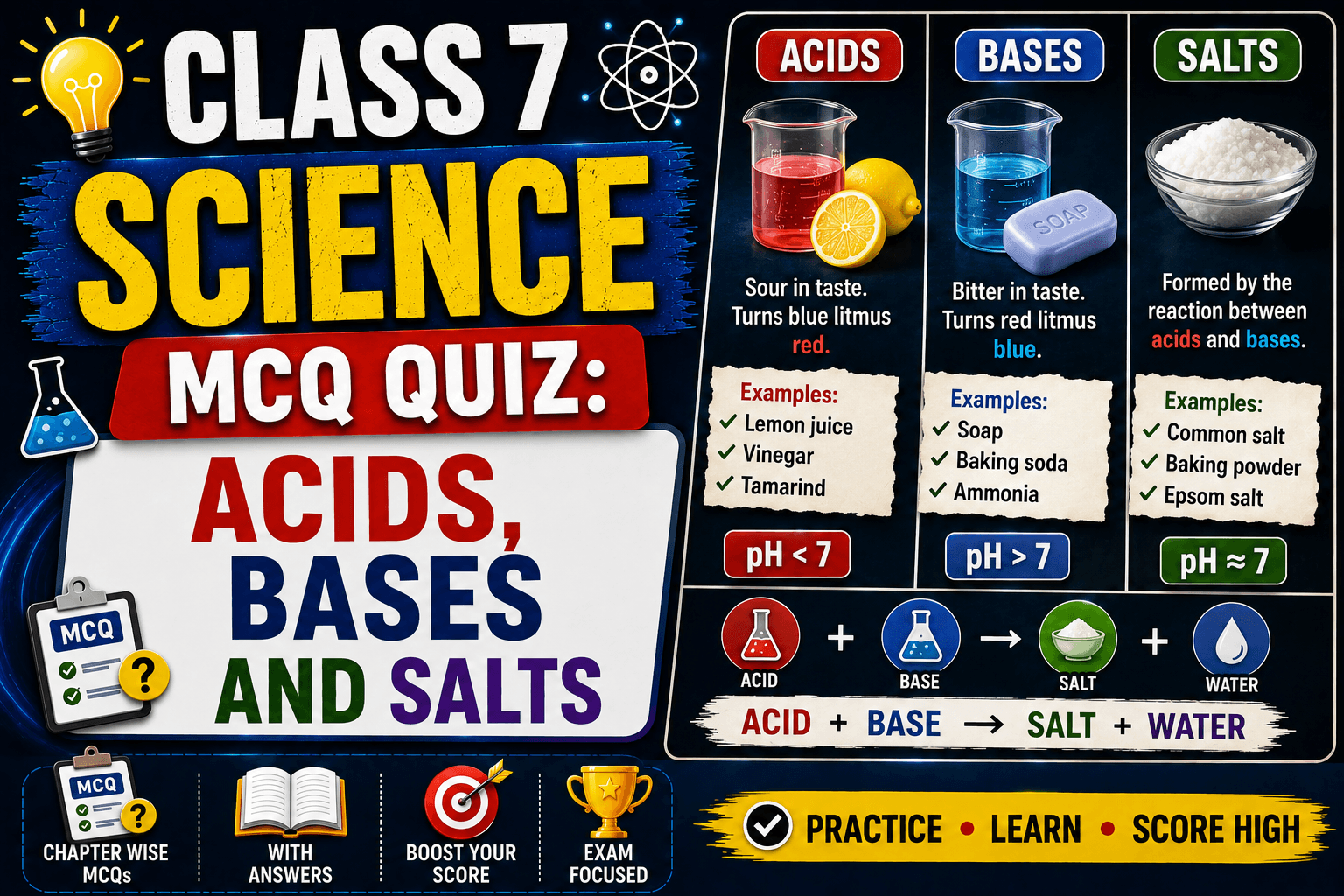
Practice Class 7 Science MCQs on acids, bases, salts, neutralisation, phenolphthalein indicator, calamine solution, acidic soil treatment, and Milk of Magnesia with detailed explanations and real-life examples.
Do You Know
Q1. When an acidic solution is mixed with a basic solution, they:
Correct Answer: Neutralise each other
Detailed Explanation:
Neutralisation is a chemical reaction that occurs when an acid reacts with a base. During this reaction, the acidic and basic properties cancel each other, resulting in the formation of salt and water. This process is called a neutralisation reaction.
Acids generally have a sour taste and release hydrogen ions in solution, while bases are bitter and slippery in nature. When these two substances are mixed in appropriate amounts, they react chemically and produce a neutral solution. This means the resulting solution is neither strongly acidic nor strongly basic.
Neutralisation reactions are very important in everyday life. For example, when excess acid is present in the stomach, antacids are used to neutralise it. Similarly, farmers use neutralisation to improve soil quality when soil becomes too acidic.
Scientists also use neutralisation reactions in industries, laboratories, and environmental protection activities. Waste chemicals released from factories are often treated through neutralisation before disposal.
Understanding neutralisation helps students learn how acids and bases interact and why maintaining balance is important in nature and daily life.
Real-Life Examples:
- Antacids neutralise excess stomach acid.
- Farmers treat acidic soil using lime.
- Neutralisation is used in wastewater treatment plants.
Important NCERT Points:
- Acid + Base → Salt + Water.
- The reaction is called neutralisation.
- Neutralisation reduces harmful effects of acids and bases.
- It has many practical applications in daily life.
Exam-Oriented Fact:
The products of a neutralisation reaction are salt and water.
Quick Revision Line:
Acids and bases neutralise each other to form salt and water.
Q2. Phenolphthalein indicator gives ______ color in basic solution.
Correct Answer: Pink
Detailed Explanation:
Phenolphthalein is a commonly used chemical indicator that helps identify whether a solution is acidic or basic. Indicators are substances that change color depending on the nature of the solution in which they are added.
Phenolphthalein remains colorless in acidic and neutral solutions but turns pink when added to a basic solution. This color change helps scientists, students, and laboratory workers determine the nature of unknown substances.
Indicators are important because acids and bases often look similar. Without indicators, it would be difficult to distinguish between them. Different indicators show different color changes. For example, litmus turns red in acids and blue in bases, while turmeric changes color only in basic solutions.
Phenolphthalein is widely used during titration experiments in laboratories. It provides a clear visual indication of when a neutralisation reaction is complete.
Learning about indicators helps students understand how chemicals can be identified safely without tasting or touching them.
Real-Life Examples:
- Used in school laboratory experiments.
- Helps identify acidic and basic household substances.
- Used in chemical analysis and research.
Important NCERT Points:
- Phenolphthalein is an indicator.
- It remains colorless in acidic solutions.
- It turns pink in basic solutions.
- Indicators help identify unknown solutions.
Exam-Oriented Fact:
Phenolphthalein gives a pink color in basic solutions.
Quick Revision Line:
Phenolphthalein is colorless in acids and pink in bases.
Q3. Calamine solution is applied on the skin when an ant bites because it contains:
Correct Answer: Zinc carbonate
Detailed Explanation:
An ant bite injects formic acid into the skin, causing irritation, itching, redness, and a burning sensation. To reduce these effects, calamine solution is often applied to the affected area.
Calamine contains zinc carbonate, which is basic in nature. Since ant bites introduce an acid into the skin, the basic zinc carbonate helps neutralise the acid and provides relief from discomfort.
This is another practical example of a neutralisation reaction in everyday life. The acid from the ant bite and the base present in calamine react with each other, reducing irritation.
Calamine lotion is commonly used to soothe skin problems such as insect bites, minor rashes, itching, and allergic reactions. It has cooling properties that provide additional comfort.
Understanding this concept helps students connect chemistry with daily experiences and shows how acids and bases affect our lives.
Real-Life Examples:
- Calamine lotion for ant bites.
- Relief from itching caused by insect stings.
- Treatment of minor skin irritations.
Important NCERT Points:
- Ant bites inject formic acid.
- Calamine contains zinc carbonate.
- Zinc carbonate is basic in nature.
- It neutralises the acid and reduces irritation.
Exam-Oriented Fact:
Formic acid from ant bites is neutralised by zinc carbonate present in calamine.
Quick Revision Line:
Calamine contains zinc carbonate, which neutralises the acid from ant bites.
Q4. Which of the following is used to treat acidic soil?
Correct Answer: B) Quick lime
Detailed Explanation:
Plants grow best when soil has a suitable pH balance. If soil becomes too acidic, crop growth can be affected because nutrients become less available to plants.
To improve acidic soil, farmers add basic substances such as quick lime (calcium oxide) or slaked lime (calcium hydroxide). These substances neutralise the excess acid present in the soil and help restore proper soil conditions.
Soil treatment is an important agricultural practice because healthy soil leads to better crop production. Farmers often test soil before deciding which treatment is required.
Neutralisation in agriculture helps increase crop yield, improve plant health, and enhance nutrient availability. This concept demonstrates the practical importance of chemistry in farming and food production.
Many agricultural regions around the world regularly use lime treatment to maintain soil quality.
Real-Life Examples:
- Farmers add lime to acidic fields.
- Improved soil helps crops grow better.
- Soil testing helps determine treatment needs.
Important NCERT Points:
- Acidic soil is harmful to many crops.
- Quick lime is basic in nature.
- Lime neutralises excess acidity.
- Soil treatment improves agricultural productivity.
Exam-Oriented Fact:
Quick lime is commonly used to reduce soil acidity.
Quick Revision Line:
Quick lime neutralises acidic soil and improves crop growth.
Q5. Milk of Magnesia is used as an:
Correct Answer: Antacid
Detailed Explanation:
Milk of Magnesia is a suspension of magnesium hydroxide, which is a mild base. It is commonly used as an antacid to relieve acidity, indigestion, and stomach discomfort caused by excess hydrochloric acid in the stomach.
The stomach naturally produces hydrochloric acid to help digest food and kill harmful bacteria. However, excessive production of this acid can lead to heartburn, acidity, and pain.
When Milk of Magnesia is consumed, magnesium hydroxide reacts with the excess stomach acid and neutralises it. This reduces irritation and provides relief from discomfort.
Antacids are widely used medicines and are available in different forms such as tablets, liquids, and chewable products. They work quickly and help restore the acid-base balance in the stomach.
This topic is a classic example of the practical use of neutralisation in human health and medicine.
Real-Life Examples:
- Relief from acidity after overeating.
- Treatment of heartburn and indigestion.
- Common ingredient in many antacid medicines.
Important NCERT Points:
- Milk of Magnesia contains magnesium hydroxide.
- It is basic in nature.
- It neutralises excess stomach acid.
- It is used as an antacid.
Exam-Oriented Fact:
Milk of Magnesia helps neutralise excess hydrochloric acid in the stomach.
Quick Revision Line:
Milk of Magnesia is an antacid used to relieve stomach acidity.
Chapter Summary:
Acids, bases, and salts are important substances used in daily life. Neutralisation reactions occur when acids and bases react to form salt and water. Phenolphthalein helps identify bases by turning pink, calamine neutralises acid from ant bites, quick lime treats acidic soil, and Milk of Magnesia neutralises excess stomach acid. These concepts show how chemistry is applied in health, agriculture, and everyday activities.
Related links
Latest Posts
- Class 7 Science MCQ Quiz: Acids, Bases and Salts
- Class 8 Science MCQ Quiz: Sound, Pitch & Noise Pollution
- Class 9 Science MCQ Quiz: Matter, Energy, Valency, Motion and Neurons
- Class 10 Science MCQ Quiz: Energy, Global Warming & Life Processes
- Class 10 Science MCQs with Answers | Light & Electricity
Join Our Other Communities