

Welcome To My School Study
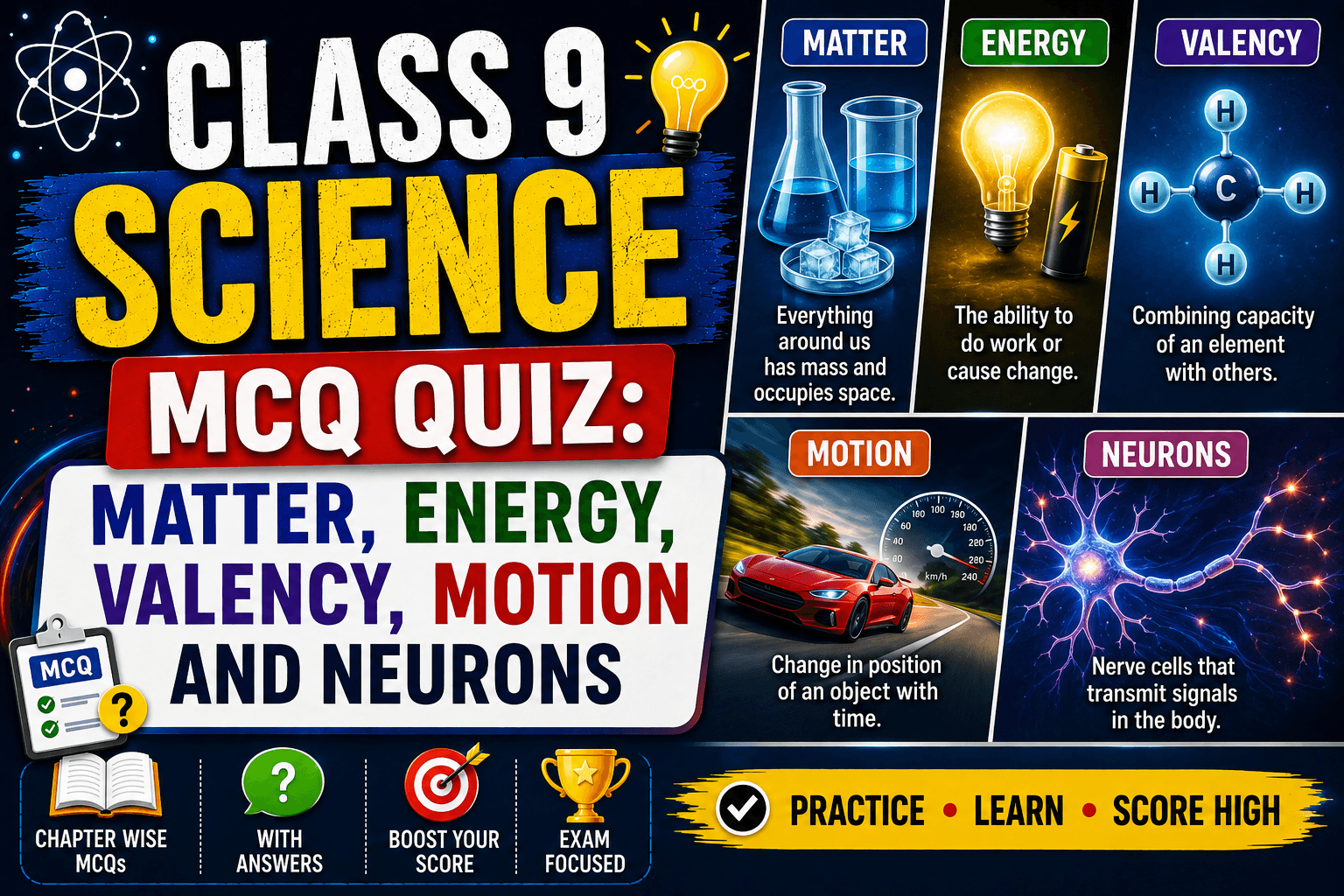
Practice Class 9 Science MCQs on gas particles, SI unit of energy, valency, rest and motion, neurons, nervous tissue, atoms and molecules with detailed explanations, real-life examples, NCERT concepts, and exam-oriented facts.
Do You Know
Q1. Gas particles are:
Correct Answer: Far apart
Detailed Explanation:
According to the particle theory of matter, all substances are made up of tiny particles called atoms or molecules. In gases, these particles are very far apart from one another compared to solids and liquids. The large spaces between gas particles allow them to move freely and randomly in all directions.
Because gas particles are not closely packed, gases do not have a fixed shape or fixed volume. They spread out to fill the entire container in which they are kept. For example, when perfume is sprayed in one corner of a room, its smell quickly spreads throughout the room because gas particles move freely and mix with air.
The weak force of attraction between gas particles is another important characteristic. Since the particles are far apart, the attractive forces between them are very weak. This allows gases to be compressed easily, unlike solids and liquids.
The movement of gas particles is continuous and rapid. They frequently collide with each other and with the walls of the container. These collisions create pressure, which is why gases exert force on the walls of their containers.
Understanding the arrangement of particles in gases helps explain many everyday phenomena such as inflation of balloons, diffusion of perfumes, LPG storage, and weather-related processes.
The concept of particle spacing is one of the fundamental topics in Class 9 Science and forms the basis for understanding the different states of matter.
Real-Life Examples:
- Perfume fragrance spreading across a room.
- Air filling a balloon completely.
- LPG gas spreading quickly when released.
Important NCERT Points:
- Gas particles are far apart.
- They move freely in all directions.
- Gases have no fixed shape or volume.
- Intermolecular forces are very weak.
Exam-Oriented Fact:
Gases are highly compressible because large spaces exist between their particles.
Quick Revision Line:
Gas particles are far apart and move freely in all directions.
Q2. SI unit of energy:
Correct Answer: Joule
Detailed Explanation:
Energy is the ability to do work. Every activity around us requires energy, whether it is walking, running, cooking food, operating machines, or generating electricity. Scientists use standard units to measure energy, and the SI (International System of Units) unit of energy is the Joule (J).
One joule is defined as the amount of work done when a force of one newton moves an object through a distance of one metre in the direction of the force. This standard unit helps scientists and engineers measure and compare energy accurately across the world.
Energy exists in many forms, such as mechanical energy, heat energy, light energy, sound energy, electrical energy, and chemical energy. Although these forms appear different, they are all measured using the same SI unit, the joule.
In daily life, larger units are often used because one joule is a relatively small amount of energy. For example, electrical energy consumed in homes is measured in kilowatt-hours (kWh). One kilowatt-hour is equal to 3.6 × 10⁶ joules.
The concept of energy is central to science because energy cannot be created or destroyed; it can only be transformed from one form to another. For instance, a battery converts chemical energy into electrical energy, while a bulb converts electrical energy into light and heat energy.
Understanding the SI unit of energy helps students solve numerical problems and understand energy transformations in real-life situations.
Real-Life Examples:
- Electricity consumption is measured using energy units.
- Food provides chemical energy to our body.
- Batteries store and supply energy.
Important NCERT Points:
- Energy is the capacity to do work.
- SI unit of energy is Joule (J).
- Energy exists in many forms.
- Energy can be transformed from one form to another.
Exam-Oriented Fact:
The SI unit of both work and energy is Joule (J).
Quick Revision Line:
Joule (J) is the SI unit used to measure energy.
Q3. Valency means:
Correct Answer: Combining capacity
Detailed Explanation:
Valency refers to the combining capacity of an atom. It indicates the number of electrons an atom can lose, gain, or share to achieve a stable electronic configuration. Understanding valency is essential because it explains how atoms combine to form molecules and compounds.
Atoms are most stable when their outermost electron shell is complete. To achieve stability, atoms may transfer or share electrons with other atoms. The number of electrons involved in this process determines the atom’s valency.
For example, sodium has one electron in its outermost shell and tends to lose one electron. Therefore, its valency is one. Chlorine needs one electron to complete its outer shell, so its valency is also one. When sodium and chlorine combine, they form sodium chloride (common salt).
Valency helps scientists write chemical formulae correctly. For instance, water has the formula H₂O because hydrogen has valency one and oxygen has valency two. Similarly, carbon dioxide is CO₂ because carbon has valency four and oxygen has valency two.
The concept of valency also helps explain chemical reactions and bonding. Without understanding valency, it would be difficult to predict how different elements combine with one another.
Class 9 students learn valency as a fundamental concept in chemistry because it serves as the foundation for studying atoms, molecules, compounds, and chemical equations.
Real-Life Examples:
- Common salt (NaCl) formation.
- Water (H₂O) formation.
- Carbon dioxide (CO₂) formation.
Important NCERT Points:
- Valency means combining capacity.
- Atoms gain, lose, or share electrons.
- Valency helps write chemical formulae.
- Stable electronic configuration drives bonding.
Exam-Oriented Fact:
Hydrogen has valency 1, while oxygen has valency 2.
Quick Revision Line:
Valency is the combining capacity of an atom.
Q4. Rest means:
Correct Answer: Zero velocity
Detailed Explanation:
An object is said to be at rest when its position does not change with time relative to its surroundings or a chosen reference point. In simple terms, if an object remains in the same position and shows no motion, it is considered to be at rest.
Velocity describes both the speed and direction of an object’s motion. When an object is completely at rest, its velocity becomes zero because there is no change in position over time.
The concept of rest is relative. An object that appears to be at rest to one observer may appear to be moving to another observer. For example, a passenger sitting inside a moving train appears at rest relative to other passengers but appears to be moving relative to a person standing on the platform.
Scientists use reference points to determine whether an object is at rest or in motion. Without a reference point, it is impossible to describe motion accurately.
Understanding rest and motion is important because they form the basis of mechanics. Concepts such as speed, velocity, acceleration, and force are all related to the study of motion.
In daily life, we often encounter objects at rest, such as books placed on a table, parked vehicles, and buildings. These objects have zero velocity relative to the ground.
The study of rest and motion helps students understand how objects behave in different situations and prepares them for advanced topics in physics.
Real-Life Examples:
- A parked car on the roadside.
- A book lying on a table.
- A building standing at a fixed location.
Important NCERT Points:
- Rest means no change in position.
- Velocity is zero when an object is at rest.
- Motion and rest are relative concepts.
- A reference point is necessary.
Exam-Oriented Fact:
An object at rest has zero velocity relative to its reference point.
Quick Revision Line:
Rest means an object has zero velocity and no change in position.
Q5. Neuron transmits:
Correct Answer: Signals
Detailed Explanation:
A neuron is the basic structural and functional unit of the nervous system. Its primary function is to receive, process, and transmit signals throughout the body. These signals help coordinate activities such as movement, sensation, thinking, memory, and reflex actions.
Neurons are specialized cells designed for communication. They transmit information in the form of electrical impulses and chemical signals. The human nervous system contains billions of neurons working together to control body functions.
A typical neuron consists of three main parts: the cell body, dendrites, and axon. Dendrites receive signals from other neurons, the cell body processes the information, and the axon carries signals away from the cell body to other neurons, muscles, or glands.
Whenever you touch a hot object, neurons quickly transmit signals from the skin to the brain. The brain processes the information and sends instructions back to the muscles to withdraw the hand immediately. This rapid communication helps protect the body from harm.
Neurons are essential for all nervous activities, including learning, memory, emotions, and voluntary actions. Damage to neurons can affect communication between different parts of the body and may lead to neurological disorders.
The nervous system works continuously throughout life, allowing humans to respond quickly to internal and external changes. Understanding neurons helps students appreciate how the body controls and coordinates various functions.
Real-Life Examples:
- Feeling pain after touching a hot surface.
- Seeing and recognizing objects.
- Moving hands and legs during sports.
Important NCERT Points:
- Neuron is the basic unit of the nervous system.
- Neurons transmit signals.
- Signals travel as nerve impulses.
- The brain and spinal cord coordinate activities.
Exam-Oriented Fact:
Neurons are specialized cells responsible for transmitting nerve impulses.
Quick Revision Line:
A neuron transmits signals throughout the body for communication and control
Related Links
- Class 9 MCQ Questions Answers– History, Geography, Civics
- Class 9 SST MCQs with Detailed Explanations
Latest Posts
- Class 7 Science MCQ Quiz: Acids, Bases and Salts
- Class 8 Science MCQ Quiz: Sound, Pitch & Noise Pollution
- Class 9 Science MCQ Quiz: Matter, Energy, Valency, Motion and Neurons
- Class 10 Science MCQ Quiz: Energy, Global Warming & Life Processes
- Class 10 Science MCQs with Answers | Light & Electricity
Join Our Other Communities