

Welcome To My School Study
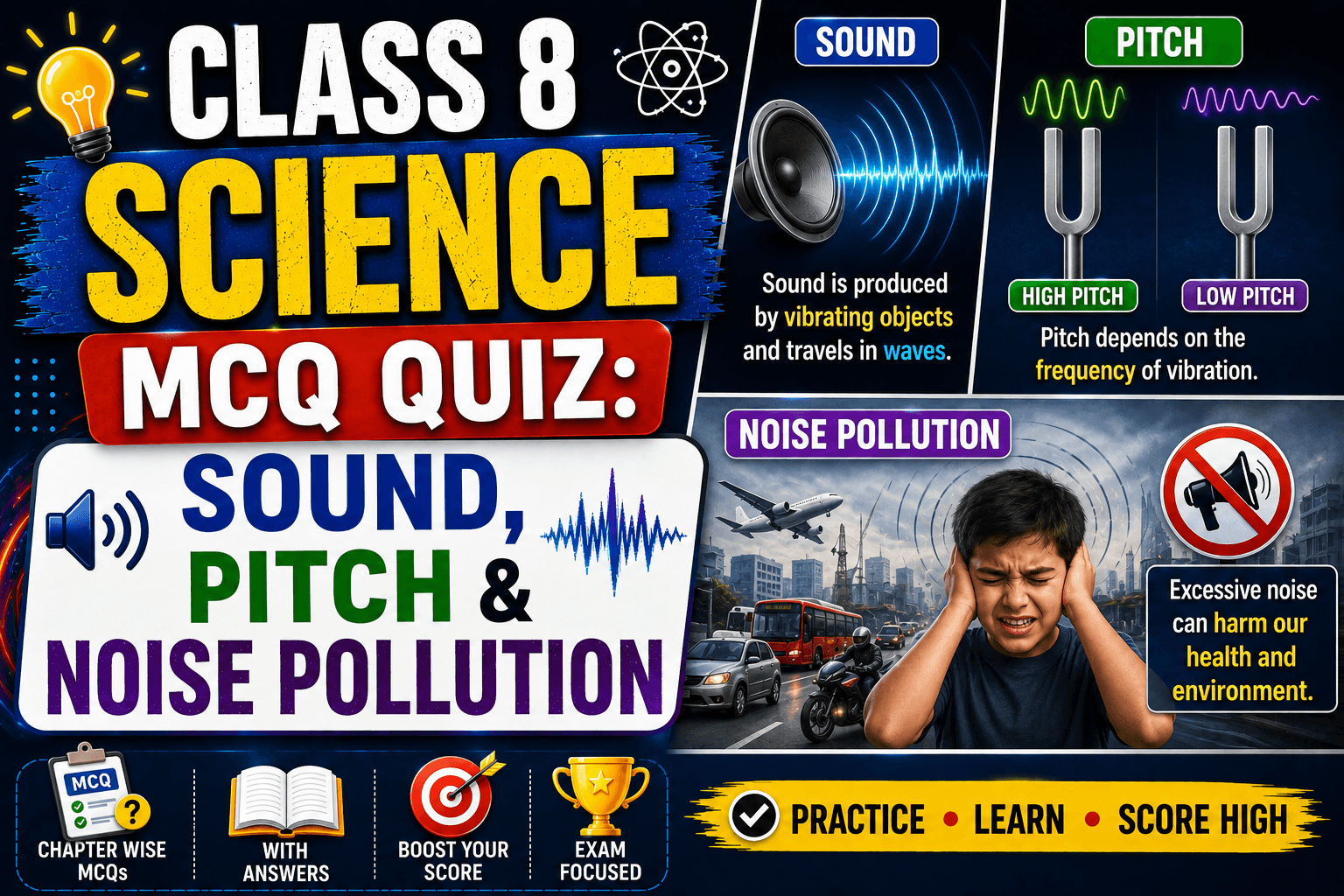
Class 8 Science MCQs on sound, pitch, frequency, amplitude, audible range, noise pollution, voice box, and human hearing with detailed explanations and real-life examples.
Do You Know
Q1. The pitch of a sound depends on?
Correct Answer: Frequency
Detailed Explanation:
Pitch is the characteristic of sound that helps us identify whether a sound is high-pitched or low-pitched. The pitch of a sound depends directly on its frequency. Frequency refers to the number of vibrations or oscillations produced in one second and is measured in Hertz (Hz).
When an object vibrates rapidly, it produces a high-frequency sound, which is heard as a high-pitched sound. On the other hand, when an object vibrates slowly, it produces a low-frequency sound, resulting in a low-pitched sound. Therefore, pitch and frequency are directly related.
For example, the voice of a child or a whistle generally has a higher pitch because it has a higher frequency. In contrast, the voice of an adult man often has a lower pitch because the frequency of sound produced is lower.
Musical instruments also demonstrate this concept clearly. A thin guitar string vibrates faster and produces a higher-pitched sound, while a thicker string vibrates more slowly and produces a lower-pitched sound. Similarly, birds generally produce high-pitched sounds, whereas lions and elephants produce lower-pitched sounds.
Pitch helps us distinguish between different voices and musical notes. Even when two sounds have the same loudness, they may differ in pitch because of differences in frequency.
Understanding pitch is important in music, communication, and sound technology. It allows us to recognize different speakers, enjoy melodies, and analyze sound scientifically.
Real-Life Examples:
- A whistle produces a high-pitched sound.
- Children’s voices are usually higher pitched than adults.
- Thin guitar strings produce higher-pitched notes.
Important NCERT Points:
- Pitch depends on frequency.
- Higher frequency means higher pitch.
- Lower frequency means lower pitch.
- Frequency is measured in Hertz (Hz).
Exam-Oriented Fact:
Pitch increases when the frequency of vibration increases.
Quick Revision Line:
The pitch of a sound depends on its frequency.
Q2. Loudness of sound is proportional to the square of the amplitude.
Correct Answer: Square
Detailed Explanation:
Loudness is the characteristic of sound that tells us how loud or soft a sound appears to our ears. Loudness depends on the amplitude of vibration of the sound-producing object. Amplitude is the maximum displacement of a vibrating object from its mean position.
When the amplitude of vibration increases, more energy is transferred through the sound waves. As a result, the sound becomes louder. Scientists have found that loudness is proportional to the square of the amplitude. This means that even a small increase in amplitude can significantly increase the loudness of sound.
For example, when a guitar string is plucked gently, it vibrates with a small amplitude and produces a soft sound. However, when the same string is plucked forcefully, the amplitude increases and the sound becomes louder.
Similarly, when speaking softly, our vocal cords vibrate with smaller amplitudes. When shouting, the amplitudes increase, resulting in a louder sound. Loudspeakers also work on this principle by increasing the amplitude of vibrations to produce louder sounds.
The loudness of sound is measured in decibels (dB). Excessive loudness can cause hearing problems and contribute to noise pollution. Therefore, controlling sound intensity is important in daily life.
Understanding the relationship between loudness and amplitude helps explain how sound systems, microphones, and speakers operate.
Real-Life Examples:
- Shouting produces a louder sound than whispering.
- A drum beaten harder sounds louder.
- Loudspeakers increase amplitude to amplify sound.
Important NCERT Points:
- Loudness depends on amplitude.
- Greater amplitude produces louder sound.
- Loudness is proportional to the square of amplitude.
- Loudness is measured in decibels.
Exam-Oriented Fact:
Doubling the amplitude greatly increases the loudness of sound.
Quick Revision Line:
Loudness of sound is proportional to the square of its amplitude.
Q3. The audible range of frequency for human ear is?
Correct Answer: 20 Hz to 20,000 Hz
Detailed Explanation:
Human ears can hear sounds only within a specific frequency range known as the audible range. For a healthy human ear, this range extends from approximately 20 Hz to 20,000 Hz (20 kHz).
Sounds with frequencies below 20 Hz are called infrasonic sounds. These sounds cannot normally be heard by humans but can be detected by some animals such as elephants and whales. Sounds with frequencies above 20,000 Hz are called ultrasonic sounds. Dogs, bats, and dolphins can hear ultrasonic frequencies that humans cannot detect.
The ability to hear different frequencies helps humans communicate, enjoy music, and detect environmental sounds. As people grow older, their ability to hear very high frequencies often decreases.
Ultrasonic sounds have many practical applications. They are used in medical imaging, cleaning delicate instruments, and detecting cracks in metals. Infrasonic waves are used in studying earthquakes and volcanic activities.
Understanding the audible range helps scientists design audio devices such as headphones, microphones, hearing aids, and communication systems. Most musical instruments are designed to produce sounds within the human audible range.
The human ear is a remarkable organ capable of detecting a wide variety of sound frequencies and intensities, making hearing an essential sense for everyday life.
Real-Life Examples:
- Humans can hear normal conversation sounds.
- Bats use ultrasonic sounds for navigation.
- Elephants communicate using infrasonic sounds.
Important NCERT Points:
- Audible range is 20 Hz to 20,000 Hz.
- Below 20 Hz are infrasonic sounds.
- Above 20,000 Hz are ultrasonic sounds.
- Different animals hear different frequency ranges.
Exam-Oriented Fact:
The normal audible frequency range for humans is 20 Hz to 20 kHz.
Quick Revision Line:
Humans can hear sounds ranging from 20 Hz to 20,000 Hz.
Q4. Noise pollution can cause?
Correct Answer: All of the above
Detailed Explanation:
Noise pollution refers to the presence of unwanted, unpleasant, or excessive sound in the environment. It is one of the major environmental problems in urban and industrial areas. Continuous exposure to loud noise can have harmful effects on both physical and mental health.
One common effect of noise pollution is lack of sleep. Loud sounds from traffic, construction work, loudspeakers, and machinery can disturb sleep patterns and cause fatigue. Noise pollution can also increase stress levels and contribute to high blood pressure (hypertension).
Long-term exposure to very loud sounds can damage the sensitive structures of the inner ear, leading to hearing impairment or even permanent hearing loss. Students may also experience reduced concentration and learning difficulties in noisy environments.
Noise pollution affects not only humans but also animals. Excessive noise can disturb communication, migration, and breeding activities of birds and wildlife. Therefore, controlling noise levels is important for environmental protection.
Governments and environmental organizations encourage measures such as using silencers in vehicles, reducing unnecessary honking, maintaining machinery, and limiting loudspeaker use in residential areas.
Creating awareness about noise pollution helps people understand the importance of maintaining a peaceful and healthy environment.
Real-Life Examples:
- Traffic noise disturbing sleep.
- Loud music causing headaches.
- Factory noise affecting hearing ability.
Important NCERT Points:
- Noise pollution is harmful to health.
- It may cause sleeplessness.
- It can lead to hypertension.
- Long exposure may damage hearing.
Exam-Oriented Fact:
Noise pollution can cause sleep disturbance, stress, and hearing loss.
Quick Revision Line:
Noise pollution negatively affects human health and hearing.
Q5. In humans, sound is produced by the?
Correct Answer: Larynx / Voice Box
Detailed Explanation:
In humans, sound is produced by a special organ called the larynx, commonly known as the voice box. It is located in the throat at the upper end of the windpipe (trachea). Inside the larynx are two elastic vocal cords stretched across the air passage.
When we breathe, the vocal cords remain apart, allowing air to pass freely. When we speak or sing, air from the lungs passes through the narrow gap between the vocal cords. This airflow causes the vocal cords to vibrate, producing sound.
The pitch of the sound produced depends on the tension and length of the vocal cords. Shorter and tighter vocal cords generally produce higher-pitched sounds, while longer and thicker vocal cords produce lower-pitched sounds.
Men usually have longer vocal cords than women, which is why adult males often have deeper voices. During adolescence, hormonal changes cause the larynx to grow, especially in boys, resulting in noticeable voice changes.
The tongue, lips, teeth, and mouth help modify the sounds produced by the larynx into meaningful speech. Thus, speaking involves coordination among several organs of the body.
The voice box is essential for communication, singing, public speaking, and expressing emotions. Proper care of the throat and vocal cords helps maintain a healthy voice.
Real-Life Examples:
- Speaking in a classroom.
- Singing songs.
- Voice changes during puberty.
Important NCERT Points:
- Sound is produced by the larynx.
- Vocal cords vibrate to produce sound.
- Air from the lungs causes vibration.
- Vocal cord length affects pitch.
Exam-Oriented Fact:
The larynx is commonly called the voice box.
Quick Revision Line:
Humans produce sound through the vibration of vocal cords present in the larynx.
Related links
- Class 8 MCQ Questions Answers – History, Civics, Geography
- Class 8 MCQ Questions with Answers– History, Civics, Geography
Latest Posts
- Class 7 Science MCQ Quiz: Acids, Bases and Salts
- Class 8 Science MCQ Quiz: Sound, Pitch & Noise Pollution
- Class 9 Science MCQ Quiz: Matter, Energy, Valency, Motion and Neurons
- Class 10 Science MCQ Quiz: Energy, Global Warming & Life Processes
- Class 10 Science MCQs with Answers | Light & Electricity
Join Our Other Communities