

Welcome To My School Study
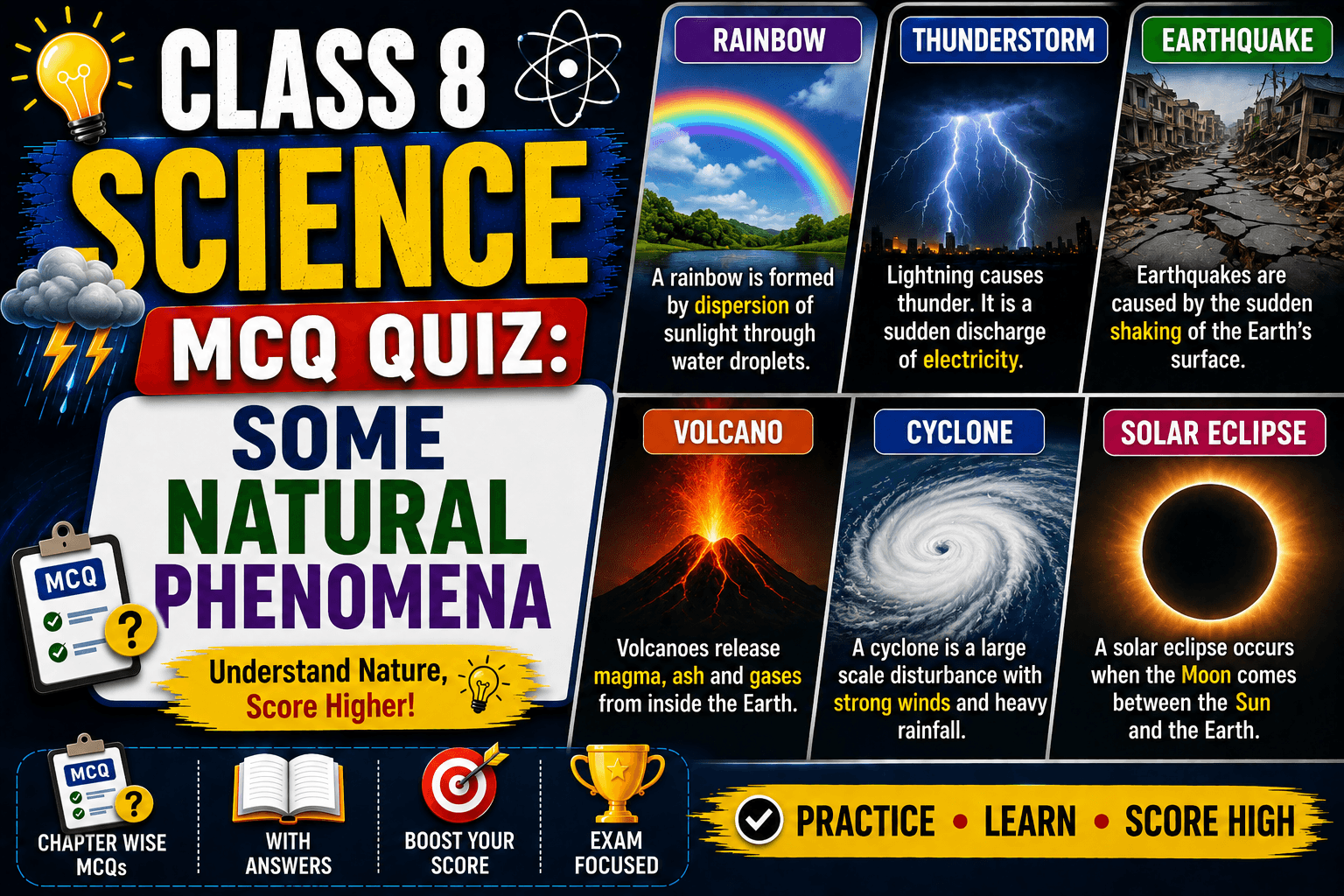
Practice Class 8 Science MCQs on electroscope, electric charges, lightning, earthquakes, seismic zones, tsunami, disaster safety, and natural phenomena with detailed explanations.
Do You Know
Q1. A device used to test whether an object is carrying charge or not is?
Correct Answer: Electroscope
Detailed Explanation:
An electroscope is a scientific instrument used to detect the presence of electric charge on an object. It helps determine whether an object is charged or uncharged. The electroscope was one of the earliest devices invented for studying static electricity and played an important role in understanding electric charges.
A simple electroscope consists of a metal rod connected to two thin metal leaves, usually made of gold or aluminum foil. When a charged object is brought near or touches the metal rod, electric charges are transferred to the leaves. Since both leaves acquire the same type of charge, they repel each other and move apart. This separation indicates the presence of electric charge.
Electroscopes cannot accurately measure the amount of charge present, but they are very useful for detecting whether an object carries a charge. Scientists and students often use electroscopes in laboratory experiments related to static electricity.
Static electricity is produced when objects are rubbed together. For example, rubbing a plastic comb on dry hair or rubbing a balloon on wool can create electric charges. An electroscope can be used to detect these charges.
The study of electric charges helps us understand many natural phenomena, including lightning. This is why the electroscope is an important topic in Class 8 Science.
Real-Life Examples:
- Detecting charge on a rubbed plastic comb.
- Testing a charged balloon.
- Demonstrating static electricity in science laboratories.
Important NCERT Points:
- Electroscope detects electric charges.
- Like charges repel each other.
- Metal leaves separate when charged.
- It is used in static electricity experiments.
Exam-Oriented Fact:
An electroscope is used to determine whether an object carries an electric charge.
Quick Revision Line:
An electroscope is a device used to detect the presence of electric charge.
Q2. During lightning, where is it safest to be?
Correct Answer: Inside a car or bus
Detailed Explanation:
Lightning is a powerful natural electrical discharge that occurs during thunderstorms. It can produce extremely high temperatures and powerful electric currents, making it very dangerous for humans and animals.
During lightning, the safest place is inside a closed vehicle such as a car or bus. This safety is due to a principle called the Faraday Cage Effect. The metal body of the vehicle conducts the electric charge around the outer surface and safely directs it to the ground, protecting the people inside.
On the other hand, standing under a tall tree, staying on a rooftop, or remaining in an open field is dangerous because lightning usually strikes tall or isolated objects.
During thunderstorms, people should avoid open areas, water bodies, metal poles, and electrical equipment. Staying indoors and away from electrical appliances is also recommended.
Lightning causes thousands of injuries and deaths worldwide every year. Therefore, understanding lightning safety measures is extremely important.
The Class 8 NCERT chapter emphasizes the importance of following safety precautions during thunderstorms to minimize risks and save lives.
Real-Life Examples:
- Staying inside a car during a thunderstorm.
- Avoiding open playgrounds during lightning.
- Taking shelter inside a building during heavy storms.
Important NCERT Points:
- Lightning is a natural electrical discharge.
- Closed vehicles provide protection.
- Avoid tall trees during thunderstorms.
- Open fields are unsafe during lightning.
Exam-Oriented Fact:
A closed vehicle is one of the safest places during a lightning storm.
Quick Revision Line:
During lightning, staying inside a car or bus is much safer than remaining outdoors.
Q3. Lightning is caused by the accumulation of ________ in the clouds.
Correct Answer: Charges
Detailed Explanation:
Lightning occurs due to the accumulation of electric charges within clouds. During thunderstorms, strong air currents cause water droplets, ice crystals, and dust particles to collide with one another. These collisions result in the separation of electric charges.
Generally, positive charges accumulate in one part of the cloud while negative charges accumulate in another. As the difference between these charges increases, a large amount of electrical energy builds up.
When the charge difference becomes very high, the air between the charged regions can no longer act as an insulator. A sudden discharge of electricity occurs, producing a bright flash of lightning.
This discharge may occur between clouds, within the same cloud, or between a cloud and the Earth. The intense heat generated by lightning causes the surrounding air to expand rapidly, producing the sound known as thunder.
Lightning is one of nature’s most powerful demonstrations of electricity. Understanding how charges accumulate in clouds helps explain many weather-related phenomena.
Real-Life Examples:
- Lightning during thunderstorms.
- Sparks generated by static electricity.
- Small electric shocks after rubbing synthetic clothes.
Important NCERT Points:
- Clouds accumulate electric charges.
- Charge separation causes lightning.
- Lightning is an electrical discharge.
- Thunder is produced due to rapid air expansion.
Exam-Oriented Fact:
Lightning occurs because of the buildup and discharge of electric charges in clouds.
Quick Revision Line:
The accumulation of electric charges in clouds causes lightning.
Q4. The seismic zone is an area which is?
Correct Answer: B) More prone to earthquakes
Detailed Explanation:
A seismic zone is a geographical region where earthquakes are more likely to occur. Scientists classify different areas into seismic zones based on their history of earthquakes, geological structure, and tectonic activity.
The Earth’s crust is made up of large tectonic plates that are constantly moving. When these plates collide, separate, or slide past one another, energy is released in the form of earthquakes. Areas located near tectonic plate boundaries are usually more earthquake-prone.
In India, different regions are divided into seismic zones according to their earthquake risk. Areas such as the Himalayan region and parts of Northeast India are considered highly active seismic zones.
Understanding seismic zones helps governments and engineers design earthquake-resistant buildings and disaster management plans. This reduces damage and helps protect lives during earthquakes.
Earthquakes cannot be prevented, but proper planning and construction techniques can significantly reduce their impact.
The study of seismic zones is important because it helps communities prepare for natural disasters and improve safety measures.
Real-Life Examples:
- Himalayan regions experience frequent earthquakes.
- Earthquake-resistant buildings in seismic areas.
- Disaster preparedness programs in vulnerable regions.
Important NCERT Points:
- Seismic zones are earthquake-prone areas.
- Earthquakes occur due to tectonic plate movement.
- Scientists classify regions based on risk.
- Preparedness reduces earthquake damage.
Exam-Oriented Fact:
Seismic zones indicate the likelihood of earthquake occurrence in an area.
Quick Revision Line:
A seismic zone is a region where earthquakes are more likely to occur.
Q5. A major Tsunami occurred in the Indian Ocean on?
Correct Answer: 26 December 2004
Detailed Explanation:
One of the most devastating natural disasters in modern history occurred on 26 December 2004, when a massive tsunami struck countries surrounding the Indian Ocean.
The tsunami was triggered by a powerful undersea earthquake near the west coast of Indonesia. The earthquake measured more than 9 on the Richter Scale and caused a sudden displacement of the ocean floor.
This displacement generated enormous sea waves that traveled across the Indian Ocean at very high speeds. When these waves approached coastal areas, they increased dramatically in height and caused widespread destruction.
Countries such as India, Indonesia, Sri Lanka, Thailand, and several others suffered severe damage. Thousands of people lost their lives, and coastal communities were heavily affected.
The disaster highlighted the importance of tsunami warning systems, disaster preparedness, and international cooperation in responding to natural calamities.
Today, advanced monitoring systems help detect undersea earthquakes and issue tsunami warnings to reduce the loss of life during future events.
Real-Life Examples:
- The Indian Ocean Tsunami of 2004.
- Tsunami warning systems used today.
- Coastal evacuation drills in vulnerable regions.
Important NCERT Points:
- The tsunami occurred on 26 December 2004.
- It was triggered by an undersea earthquake.
- Large sea waves caused widespread destruction.
- Warning systems help reduce disaster risks.
Exam-Oriented Fact:
The Indian Ocean Tsunami of 2004 was caused by a major underwater earthquake.
Quick Revision Line:
A devastating tsunami struck the Indian Ocean region on 26 December 2004.
Chapter Summary:
An electroscope is used to detect electric charges. During lightning, staying inside a closed vehicle such as a car or bus is one of the safest options. Lightning occurs because of the accumulation and discharge of electric charges in clouds. Seismic zones are areas where earthquakes are more likely to occur due to tectonic activity. The devastating Indian Ocean Tsunami occurred on 26 December 2004 after a powerful undersea earthquake. These topics help students understand important natural phenomena and disaster safety measures covered in Class 8 Science.
Related links
- Class 8 Science MCQ Quiz: Reproduction & Hormones
- Class 8 MCQ Questions Answers – History, Civics, Geography
- Class 8 MCQ Questions with Answers– History, Civics, Geography
Latest Posts
- NCERT Class 7 Maths Chapter 1 Integers,addition, subtraction
- Class 10 Maths Chapter-1 Real Numbers-Rational numbers-MCQ
- Class9 Maths- Number Systems, decimal expansion, exponents
- Class 8 Maths Chapter 1 Rational Numbers, multiplicative
- Class 10 Maths Chapter 1 Real Numbers MCQ Questions with Solutions
Join Our Other Communities