

Welcome To My School Study
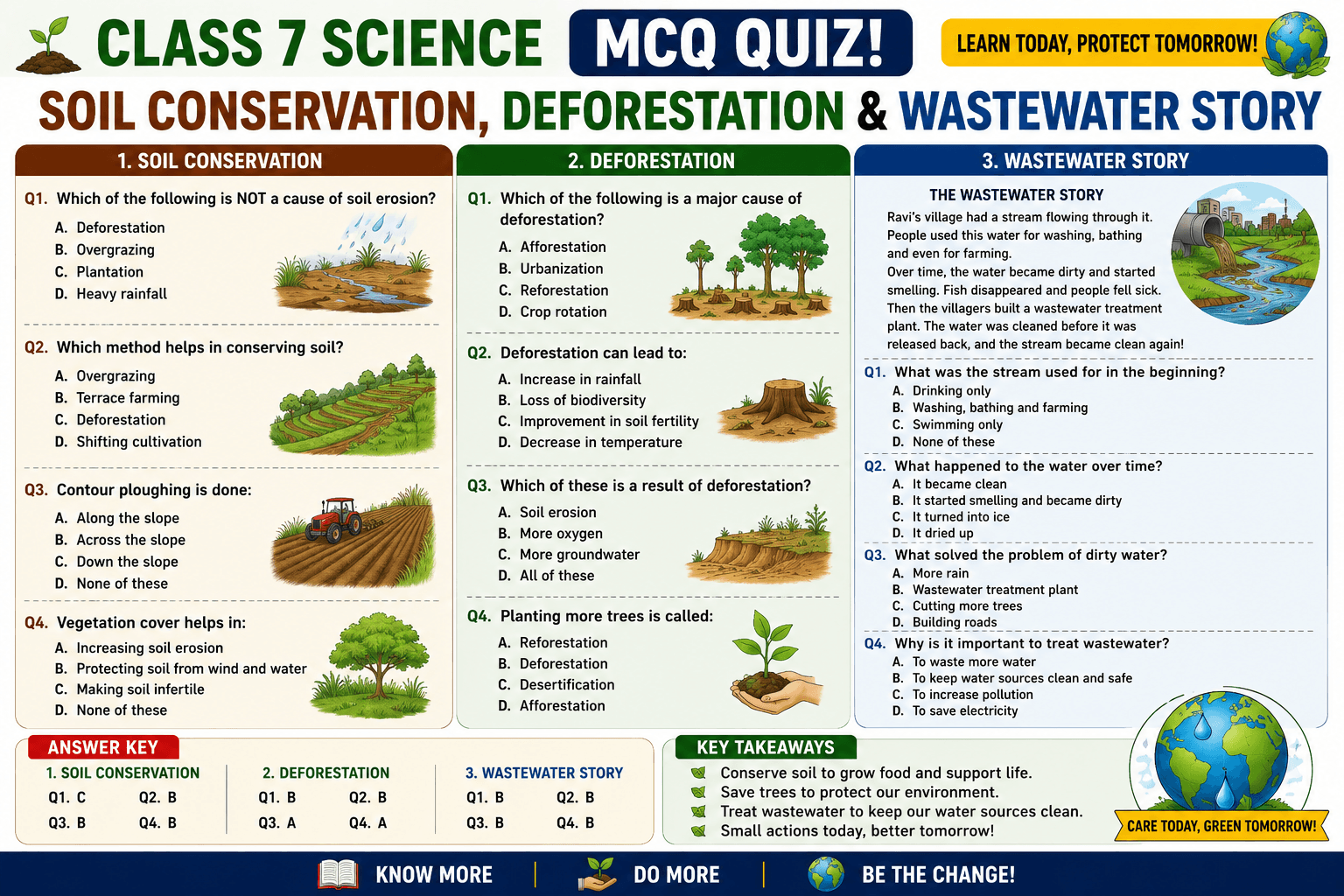
Practice Class 7 Science MCQs on soil erosion, afforestation, deforestation, wastewater treatment, sludge, bacteria, typhoid, and sewage treatment with detailed NCERT-based explanations, examples, revision notes, FAQs, and exam preparation tips
Do You Know
Introduction
Natural resources such as soil, forests, and water are essential for the survival of all living organisms. Human activities like deforestation and improper disposal of wastewater can seriously affect the environment. Soil erosion reduces land fertility, while contaminated wastewater spreads diseases and pollutes water bodies. To overcome these problems, methods such as afforestation, wastewater treatment, and proper sanitation systems are used.
These Class 7 Science MCQs are based on NCERT concepts from environmental conservation and wastewater management. The detailed explanations below help students understand not only the correct answer but also the scientific reasoning behind it. Real-life examples, memory tricks, exam facts, and revision notes make learning easier and more effective.
Q1. Which of the following does not help in soil erosion?
Correct Answer: Afforestation
Detailed Explanation
Soil erosion is the process in which the top fertile layer of soil is removed by natural agents such as wind and water. This topsoil contains essential nutrients required for plant growth. When soil erosion occurs, agricultural productivity decreases and the land gradually becomes less fertile.
Afforestation means planting trees on barren land or increasing forest cover in an area. Trees play a very important role in preventing soil erosion. Their roots hold soil particles firmly together and prevent them from being washed away by rainwater or blown away by strong winds. Trees also reduce the direct impact of rainfall on the ground and slow down water flow, helping soil remain in place.
Deforestation, heavy rainfall, and strong winds increase soil erosion. When trees are cut down, the soil loses its natural support system. Heavy rains can wash away loose soil, while strong winds can carry dry soil particles over long distances.
Afforestation is therefore considered one of the most effective methods of soil conservation. Governments and environmental organizations conduct plantation drives every year to increase green cover and reduce land degradation. Afforestation also improves biodiversity, increases rainfall, and helps maintain ecological balance.
Soil conservation is extremely important because fertile soil takes hundreds of years to form naturally. Once lost, it cannot be restored quickly. Therefore, planting trees remains one of the best long-term solutions to protect soil resources.
Real-Life Examples
- Trees planted along highways reduce soil erosion.
- Forest areas experience less soil loss than barren land.
- Van Mahotsav promotes tree plantation across India.
Important NCERT Points
- Soil erosion removes fertile topsoil.
- Tree roots bind soil particles.
- Afforestation helps conserve soil.
- Deforestation increases erosion.
Why Other Options Are Wrong
- A. Deforestation – Increases soil erosion.
- C. Heavy rain – Washes away topsoil.
- D. High speed winds – Carry soil particles away.
Exam-Oriented Fact
Tree roots act like natural anchors that hold soil firmly.
Memory Trick
“More Trees = More Soil Safety”
Quick Revision Line
Afforestation prevents soil erosion by holding soil with roots.
Related Questions
- What is soil conservation?
- How does deforestation affect the environment?
- What is afforestation?
Q2. Large-scale cutting of trees is known as:
Correct Answer: Deforestation
Detailed Explanation
Deforestation refers to the large-scale removal of forests and trees from a region. It is one of the most serious environmental problems faced by the world today. Forests provide oxygen, absorb carbon dioxide, regulate climate, conserve biodiversity, and protect soil from erosion.
Trees are often cut down for agriculture, urban development, industries, roads, mining, and human settlements. While development is necessary, uncontrolled cutting of trees causes severe environmental damage. Deforestation destroys habitats of animals and birds, leading to loss of biodiversity.
Forests also play a crucial role in maintaining the water cycle. Trees absorb water from the soil and release moisture into the atmosphere through transpiration. When forests disappear, rainfall patterns may change and drought conditions may become more frequent.
Another major consequence of deforestation is increased greenhouse gas concentration. Trees absorb carbon dioxide during photosynthesis. Fewer trees mean less carbon dioxide removal, which contributes to global warming and climate change.
Deforestation also increases soil erosion because roots no longer hold soil together. Rivers may become filled with eroded soil, leading to flooding and reduced water quality.
To reduce deforestation, governments encourage afforestation, sustainable forestry, and environmental awareness programs. Protecting forests is essential for maintaining ecological balance and ensuring resources for future generations.
Real-Life Examples
- Forests cleared for road construction.
- Trees cut for urban expansion.
- Agricultural land created by removing forests.
Important NCERT Points
- Deforestation means cutting forests.
- Causes soil erosion and biodiversity loss.
- Increases carbon dioxide levels.
- Disturbs ecological balance.
Why Other Options Are Wrong
- A. Afforestation – Planting trees.
- C. Pollination – Transfer of pollen grains.
- D. Cultivation – Growing crops.
Exam-Oriented Fact
Deforestation contributes significantly to climate change.
Memory Trick
“De-forestation = Decrease of Forests”
Quick Revision Line
Deforestation is the large-scale cutting of trees and forests.
Related Questions
- What are the effects of deforestation?
- How can afforestation help the environment?
Q3. Bacteria such as Salmonella typhi in wastewater cause:
Correct Answer: Typhoid
Detailed Explanation
Wastewater contains many harmful microorganisms, including bacteria, viruses, protozoa, and parasites. One such bacterium is Salmonella typhi, which causes typhoid fever in humans.
Typhoid spreads mainly through contaminated food and drinking water. When sewage is not treated properly, disease-causing bacteria can enter rivers, lakes, and groundwater sources. People consuming contaminated water may become infected.
Typhoid is characterized by prolonged fever, weakness, headache, stomach pain, and digestive problems. It can become serious if not treated promptly.
Proper wastewater treatment removes harmful microorganisms before water is released into the environment. Safe drinking water, sanitation facilities, and good hygiene practices are essential to prevent typhoid outbreaks.
Public health departments regularly monitor drinking water quality to reduce the risk of waterborne diseases. Boiling water, using water purifiers, and maintaining cleanliness help protect people from infections.
Real-Life Examples
- Contaminated water spreading typhoid.
- Water purification preventing disease outbreaks.
- Sewage treatment plants improving public health.
Important NCERT Points
- Salmonella typhi causes typhoid.
- Wastewater may contain disease-causing microbes.
- Safe sanitation reduces disease spread.
- Clean water is essential for health.
Why Other Options Are Wrong
- A. Cholera – Caused by Vibrio cholerae.
- C. Malaria – Caused by Plasmodium parasite.
- D. Dengue – Caused by dengue virus.
Exam-Oriented Fact
Typhoid spreads through contaminated food and water.
Memory Trick
“Typhi → Typhoid”
Quick Revision Line
Salmonella typhi bacteria cause typhoid fever.
Related Questions
- What is wastewater treatment?
- How do waterborne diseases spread?
Q4. Sludge is settled in a separate tank and decomposed by:
Correct Answer: Anaerobic bacteria
Detailed Explanation
During wastewater treatment, heavy solid materials settle at the bottom of sedimentation tanks. This semi-solid waste is called sludge.
The sludge is transferred to special digestion tanks where anaerobic bacteria break down organic matter. Anaerobic bacteria work in the absence of oxygen and convert complex organic substances into simpler compounds.
This decomposition process reduces the volume of sludge and produces useful gases such as methane. Methane can be used as a fuel source in some treatment plants.
Proper sludge treatment helps reduce pollution and prevents harmful waste from entering natural water bodies.
Real-Life Examples
- Sewage treatment plants use anaerobic digesters.
- Methane gas produced from sludge can generate energy.
- Organic waste decomposition occurs without oxygen.
Important NCERT Points
- Sludge settles at the bottom.
- Anaerobic bacteria decompose sludge.
- Methane gas may be produced.
- Sludge treatment reduces pollution.
Why Other Options Are Wrong
- A. Aerobic bacteria – Require oxygen.
- C. Algae – Do not decompose sludge.
- D. Protozoa – Not primarily used for sludge digestion.
Exam-Oriented Fact
Anaerobic digestion helps reduce sludge volume.
Memory Trick
“Anaerobic = No Air”
Quick Revision Line
Sludge is decomposed by anaerobic bacteria in treatment tanks.
Q5. Clarified water is cleaned by pumping _______ into it.
Correct Answer: Air
Detailed Explanation
After sludge removal, wastewater still contains dissolved impurities and harmful microorganisms. The partially treated water is known as clarified water.
To further clean it, air is pumped into large aeration tanks. The oxygen supplied through aeration helps aerobic bacteria grow rapidly. These bacteria consume organic pollutants and break them down into harmless substances.
This process significantly improves water quality and removes many contaminants. After aeration, water undergoes additional treatment and disinfection before being released into rivers or reused.
Aeration is one of the most important steps in modern wastewater treatment plants because it encourages beneficial microbial activity.
Real-Life Examples
- Aeration tanks in sewage treatment plants.
- Bubbling oxygen through wastewater.
- Municipal water treatment systems.
Important NCERT Points
- Clarified water undergoes aeration.
- Air supplies oxygen to aerobic bacteria.
- Bacteria consume organic pollutants.
- Water becomes cleaner and safer.
Why Other Options Are Wrong
- A. Nitrogen – Does not support aerobic decomposition.
- C. Oil – Pollutes water.
- D. Sludge – Waste material, not cleaning agent.
Exam-Oriented Fact
Aeration promotes the growth of oxygen-loving bacteria.
Memory Trick
“Air Adds Oxygen, Oxygen Adds Cleaning”
Quick Revision Line
Air is pumped into clarified water during the aeration process.
Final Revision Notes
✅ Afforestation helps prevent soil erosion.
✅ Deforestation means large-scale cutting of trees.
✅ Salmonella typhi causes typhoid.
✅ Sludge is decomposed by anaerobic bacteria.
✅ Air is pumped into clarified water during wastewater treatment.
✅ Forest conservation is essential for environmental balance.
✅ Wastewater treatment protects human health and water resources.
FAQ Section
Q1. What is soil erosion?
Soil erosion is the removal of fertile topsoil by wind, water, or human activities.
Q2. Why is afforestation important?
Afforestation prevents soil erosion, improves biodiversity, and helps maintain ecological balance.
Q3. What causes typhoid?
Typhoid is caused by the bacterium Salmonella typhi through contaminated food or water.
Q4. What is sludge?
Sludge is the solid waste that settles at the bottom during wastewater treatment.
Q5. Why is air pumped into wastewater?
Air provides oxygen for aerobic bacteria that help clean wastewater.
Related links
- Class 7 Science: Electric Current and Its Effects
- Class 7 Science: Respiration in Organisms & Transportation in Animals and Plants
- NCERT Class 7 Science: Nutrition in Animals
- Class 7 Civics MCQs with Answers | Equality & TMS
Latest Posts
- NCERT Class 7 Maths Chapter 1 Integers,addition, subtraction
- Class 10 Maths Chapter-1 Real Numbers-Rational numbers-MCQ
- Class9 Maths- Number Systems, decimal expansion, exponents
- Class 8 Maths Chapter 1 Rational Numbers, multiplicative
- Class 10 Maths Chapter 1 Real Numbers MCQ Questions with Solutions
Join Our Other Communities
Instagram , Youtube , Facebook