

Welcome To My School Study
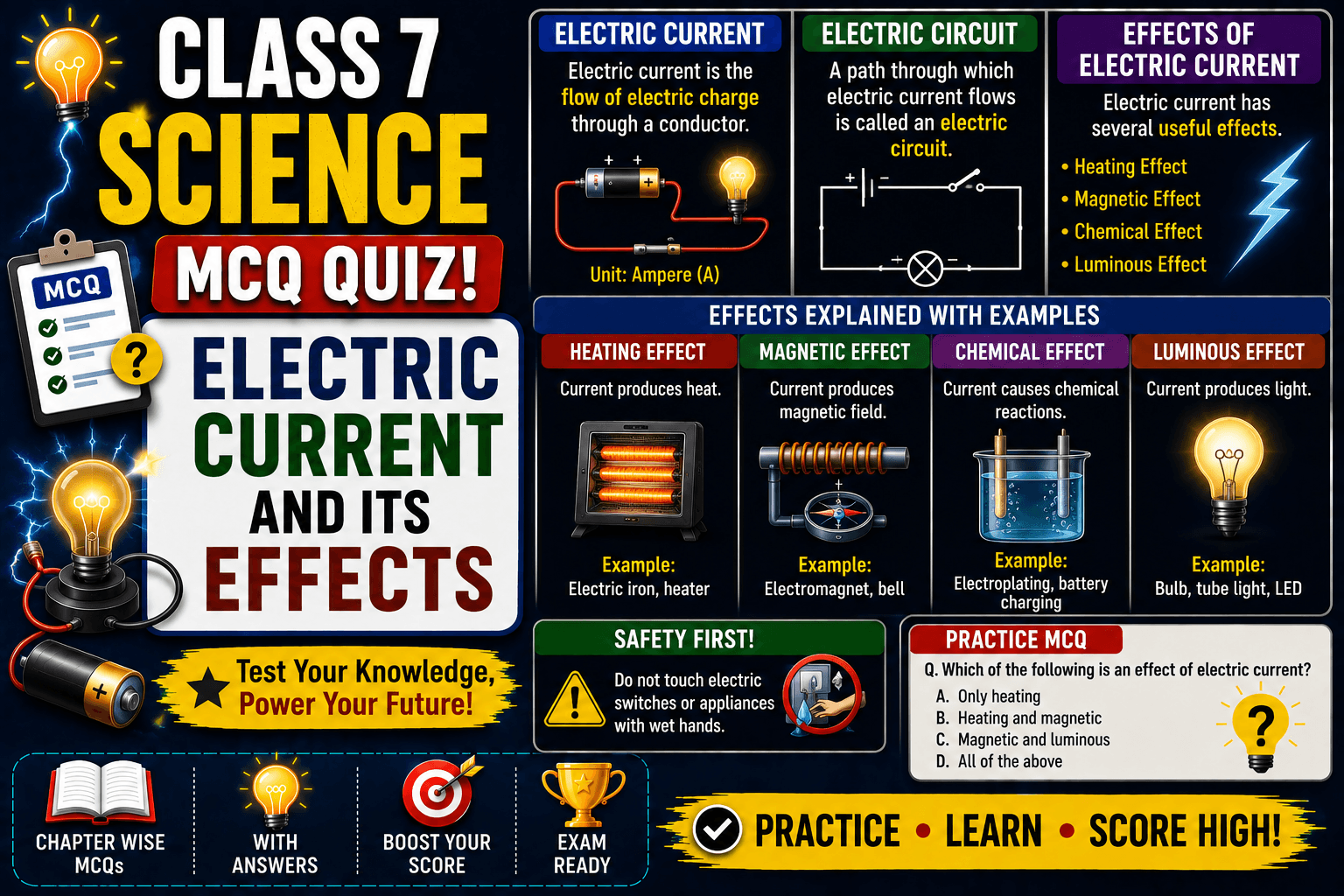
Practice Class 7 Science MCQs on pendulum, time period, electric circuits, switches, electromagnets, MCBs, electric current, and circuit safety with detailed explanations.
Do You Know
Q1. The time taken by a pendulum to complete one oscillation is its:
Correct Answer: Time Period
Detailed Explanation:
The time period of a pendulum is the time taken to complete one full oscillation. An oscillation means one complete to-and-fro movement of the pendulum bob from its mean position and back to the same position.
A simple pendulum consists of a small heavy bob suspended by a thread from a fixed support. When the bob is displaced slightly and released, it starts moving back and forth. This repeated motion is called oscillatory motion.
The time period is usually represented by the symbol T and measured in seconds (s). For example, if a pendulum takes 2 seconds to complete one full oscillation, its time period is 2 seconds.
The time period depends mainly on the length of the pendulum. A longer pendulum generally has a greater time period, while a shorter pendulum oscillates more quickly. However, for small oscillations, the mass of the bob does not significantly affect the time period.
Pendulums have been used in clocks for centuries because of their regular motion. Scientists also use pendulums to study motion, gravity, and periodic phenomena.
Understanding the concept of time period helps students learn about vibrations, waves, and various periodic motions found in nature.
Real-Life Examples:
- Pendulum clocks.
- Swinging playground swings.
- Oscillating decorative hanging objects.
Important NCERT Points:
- One complete to-and-fro motion is one oscillation.
- Time period is measured in seconds.
- Represented by the symbol T.
- Depends mainly on pendulum length.
Exam-Oriented Fact:
Time taken for one complete oscillation is called the time period.
Quick Revision Line:
Time period is the time taken by a pendulum to complete one full oscillation.
Q2. A path through which electric current flows is called an electric:
Correct Answer: Circuit
Detailed Explanation:
An electric circuit is a complete closed path through which electric current flows. It connects electrical components such as cells, batteries, bulbs, switches, and wires, allowing electricity to move from one point to another.
For electric current to flow, the circuit must be complete. If there is any break in the path, the current stops flowing. This is why a bulb glows only when the circuit is closed and stops glowing when the circuit is open.
A simple electric circuit usually consists of a battery, connecting wires, a switch, and an electrical device such as a bulb. The battery provides electrical energy, while the wires provide a conducting path for the movement of electric charges.
Electric circuits are found everywhere in daily life. Household wiring systems, mobile phone chargers, televisions, fans, refrigerators, and computers all operate using electrical circuits.
Understanding electric circuits is important because they form the basis of all electrical and electronic devices. Learning about circuits also helps students understand safety measures while handling electricity.
Real-Life Examples:
- A glowing torch circuit.
- Home electrical wiring.
- Battery-operated toys.
Important NCERT Points:
- Current flows only in a closed circuit.
- Wires provide the conducting path.
- Batteries supply electrical energy.
- Switches control current flow.
Exam-Oriented Fact:
An incomplete circuit cannot conduct electric current.
Quick Revision Line:
An electric circuit is a closed path through which electric current flows.
Q3. An electromagnet is a:
Correct Answer: Temporary Magnet
Detailed Explanation:
An electromagnet is a temporary magnet produced by passing electric current through a coil of wire. Unlike permanent magnets, electromagnets lose their magnetic properties when the electric current is switched off.
To make an electromagnet, a wire is wound around a soft iron core. When electric current flows through the wire, a magnetic field is created around the core, turning it into a magnet. As soon as the current stops, the magnetic effect disappears.
One of the greatest advantages of electromagnets is that their strength can be controlled. Increasing the number of wire turns or increasing the current makes the electromagnet stronger.
Electromagnets are widely used in modern technology. They are found in electric bells, loudspeakers, motors, cranes used for lifting scrap iron, magnetic locks, and various industrial machines.
The invention of electromagnets has greatly improved many technologies because they can be switched on and off whenever needed.
Understanding electromagnets helps students see how electricity and magnetism are closely related.
Real-Life Examples:
- Electric bells.
- Magnetic cranes in factories.
- Loudspeakers and headphones.
Important NCERT Points:
- Electromagnets work only when current flows.
- Soft iron is commonly used as the core.
- They are temporary magnets.
- Their strength can be controlled.
Exam-Oriented Fact:
An electromagnet loses its magnetism when the electric current is switched off.
Quick Revision Line:
An electromagnet is a temporary magnet produced by electric current.
Q4. When the switch is in the ‘OFF’ position, the circuit is said to be:
Correct Answer: Open
Detailed Explanation:
A circuit is said to be open when there is a break in the conducting path. In an open circuit, electric current cannot flow because the path is incomplete.
A switch is used to control the flow of electricity in a circuit. When the switch is turned ON, it completes the circuit and allows current to flow. When the switch is turned OFF, the circuit becomes open and the flow of current stops immediately.
Open circuits are important for safety and energy conservation. Electrical appliances can be switched off when not needed, preventing unnecessary power consumption and reducing the risk of electrical accidents.
For example, when you switch off a room light, the circuit becomes open, and the bulb stops glowing because electricity can no longer reach it.
The concepts of open and closed circuits form the foundation of electrical engineering and help explain the operation of almost every electrical device.
Real-Life Examples:
- Switching off a room light.
- Turning off a fan.
- Disconnecting a charger from a socket.
Important NCERT Points:
- Open circuits do not allow current flow.
- OFF position creates a break in the circuit.
- Electrical devices stop working in an open circuit.
- Switches control circuit operation.
Exam-Oriented Fact:
Current flows only in a closed circuit and stops in an open circuit.
Quick Revision Line:
When a switch is OFF, the circuit becomes open and current stops flowing.
Q5. MCB stands for:
Correct Answer: Miniature Circuit Breaker
Detailed Explanation:
MCB stands for Miniature Circuit Breaker. It is an automatic electrical safety device used to protect electrical circuits from damage caused by excessive current, overload, or short circuits.
In earlier times, electric fuses were commonly used for protection. However, fuses melt when excess current flows and need replacement after every operation. MCBs are more convenient because they automatically trip when an abnormal current is detected and can be reset easily.
An MCB continuously monitors the flow of electricity in a circuit. If the current exceeds the safe limit, the MCB immediately disconnects the circuit, preventing overheating, fire hazards, and damage to electrical appliances.
MCBs are commonly installed in homes, schools, offices, factories, and commercial buildings. They improve electrical safety and reduce maintenance costs.
Modern electrical systems rely heavily on MCBs because they provide quick, reliable, and reusable protection against electrical faults.
Learning about MCBs helps students understand how electrical safety is maintained in everyday life.
Real-Life Examples:
- Home distribution boards.
- School electrical panels.
- Office and factory wiring systems.
Important NCERT Points:
- MCB means Miniature Circuit Breaker.
- Protects against overload and short circuits.
- Automatically switches off faulty circuits.
- Can be reset without replacement.
Exam-Oriented Fact:
MCBs have largely replaced traditional electric fuses in modern buildings.
Quick Revision Line:
MCB is a Miniature Circuit Breaker that protects electrical circuits from damage.
Related links
- Class 7 Science: Respiration in Organisms & Transportation in Animals and Plants
- NCERT Class 7 Science: Nutrition in Animals
- Class 7 Civics MCQs with Answers | Equality & TMS
Latest Posts
- NCERT Class 7 Maths Chapter 1 Integers,addition, subtraction
- Class 10 Maths Chapter-1 Real Numbers-Rational numbers-MCQ
- Class9 Maths- Number Systems, decimal expansion, exponents
- Class 8 Maths Chapter 1 Rational Numbers, multiplicative
- Class 10 Maths Chapter 1 Real Numbers MCQ Questions with Solutions
Join Our Other Communities
Instagram , Youtube , Facebook