

Welcome To My School Study
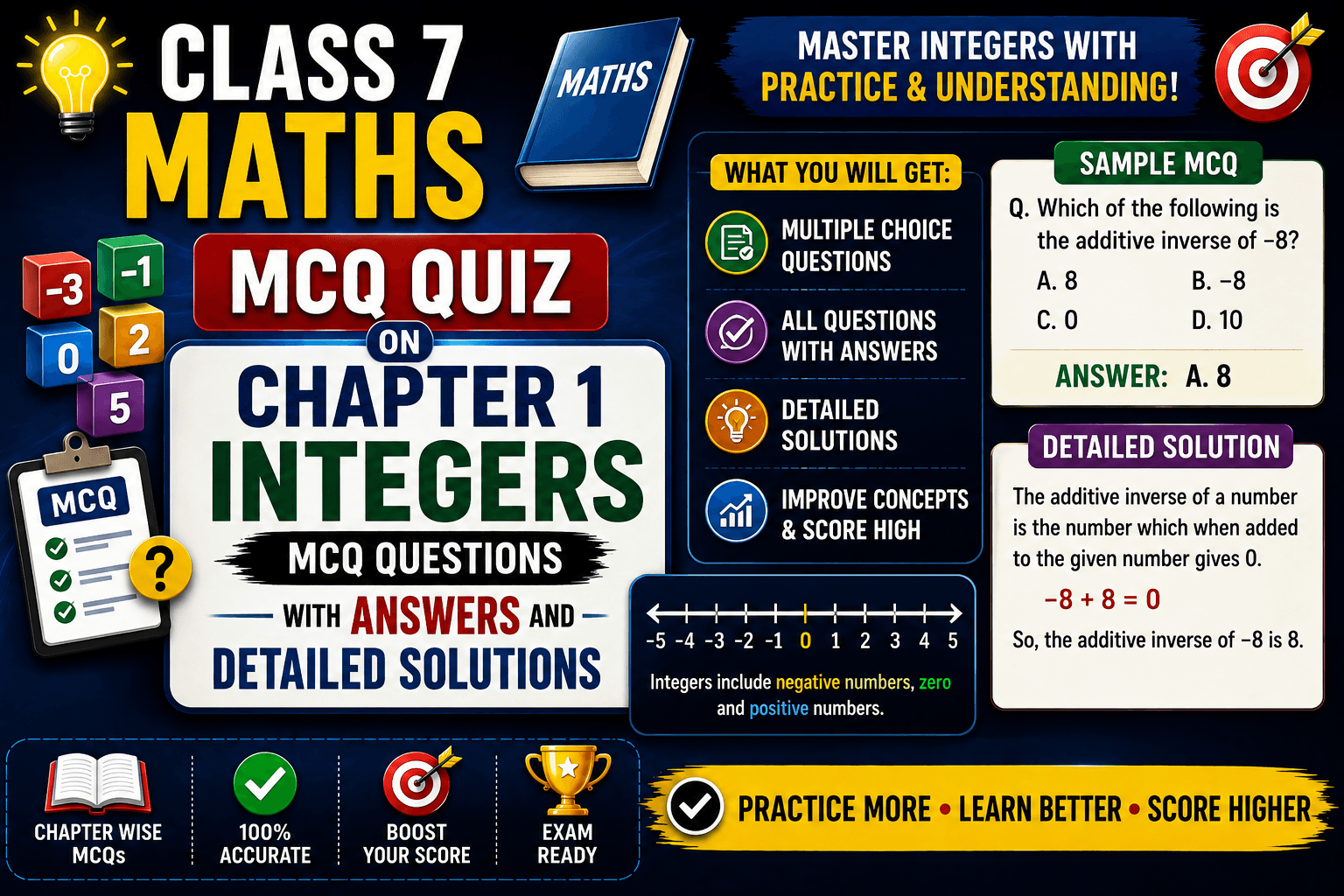
Practice Class 7 Maths Chapter 1 Integers MCQ Questions with Answers based on NCERT syllabus. Learn positive and negative integers, number line, addition, subtraction, multiplication, and properties of integers with detailed solutions for CBSE exams.
Do You Know
Chapter Information
Subject: Mathematics
Class: 7
Chapter: Integers
Question Type: Multiple Choice Questions (MCQs)
Difficulty Level: Moderate to Difficult
Based On: NCERT Latest Syllabus
Introduction:
Integers is a fundamental chapter in Class 7 Mathematics that introduces students to positive numbers, negative numbers, and zero. Students learn to represent integers on a number line and perform operations such as addition, subtraction, and multiplication. A strong understanding of integers develops logical reasoning and builds the foundation for algebra and higher mathematics.
What You Will Learn?
✔ Positive Integers
✔ Negative Integers
✔ Representation on Number Line
✔ Addition of Integers
✔ Subtraction of Integers
✔ Multiplication of Integers
✔ Properties of Integers
✔ Real-Life Applications of Integers
Why This Topic Is Important?
Integers are used extensively in mathematics and daily life. They help represent temperatures above and below zero, profits and losses, elevations, and bank transactions. Understanding integers builds a strong mathematical foundation and improves problem-solving skills.
Exam Relevance
These questions are useful for:
✔ CBSE Exams
✔ State Board Exams
✔ School Tests
✔ Unit Tests
✔ Half-Yearly Exams
✔ Annual Exams
✔ Scholarship Examinations
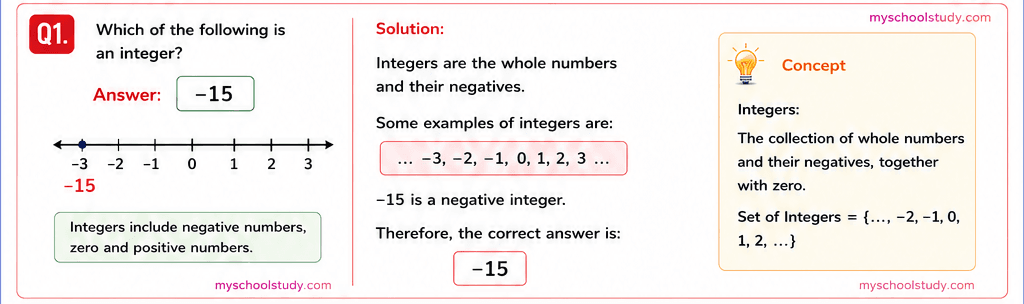
Q1. Which of the following is a negative integer?
A) $$5$$
B) $$0$$
C) $$-8$$
D) $$12$$
Answer:
$$-8$$
Useful Formula for this Question:
Negative integers are numbers less than zero.
$$a<0$$
Concept Behind This Question:
Students should identify positive and negative integers correctly.
Step-by-Step Solution:
Among the given numbers, $$5$$ and $$12$$ are positive integers.
$$0$$ is neither positive nor negative.
Since
$$-8<0$$
therefore, $$-8$$ is a negative integer.
Hence, the correct answer is:
$$-8$$
Exam Tip:
Every integer with a negative sign is a negative integer.
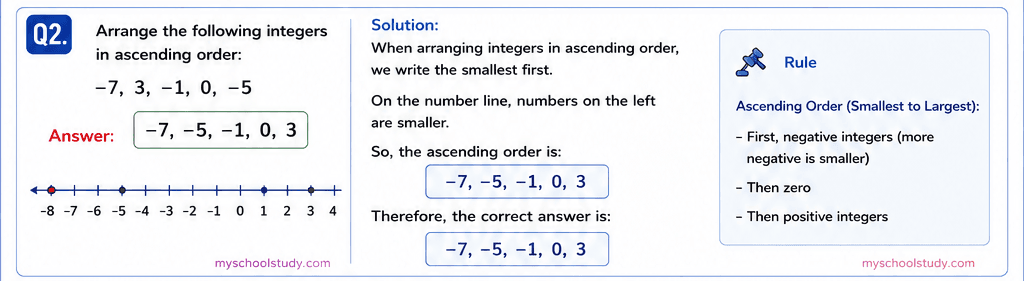
Q2. Find the value of:
$$(-7)+12$$
A) $$19$$
B) $$5$$
C) $$-5$$
D) $$-19$$
Answer:
$$5$$
Useful Formula for this Question:
When integers have different signs, subtract their absolute values and keep the sign of the number with the greater absolute value.
Concept Behind This Question:
Students should perform addition of integers correctly.
Step-by-Step Solution:
Given:
$$(-7)+12$$
Subtract the absolute values:
$$12-7=5$$
Since $$12$$ has the greater absolute value and is positive, the result is positive.
Therefore,
$$(-7)+12=5$$
Hence, the correct answer is:
$$5$$
Exam Tip:
For integers with opposite signs, subtract and keep the sign of the larger number.
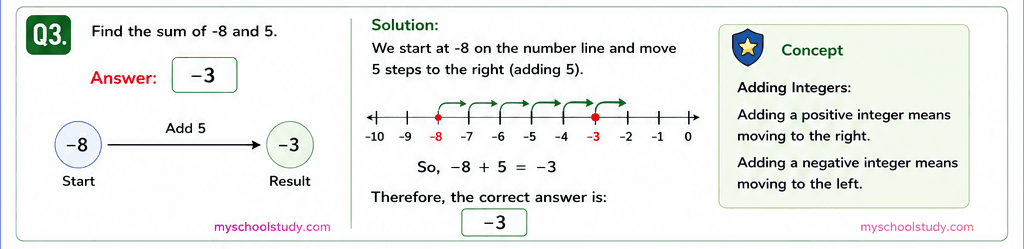
Q3. Evaluate:
$$8-(-6)$$
A) $$2$$
B) $$14$$
C) $$-14$$
D) $$48$$
Answer:
$$14$$
Useful Formula for this Question:
$$a-(-b)=a+b$$
Concept Behind This Question:
Students should understand subtraction of integers.
Step-by-Step Solution:
Given:
$$8-(-6)$$
Using the rule:
$$a-(-b)=a+b$$
We get:
$$8+6=14$$
Therefore,
$$8-(-6)=14$$
Hence, the correct answer is:
$$14$$
Exam Tip:
Subtracting a negative integer is equivalent to adding its positive value.
Q4. Which property is represented by:
$$(-3)+5=5+(-3)$$
A) Closure Property
B) Associative Property
C) Commutative Property of Addition
D) Multiplicative Identity
Answer:
Commutative Property of Addition

Useful Formula for this Question:
$$a+b=b+a$$
Concept Behind This Question:
Students should identify the properties of integers.
Step-by-Step Solution:
The order of the numbers is changed, but the result remains the same.
$$(-3)+5=2$$
and
$$5+(-3)=2$$
Thus,
$$(-3)+5=5+(-3)$$
This represents the commutative property of addition.
Hence, the correct answer is:
Commutative Property of Addition
Exam Tip:
Changing the order of addition does not change the result.
Q5. What is the product of:
$$(-4)\times(-9)$$
A) $$-36$$
B) $$36$$
C) $$13$$
D) $$-13$$
Answer:
$$36$$

Useful Formula for this Question:
$$(-a)\times(-b)=ab$$
Concept Behind This Question:
Students should apply multiplication rules of integers correctly.
Step-by-Step Solution:
Given:
$$(-4)\times(-9)$$
Multiply the numbers:
$$4\times9=36$$
The product of two negative integers is positive.
Therefore,
$$(-4)\times(-9)=36$$
Hence, the correct answer is:
$$36$$
Exam Tip:
Integers with the same signs give a positive product, while different signs give a negative product.
Important Formulas & Concepts
1. Set of Integers
$$\ldots,-3,-2,-1,0,1,2,3,\ldots$$
2. Addition of Integers
$$(+a)+(+b)=+(a+b)$$
$$(-a)+(-b)=-(a+b)$$
3. Subtraction of Integers
$$a-b=a+(-b)$$
4. Multiplication Rules
$$(+)\times(+)=+$$
$$(-)\times(-)=+$$
$$(+)\times(-)=-$$
$$(-)\times(+)=-$$
5. Additive Identity
$$a+0=a$$
6. Multiplicative Identity
$$a\times1=a$$
7. Commutative Property of Addition
$$a+b=b+a$$
8. Associative Property of Addition
$$(a+b)+c=a+(b+c)$$
FAQs
1. What are integers?
Integers include positive numbers, negative numbers, and zero.
$$\ldots,-2,-1,0,1,2,\ldots$$
2. Is zero positive or negative?
No.
$$0$$
is neither positive nor negative.
3. What is the additive identity?
The additive identity is:
$$0$$
because
$$a+0=a$$
4. What happens when two negative integers are multiplied?
The product is always positive.
$$(-a)\times(-b)=ab$$
5. Does subtraction satisfy the commutative property?
No.
$$5-3\ne3-5$$
Therefore, subtraction is not commutative.
Common Mistakes
❌ Ignoring negative signs while calculations.
❌ Treating zero as a positive number.
❌ Forgetting that subtraction changes to addition of the opposite number.
❌ Applying multiplication sign rules incorrectly.
❌ Assuming subtraction is commutative.
❌ Reading the number line in the wrong direction.
Quick Revision Notes
✔ Integers include positive numbers, negative numbers, and zero.
✔ Zero is neither positive nor negative.
✔ Subtracting a negative integer means addition.
$$a-(-b)=a+b$$
✔ The product of two negative integers is positive.
$$(-a)\times(-b)=ab$$
✔ Addition of integers satisfies the commutative property.
$$a+b=b+a$$
✔ Integers on the right side of the number line are greater.
Conclusion Integers is one of the most important chapters in Class 7 Mathematics. A clear understanding of positive and negative numbers, number line representation, and operations on integers helps students build a strong mathematical foundation for algebra and higher classes. Regular MCQ practice improves conceptual understanding, speed, accuracy, and exam performance.
Related links
- Class 7 Science: Soil Conservation, Deforestation & Wastewater Story
- Class 7 Science: Electric Current and Its Effects
- Class 7 Science: Respiration in Organisms & Transportation in Animals and Plants
- NCERT Class 7 Science: Nutrition in Animals
- Class 7 Civics MCQs with Answers | Equality & TMS
Latest Posts
- NCERT Class 7 Maths Chapter 1 Integers,addition, subtraction
- Class 10 Maths Chapter-1 Real Numbers-Rational numbers-MCQ
- Class9 Maths- Number Systems, decimal expansion, exponents
- Class 8 Maths Chapter 1 Rational Numbers, multiplicative
- Class 10 Maths Chapter 1 Real Numbers MCQ Questions with Solutions
Join Our Other Communities
Instagram , Youtube , Facebook