

Welcome To My School Study
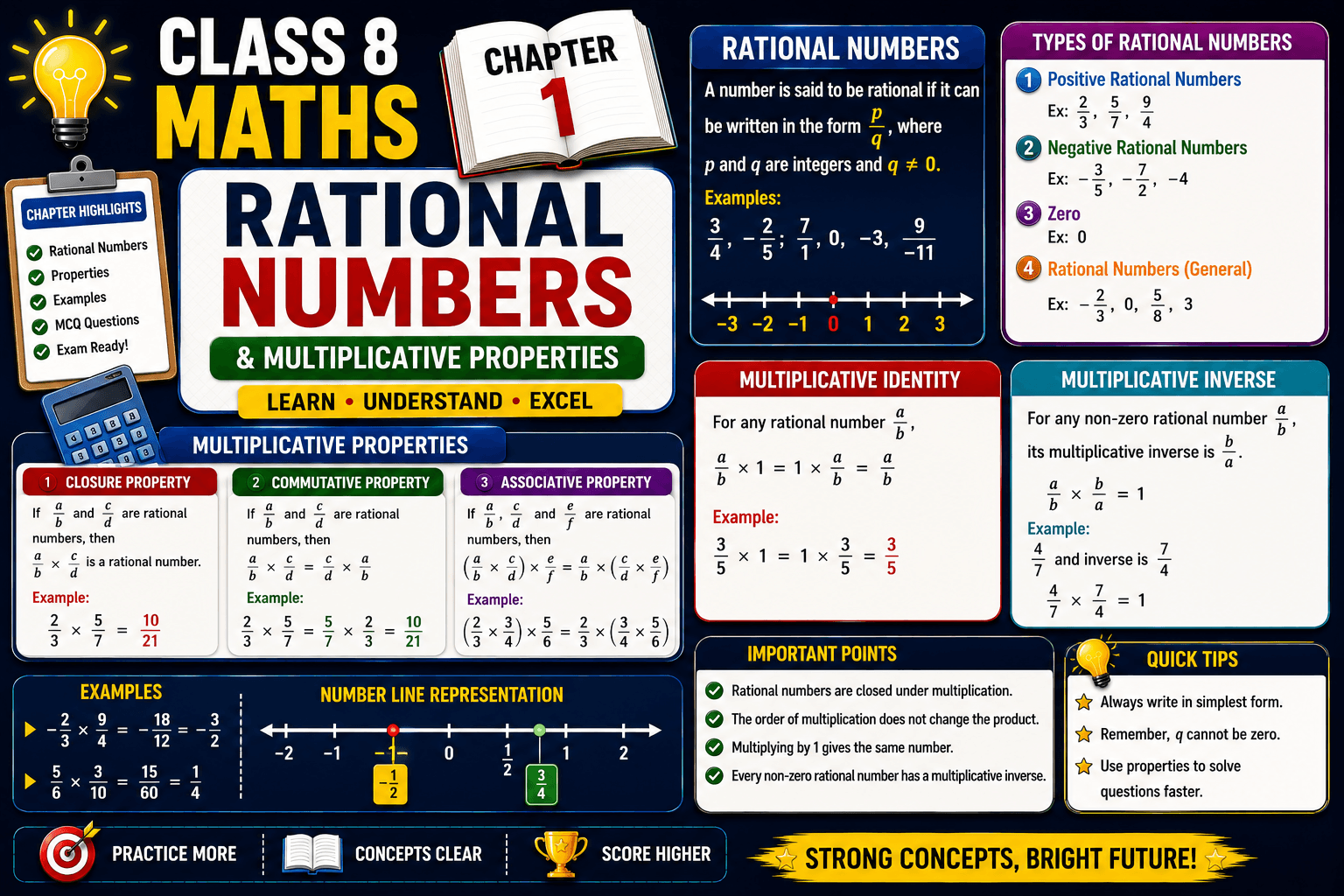
Practice Class 8 Maths Chapter 1 Rational Numbers MCQ Questions with Answers based on NCERT syllabus. Learn rational numbers, properties of rational numbers, additive inverse, multiplicative inverse, closure property, and operations on rational numbers with detailed solutions for CBSE exams.
Do You Know
Chapter Information
Subject: Mathematics
Class: 8
Chapter: Rational Numbers
Question Type: Multiple Choice Questions (MCQs)
Difficulty Level: Moderate to Difficult
Based On: NCERT Latest Syllabus
Introduction:
Rational Numbers is an important chapter in Class 8 Mathematics that helps students understand fractions, integers, and their properties. A strong understanding of rational numbers improves mathematical reasoning and problem-solving skills.
What You Will Learn?
✔ Rational Numbers
✔ Additive Inverse
✔ Multiplicative Inverse
✔ Closure Property
✔ Commutative Property
✔ Associative Property
✔ Distributive Property
✔ Operations on Rational Numbers
Why This Topic Is Important?
Rational numbers are widely used in mathematics and real-life calculations. Understanding their properties and operations builds a strong foundation for algebra and advanced mathematics.
Exam Relevance
These questions are useful for:
✔ CBSE Exams
✔ State Board Exams
✔ School Tests
✔ Unit Tests
✔ Half-Yearly Exams
✔ Annual Exams
✔ Scholarship Examinations
Q1. Which of the following numbers is not a rational number?
A) $$\frac{9}{11}$$
B) $$-7$$
C) $$\sqrt{3}$$
D) $$0$$
Answer:
$$\sqrt{3}$$
Useful Formula for this Question:
A rational number can be expressed in the form:
$$\frac{p}{q}, \quad q\ne0$$
Concept Behind This Question:
Students should identify irrational numbers among rational numbers.
Step-by-Step Solution:
- $$\frac{9}{11}$$ is rational.
- $$-7=\frac{-7}{1}$$ is rational.
- $$0=\frac{0}{1}$$ is rational.
- $$\sqrt{3}$$ cannot be expressed as:
$$\frac{p}{q}$$
Therefore:
$$\sqrt{3}$$ is not a rational number.
Hence, the correct answer is:
$$\sqrt{3}$$
Exam Tip:
Square roots of non-perfect squares are irrational numbers.
Q2. Simplify:
$$\frac{5}{8}-\left(-\frac{1}{4}\right)$$
A) $$\frac{3}{8}$$
B) $$\frac{7}{8}$$
C) $$\frac{1}{8}$$
D) $$\frac{5}{8}$$
Answer:
$$\frac{7}{8}$$
Useful Formula for this Question:
Subtracting a negative number is equivalent to addition.
Concept Behind This Question:
Students should apply sign rules correctly.
Step-by-Step Solution:
$$\frac{5}{8}-\left(-\frac{1}{4}\right)$$
$$=\frac{5}{8}+\frac{1}{4}$$
Convert into like fractions:
$$\frac{1}{4}=\frac{2}{8}$$
Now,
$$\frac{5}{8}+\frac{2}{8}=\frac{7}{8}$$
Therefore, the correct answer is:
$$\frac{7}{8}$$
Exam Tip:
Remember that minus and minus together become plus.
Q3. Find the reciprocal of:
$$\frac{14}{-15}$$
A) $$-\frac{15}{14}$$
B) $$\frac{15}{14}$$
C) $$-\frac{14}{15}$$
D) $$\frac{14}{15}$$
Answer:
$$-\frac{15}{14}$$
Useful Formula for this Question:
The reciprocal of:
$$\frac{a}{b}$$
is
$$\frac{b}{a}$$
Concept Behind This Question:
Students should know how to find the reciprocal of rational numbers.
Step-by-Step Solution:
Given rational number:
$$\frac{14}{-15}=-\frac{14}{15}$$
Interchanging numerator and denominator gives:
$$-\frac{15}{14}$$
Verification:
$$-\frac{14}{15}\times-\frac{15}{14}=1$$
Therefore, the correct answer is:
$$-\frac{15}{14}$$
Exam Tip:
The sign of a rational number remains unchanged in its reciprocal.
Q4. Which property is represented by:
$$a\times(b+c)=ab+ac$$
A) Closure Property
B) Commutative Property
C) Associative Property
D) Distributive Property
Answer:
Distributive Property
Useful Formula for this Question:
$$a\times(b+c)=ab+ac$$
Concept Behind This Question:
Students should identify properties of rational numbers.
Step-by-Step Solution:
Multiplication is distributed over addition.
Example:
$$3(2+4)=3\times2+3\times4$$
$$=6+12=18$$
Hence, the given expression represents the distributive property.
Therefore, the correct answer is:
Distributive Property
Exam Tip:
Distributive property connects multiplication with addition and subtraction.
Q5. Simplify:
$$-\frac{2}{7}\times\frac{21}{10}$$
A) $$-\frac{3}{5}$$
B) $$\frac{3}{5}$$
C) $$-\frac{5}{3}$$
D) $$\frac{5}{3}$$
Answer:
$$-\frac{3}{5}$$
Useful Formula for this Question:
For multiplication:
$$\frac{a}{b}\times\frac{c}{d}=\frac{ac}{bd}$$
Concept Behind This Question:
Students should multiply and simplify rational numbers correctly.
Step-by-Step Solution:
$$-\frac{2}{7}\times\frac{21}{10}$$
Cancelling common factors:
$$=-\frac{1}{1}\times\frac{3}{5}$$
$$=-\frac{3}{5}$$
Therefore, the correct answer is:
$$-\frac{3}{5}$$
Exam Tip:
Use cross-cancellation before multiplication to simplify calculations.
Important Formulas & Concepts
1. Rational Numbers
$$\frac{p}{q}, \quad q\ne0$$
2. Additive Inverse
$$\frac{a}{b}+\left(-\frac{a}{b}\right)=0$$
3. Multiplicative Inverse
$$\frac{a}{b}\times\frac{b}{a}=1,\quad a\ne0,\ b\ne0$$
4. Commutative Property
$$a+b=b+a$$
$$a\times b=b\times a$$
5. Associative Property
$$(a+b)+c=a+(b+c)$$
$$(a\times b)\times c=a\times(b\times c)$$
6. Distributive Property
$$a(b+c)=ab+ac$$
FAQs
1. What is a rational number?
A rational number can be expressed in the form:
$$\frac{p}{q}, \quad q\ne0$$
2. Can a rational number be negative?
Yes, rational numbers can be positive, negative, or zero.
3. What is the reciprocal of:
$$-\frac{4}{9}$$ ?
The reciprocal is:
$$-\frac{9}{4}$$
4. Are rational numbers closed under multiplication?
Yes, the product of two rational numbers is always a rational number.
5. Does zero have a multiplicative inverse?
No, zero does not have a multiplicative inverse.
Common Mistakes
❌ Ignoring negative signs.
❌ Dividing by zero.
❌ Confusing reciprocal with additive inverse.
❌ Not simplifying fractions completely.
❌ Forgetting cross-cancellation.
Quick Revision Notes
✔ Rational numbers are expressed as:
$$\frac{p}{q}$$
✔ Every integer is a rational number.
✔ Zero is a rational number.
✔ Zero has no reciprocal.
✔ Rational numbers satisfy various properties.
Conclusion
Rational Numbers is an important chapter in Class 8 Mathematics. A strong understanding of rational numbers and their properties helps students solve mathematical problems efficiently and excel in examinations. Regular MCQ practice improves confidence, speed, and conceptual understanding.
Related links
- Class 8 Maths Chapter 1 Rational Numbers, Additive inverse
- Class 8 Maths Chapter 1 Rational Numbers
- Class 8 Maths Chapter 1 Rational Numbers
- Class 8 Maths Chapter 1 Rational Numbers, additive inverse
- Class 8 Maths Chapter 1 Rational Numbers, multiplicative
- Class 8 Maths Chapter 1 Rational Numbers, Multiplicative
- Class 8 Maths Chapter 1 Rational Numbers MCQ Q&A With Solution
- Class 8 Science MCQ Quiz: Pollution, Ozone Layer & Water Resources
- Class 8 Science: Stars, Planets and Solar System
Latest Posts
- Class 7 Maths Chapter 1 Integers, number line, subtraction
- Class 8 Maths additive inverse, multiplicative inverse MCQ
- Class 9 Maths Chapter 1 Number Systems laws of exponents
- Class 10 Maths Chapter 2 Polynomials MCQ linear polynomial
- Class 10 Maths Chapter 2 Polynomials, linear polynomial
Join Our Other Communities
Instagram , Youtube , Facebook