

Welcome To My School Study
Do You Know
1. Weather – Day-to-Day Condition of the Atmosphere
Weather refers to the day-to-day condition of the atmosphere at a particular place. It changes frequently and can vary from hour to hour or day to day. Weather includes factors such as temperature, rainfall, humidity, wind speed, cloud cover, and atmospheric pressure.
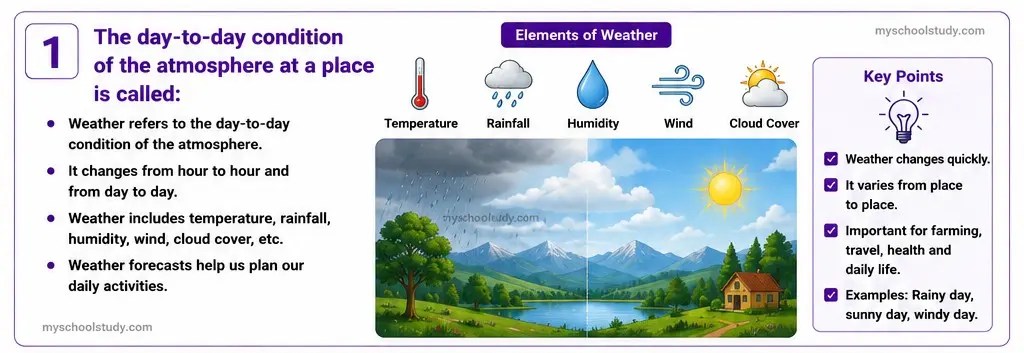
Understanding Weather
When people say:
- “Today is hot”
- “It may rain”
- “The sky is cloudy”
they are talking about weather conditions.
Weather changes continuously because the atmosphere is always moving and reacting to solar heat, air pressure, and moisture.
Elements of Weather
Temperature
Temperature tells us how hot or cold the atmosphere is.
Humidity
Humidity is the amount of water vapor present in the air.
Rainfall
Rainfall occurs when water droplets fall from clouds.
Wind
Moving air is called wind. Wind speed and direction are important parts of weather.
Cloud Cover
Clouds affect sunlight, temperature, and rainfall.
Weather Forecasting
Scientists called meteorologists study weather and make forecasts using:
- Satellites
- Weather stations
- Radar systems
- Computer models
Weather forecasts help people prepare for:
- Rain
- Storms
- Heatwaves
- Floods
Importance of Weather
Weather affects:
- Farming
- Transportation
- Human health
- Tourism
- Daily activities
Farmers especially depend on weather forecasts for crop planning and irrigation.
Difference Between Weather and Climate
Weather
- Short-term atmospheric condition
- Changes daily
Climate
- Long-term average weather pattern
- Changes over many years
Real-Life Examples
- A rainy afternoon
- A cold winter morning
- A windy evening
- A sunny day
These are all examples of weather conditions.
Interesting Facts About Weather
- Weather can change quickly within hours.
- Storms and cyclones are extreme weather events.
- Different places on Earth experience different weather patterns.
2. Polar Bear Adaptation – Thick Layer of Fat
Polar bears are large animals that live in extremely cold Arctic regions. They survive in freezing temperatures because of special body features called adaptations.
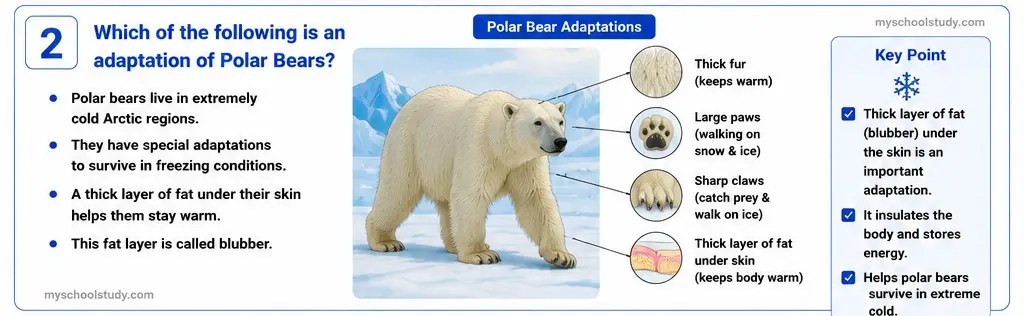
What is Adaptation?
Adaptation is a special feature or behavior that helps an organism survive in its environment.
Animals living in cold, hot, dry, or wet environments develop different adaptations over time.
Thick Layer of Fat
One important adaptation of polar bears is a thick layer of fat under the skin. This fat layer is called blubber.
Functions of Blubber
- Keeps the body warm
- Stores energy
- Protects from freezing temperatures
Other Adaptations of Polar Bears
Thick Fur
Polar bears have dense white fur that traps heat and helps them stay warm.
White Color
Their white fur helps them blend with snow and ice, making hunting easier.
Large Paws
Large paws help them walk on snow and swim in icy water.
Sharp Claws
Claws help in catching prey and walking on slippery ice.
Habitat of Polar Bears
Polar bears are mainly found in:
- Arctic regions
- Snow-covered areas
- Ice-covered oceans
Food Habits
Polar bears mainly eat:
- Seals
- Fish
- Marine animals
Importance of Adaptation
Adaptations help animals:
- Protect themselves
- Find food
- Survive climate conditions
- Escape predators
Without adaptations, survival in extreme conditions becomes difficult.
Climate Change and Polar Bears
Global warming is reducing Arctic ice. This affects polar bears because:
- Ice melts faster
- Hunting becomes difficult
- Habitat decreases
Scientists are studying ways to protect polar bear populations.
Interesting Facts
- Polar bears are excellent swimmers.
- Their skin is actually black beneath the white fur.
- They can smell prey from long distances.
3. Climate – Long-Term Weather Pattern
Climate refers to the average weather conditions of a place observed over a long period of time, usually many years.
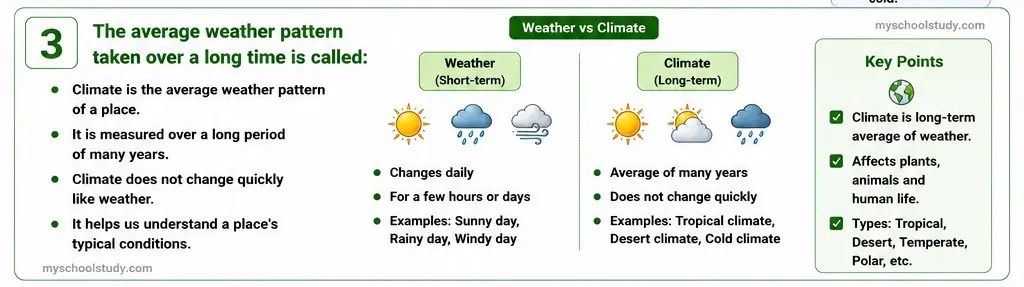
Understanding Climate
Climate tells us what type of weather usually occurs in a region.
Examples:
- Hot desert climate
- Cold polar climate
- Tropical rainforest climate
Factors Affecting Climate
Latitude
Places near the equator are hotter.
Altitude
Mountain areas are cooler.
Distance from Sea
Coastal areas have moderate climate.
Wind Patterns
Winds influence rainfall and temperature.
Types of Climate
Tropical Climate
- Hot and wet
- Heavy rainfall
Desert Climate
- Very hot and dry
- Little rainfall
Polar Climate
- Extremely cold
- Snow-covered regions
Temperate Climate
- Moderate temperature
- Distinct seasons
Importance of Climate
Climate affects:
- Agriculture
- Vegetation
- Animal life
- Human lifestyle
- Clothing and housing
Climate and Human Activities
People adapt their lifestyles according to climate conditions.
Examples
- Woolen clothes in cold regions
- Cotton clothes in hot areas
- Sloping roofs in rainy regions
Difference Between Weather and Climate
Weather
Changes daily or weekly.
Climate
Represents long-term weather averages.
Climate Change
Climate change occurs because of:
- Pollution
- Greenhouse gases
- Deforestation
- Industrial activities
This can lead to:
- Rising temperatures
- Floods
- Droughts
- Melting glaciers
Interesting Facts
- The Sahara Desert is one of the hottest regions on Earth.
- Antarctica is the coldest continent.
- Tropical rainforests receive very high rainfall throughout the year.
4. Red-Eyed Frogs and Sticky Pads
Red-eyed tree frogs are colorful frogs commonly found in tropical rainforests. One important adaptation in these frogs is sticky pads on their feet.

Purpose of Sticky Pads
Sticky pads help frogs:
- Climb trees
- Hold branches firmly
- Move easily on wet surfaces
Habitat of Red-Eyed Frogs
These frogs mainly live in:
- Rainforests
- Humid environments
- Areas with dense vegetation
Features of Red-Eyed Frogs
Bright Red Eyes
Their eyes help scare predators.
Green Body
The green color helps them hide among leaves.
Long Legs
Useful for jumping and climbing.
Sticky Pads
Help them grip surfaces securely.
Importance of Adaptation
Tree frogs spend most of their life on trees. Sticky pads help them survive by preventing falls and allowing safe movement.
Rainforest Environment
Rainforests are:
- Wet
- Humid
- Dense with trees
Animals living there require special adaptations for climbing, hiding, and finding food.
Food Habits
Red-eyed frogs mainly eat:
- Insects
- Small flies
- Worms
Defense Mechanisms
When threatened, frogs suddenly open their bright red eyes to surprise predators.
Interesting Facts
- Red-eyed frogs are mostly active at night.
- They are excellent climbers.
- Their sticky feet work even on smooth leaves.
5. Tropical Rainforests – Found in Western Ghats and Assam
Tropical rainforests are dense forests that receive heavy rainfall throughout the year. In India, such forests are found mainly in the Western Ghats and Assam.
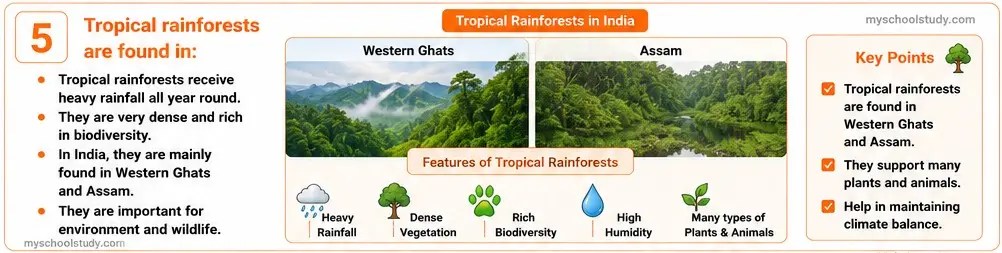
Characteristics of Tropical Rainforests
Heavy Rainfall
These forests receive large amounts of rain annually.
Dense Vegetation
Trees grow closely together forming thick forests.
High Humidity
The atmosphere remains moist most of the time.
Rich Biodiversity
Many plants and animals live in rainforests.
Tropical Rainforests in India
Western Ghats
Located along western India and known for rich biodiversity.
Assam
Receives heavy rainfall and supports dense forests.
Importance of Rainforests
Rainforests are important because they:
- Produce oxygen
- Absorb carbon dioxide
- Prevent soil erosion
- Support wildlife
- Maintain climate balance
Animals Found in Rainforests
- Elephants
- Tigers
- Monkeys
- Frogs
- Birds
- Insects
Plant Diversity
Rainforests contain:
- Tall trees
- Climbers
- Shrubs
- Medicinal plants
Threats to Rainforests
Rainforests are threatened by:
- Deforestation
- Pollution
- Urbanization
- Climate change
Conservation of Rainforests
People can help protect rainforests by:
- Planting trees
- Reducing deforestation
- Conserving wildlife
- Supporting environmental protection
Importance for Earth
Rainforests are often called the “lungs of the Earth” because they help maintain oxygen and carbon dioxide balance.
Interesting Facts
- Tropical rainforests contain millions of species.
- Some rainforest plants are used in medicines.
- Rainforests help regulate global climate.
Conclusion
Weather, climate, animal adaptations, and tropical rainforests are important topics in environmental science. Weather describes the daily condition of the atmosphere, while climate represents long-term weather patterns. Polar bears survive in cold climates because of thick fat layers, and red-eyed frogs use sticky pads to live on trees. Tropical rainforests found in regions like Western Ghats and Assam support rich biodiversity and play an important role in maintaining ecological balance.

