

Welcome To My School Study
Do You Know
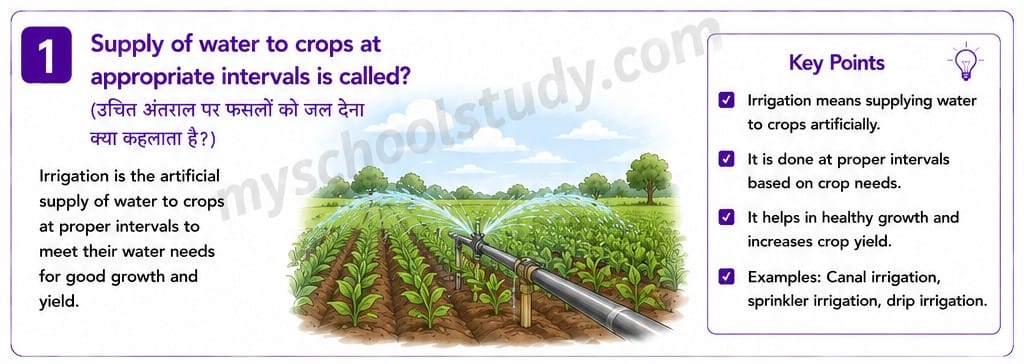
Q1. Supply of Water to Crops at Appropriate Intervals is Called Irrigation
Correct Answer: Irrigation
Explanation
Irrigation is the process of supplying water to crops at regular and proper intervals for healthy plant growth. Crops need water for germination, photosynthesis, absorption of nutrients, and overall development. Rainfall alone is not always sufficient, so farmers use irrigation methods to provide water when needed.
Without proper irrigation, crops may dry up, growth may stop, and production may decrease. Different crops require different amounts of water depending on climate, soil type, and season.
Step-by-Step Process of Irrigation
Step 1: Water is collected from sources like rivers, canals, ponds, wells, or tube wells.
Step 2: Farmers prepare the field for irrigation.
Step 3: Water is supplied to crops through canals, pipes, sprinklers, or drip systems.
Step 4: Soil absorbs the water and roots take it up.
Step 5: Plants use this water for growth and food preparation.
Importance of Irrigation
- Helps crops grow properly
- Prevents drying of plants
- Increases agricultural production
- Useful during low rainfall
- Maintains soil moisture
Types of Irrigation
Traditional Methods
- Moat
- Dhekli
- Chain pump
- Rahat
Modern Methods
- Sprinkler irrigation
- Drip irrigation
Why Drip Irrigation is Important
Drip irrigation supplies water directly to plant roots drop by drop. It saves water and is useful in dry areas.
Real Life Example
Farmers growing wheat and rice regularly irrigate fields because these crops require a large amount of water.
Key Points
- Irrigation means supplying water to crops.
- Water is necessary for plant growth.
- Modern irrigation methods save water.
- Proper irrigation increases crop yield.
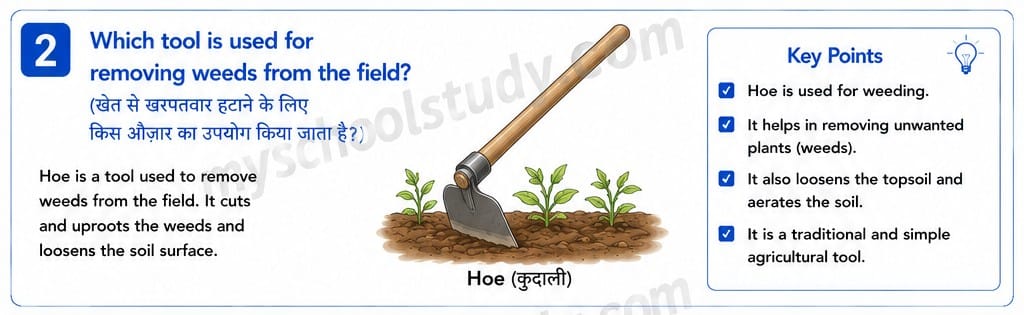
Q2. Hoe is Used for Removing Weeds from the Field
Correct Answer: Hoe
Explanation
A hoe is a farming tool used for removing weeds and loosening the soil. Weeds are unwanted plants that grow along with crops and compete for nutrients, water, sunlight, and space.
Removing weeds is very important because they reduce crop production. Farmers use hoes to cut weeds and improve soil aeration.
Step-by-Step Process of Weeding Using Hoe
Step 1: Weeds are identified in the crop field.
Step 2: The farmer uses a hoe to loosen the soil surface.
Step 3: Weeds are cut or uprooted.
Step 4: Removed weeds are collected from the field.
Step 5: Crops get more nutrients and grow better.
Why Weeding is Important
- Prevents nutrient loss
- Protects crops from competition
- Reduces spread of pests
- Improves crop growth
- Increases yield
Features of a Hoe
- Long wooden handle
- Flat or bent iron blade
- Easy to use manually
Examples of Common Weeds
- Wild grass
- Congress grass
- Bathua
Difference Between Crop Plants and Weeds
Crop Plants
- Useful plants grown by farmers
- Provide food and income
Weeds
- Unwanted plants
- Harm crop growth
Key Points
- Hoe is used for weeding.
- Weeds reduce crop production.
- Removing weeds improves plant growth.
- Hoe also loosens soil.
Q3. Rhizobium is a Nitrogen-Fixing Bacteria
Correct Answer: Rhizobium
Explanation
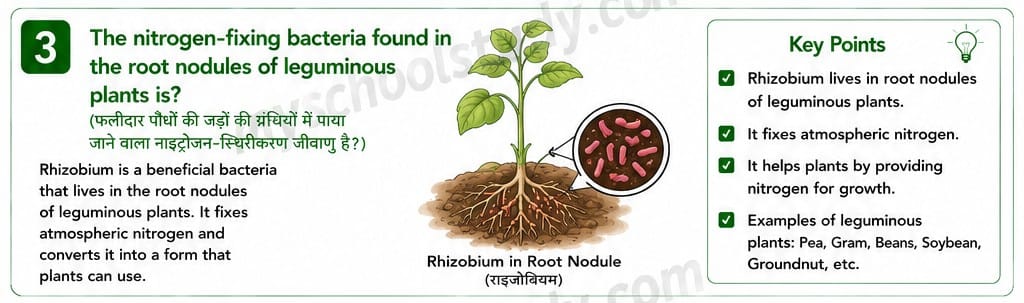
Rhizobium is a beneficial bacterium found in the root nodules of leguminous plants such as peas, gram, beans, and pulses. It converts atmospheric nitrogen into a usable form for plants. This process is called nitrogen fixation.
Plants cannot directly use nitrogen from the air, even though nitrogen is present in large amounts in the atmosphere. Rhizobium helps convert nitrogen into compounds that plants can absorb through roots.
Step-by-Step Process of Nitrogen Fixation
Step 1: Rhizobium bacteria live in root nodules of leguminous plants.
Step 2: The bacteria absorb nitrogen from the atmosphere.
Step 3: Nitrogen is converted into useful nitrogen compounds.
Step 4: Plants absorb these compounds through roots.
Step 5: Plants use nitrogen for growth and protein formation.
Importance of Nitrogen
Nitrogen is essential for:
- Leaf growth
- Protein synthesis
- Healthy crop production
- Green color in plants
Examples of Leguminous Plants
- Pea
- Gram
- Soybean
- Lentil
- Beans
Benefits of Rhizobium
- Improves soil fertility
- Reduces need for chemical fertilizers
- Supports plant growth naturally
Real Life Example
Farmers often grow pulses between major crops because Rhizobium increases nitrogen content in the soil.
Key Points
- Rhizobium fixes atmospheric nitrogen.
- Found in root nodules of leguminous plants.
- Helps increase soil fertility.
- Important for healthy crop growth.
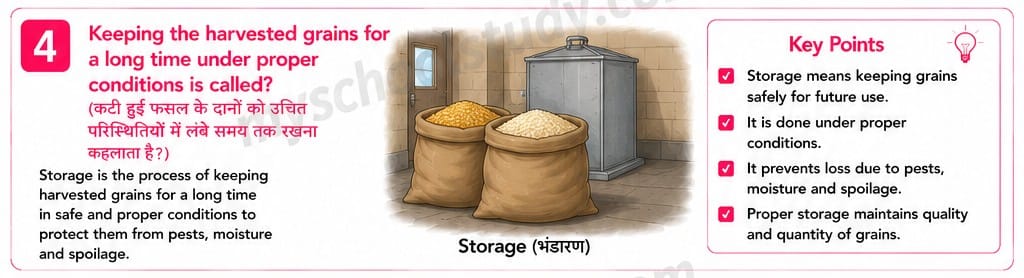
Q4. Keeping Harvested Grains Properly for Long Time is Called Storage
Correct Answer: Storage
Explanation
Storage means keeping harvested grains safely for a long period under suitable conditions. Proper storage protects grains from moisture, insects, rats, fungi, and spoilage.
If grains are not stored properly, they may get damaged and become unfit for consumption. Farmers dry grains properly before storing them.
Step-by-Step Process of Storage
Step 1: Crops are harvested from the field.
Step 2: Grains are separated and cleaned.
Step 3: Grains are dried in sunlight to remove moisture.
Step 4: Dried grains are packed in bags or containers.
Step 5: They are stored safely in granaries or silos.
Importance of Storage
- Prevents spoilage
- Protects grains from pests
- Maintains food quality
- Reduces food wastage
- Ensures food supply throughout the year
Common Storage Structures
Small Scale Storage
- Metal bins
- Bags
- Containers
Large Scale Storage
- Silos
- Granaries
- Warehouses
Problems Due to Poor Storage
- Insect attack
- Fungal growth
- Moisture damage
- Bad smell
- Grain loss
Methods to Protect Stored Grains
- Proper drying
- Regular cleaning
- Use of pesticides carefully
- Airtight storage
Key Points
- Storage means safe keeping of grains.
- Moisture must be removed before storage.
- Proper storage prevents food loss.
- Silos and granaries are used for large storage.
Q5. 2,4-D is an Example of Weedicide
Correct Answer: Weedicide
Explanation
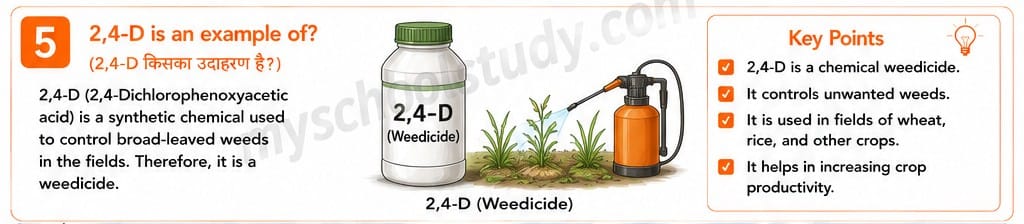
2,4-D is a chemical weedicide used to kill weeds in crop fields. Weedicides help farmers remove unwanted plants without damaging the main crop.
Weeds compete with crops for water, nutrients, sunlight, and space. Spraying weedicides saves time and labor compared to manual weeding.
Step-by-Step Process of Using Weedicide
Step 1: Farmers identify weeds in the field.
Step 2: Weedicide solution is prepared in proper quantity.
Step 3: The solution is sprayed carefully on weeds.
Step 4: Weeds absorb the chemical and die slowly.
Step 5: Crops get more nutrients and grow properly.
Advantages of Weedicides
- Saves labor and time
- Removes weeds effectively
- Increases crop yield
- Useful for large farms
Precautions While Using Weedicides
- Use correct quantity
- Wear protective clothing
- Avoid spraying near water bodies
- Follow safety instructions carefully
Difference Between Fertilizer and Weedicide
Fertilizer
- Provides nutrients to crops
- Improves plant growth
Weedicide
- Kills unwanted weeds
- Protects crops from competition
Examples of Weedicides
- 2,4-D
- Atrazine
- Glyphosate
Key Points
- 2,4-D is a weedicide.
- Weedicides kill unwanted plants.
- Proper use improves crop production.
- Safety measures are important during spraying.
Additional Learning About Crop Production and Management
Main Steps in Crop Production
- Preparation of soil
- Sowing seeds
- Adding manure and fertilizers
- Irrigation
- Protection from weeds
- Harvesting
- Storage
These steps are essential for healthy crop production and better farming results.
Importance of Agriculture
Agriculture is important because:
- It provides food
- Gives employment
- Supplies raw materials
- Supports the economy
Farmers work hard throughout the year to grow healthy crops and ensure food supply.
Difference Between Manure and Fertilizer
Manure
- Natural substance
- Made from plant and animal waste
- Improves soil texture
Fertilizer
- Chemical substance
- Rich in nutrients like nitrogen and phosphorus
- Gives quick results
Importance of Soil in Farming
Healthy soil:
- Holds water
- Provides nutrients
- Supports root growth
- Increases crop production
Farmers protect soil fertility by using manure, crop rotation, and proper irrigation methods.
Easy Revision Points
- Irrigation means supplying water to crops regularly.
- Hoe is used for removing weeds.
- Rhizobium fixes atmospheric nitrogen.
- Storage protects grains from damage.
- 2,4-D is a weedicide used to kill weeds.
- Proper farming methods increase crop production.
- Nitrogen is essential for plant growth.
- Proper storage reduces food wastage.
Simple Summary
These questions are related to agriculture and crop management. Crops require water, nutrients, protection, and proper care for healthy growth. Irrigation provides water to plants. Hoe helps remove weeds. Rhizobium bacteria improve soil fertility by fixing nitrogen. Storage protects harvested grains from damage. Weedicides like 2,4-D remove unwanted plants and improve crop yield.
