

Welcome To My School Study
Learn about Mica production, Kesari newspaper, Lok Sabha, Shaft Mining, and First World War with detailed NCERT-based explanations and revision notes.
Do You Know
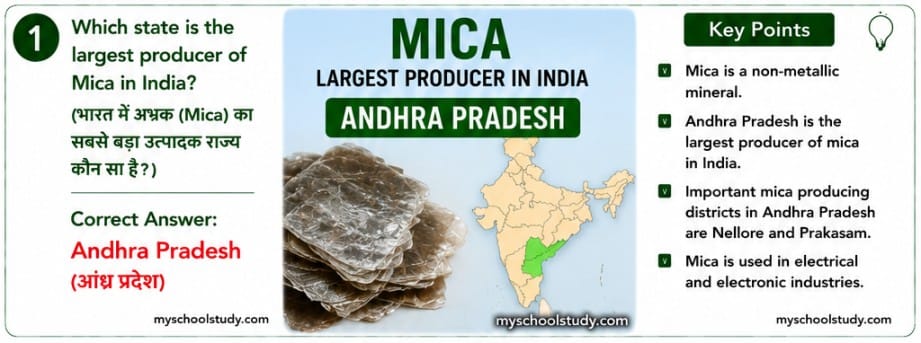
Q1. Which state is the largest producer of Mica in India?
Correct Answer: Andhra Pradesh
Detailed Explanation
Andhra Pradesh has traditionally been one of the leading producers of mica in India. Mica is a non-metallic mineral known for its excellent insulating properties and resistance to heat. It is widely used in electrical and electronic industries. India has long been recognized for its high-quality mica deposits.
Important NCERT Points
- Mica is a non-metallic mineral.
- It is used in electrical and electronic equipment.
- India possesses important mica reserves.
Exam-Oriented Fact
Mica can be split into very thin sheets, making it useful as an electrical insulator.
Quick Revision Line
Andhra Pradesh is an important producer of mica in India.
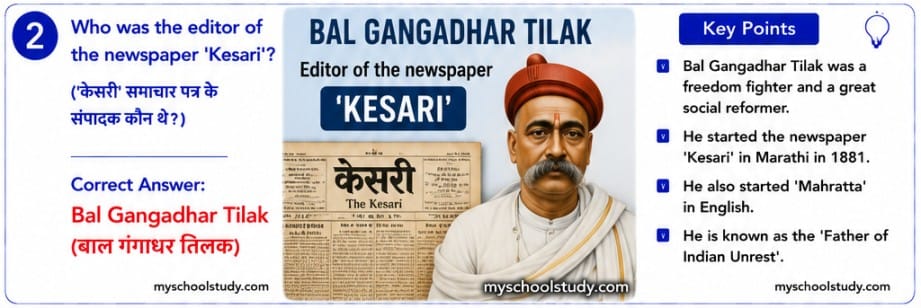
Q2. Who was the editor of the newspaper ‘Kesari’?
Correct Answer: Bal Gangadhar Tilak
Detailed Explanation
Bal Gangadhar Tilak edited the newspaper Kesari, which was published in Marathi. Through this newspaper, Tilak spread nationalist ideas and encouraged people to participate in the freedom movement. Kesari became an important medium for raising political awareness during British rule.
Important NCERT Points
- Kesari was a Marathi newspaper.
- Bal Gangadhar Tilak used it to promote nationalism.
- Newspapers played a major role in India’s freedom struggle.
Exam-Oriented Fact
Tilak is popularly known as the “Father of Indian Unrest.”
Quick Revision Line
Bal Gangadhar Tilak was the editor of the newspaper Kesari.
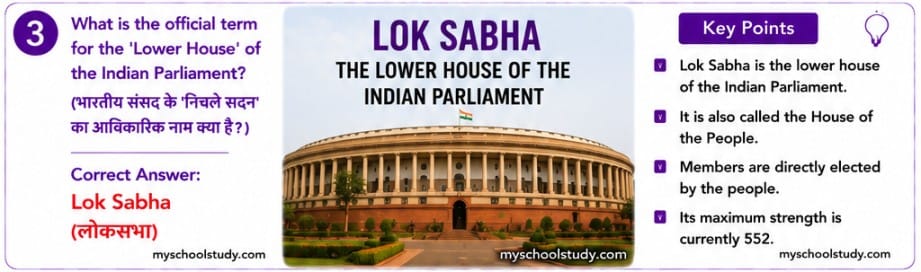
Q3. What is the official term for the ‘Lower House’ of the Indian Parliament?
Correct Answer: Lok Sabha
Detailed Explanation
The Lok Sabha is the Lower House of the Indian Parliament and represents the people of India. Members of the Lok Sabha are directly elected by citizens through general elections. It plays a crucial role in law-making, budget approval, and government accountability.
Important NCERT Points
- Lok Sabha is the House of the People.
- Members are directly elected by voters.
- It is an important part of India’s parliamentary system.
Exam-Oriented Fact
The maximum strength of the Lok Sabha is 552 members under the Constitution.
Quick Revision Line
Lok Sabha is the Lower House of the Indian Parliament.
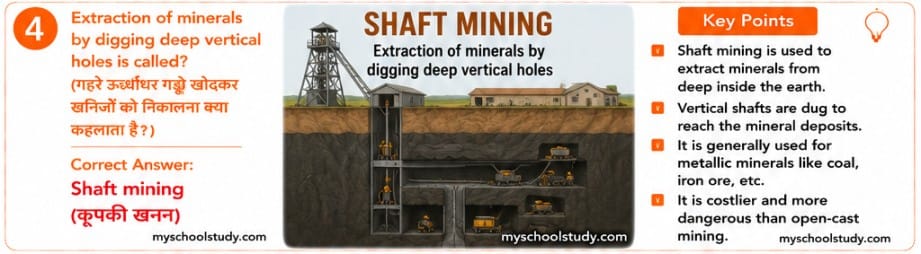
Q4. Extraction of minerals by digging deep vertical holes is called?
Correct Answer: Shaft mining
Detailed Explanation
Shaft mining is a method of extracting minerals found deep beneath the Earth’s surface. In this process, deep vertical shafts are dug to reach mineral deposits. It is commonly used when minerals are located too deep for open-cast mining. Proper safety measures are essential in shaft mining operations.
Important NCERT Points
- Shaft mining is used for deep mineral deposits.
- Vertical tunnels are constructed underground.
- It is different from open-cast mining.
Exam-Oriented Fact
Coal and certain metallic minerals are often extracted using shaft mining techniques.
Quick Revision Line
Shaft mining involves extracting minerals through deep vertical shafts.
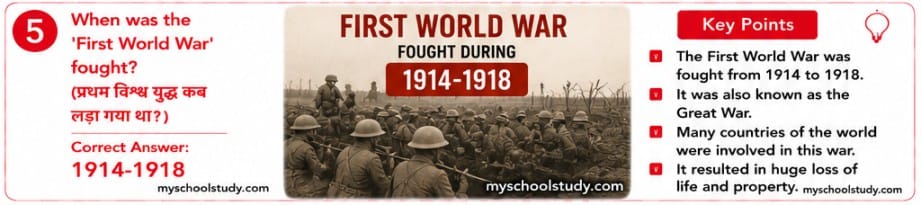
Q5. When was the ‘First World War’ fought?
Correct Answer: 1914–1918
Detailed Explanation
The First World War was fought between 1914 and 1918 and involved many countries from Europe and other parts of the world. The war began after the assassination of Archduke Franz Ferdinand of Austria. It caused massive destruction and led to significant political and economic changes worldwide.
Important NCERT Points
- World War I lasted from 1914 to 1918.
- It involved major world powers.
- The war reshaped international politics.
Exam-Oriented Fact
More than 1 million Indian soldiers served in various roles during World War I.
Quick Revision Line
The First World War was fought from 1914 to 1918.
One-Line Revision Sheet
- Andhra Pradesh is a major producer of mica in India.
- Bal Gangadhar Tilak edited the newspaper Kesari.
- Lok Sabha is the Lower House of Parliament.
- Shaft mining is used for deep underground minerals.
- The First World War was fought from 1914 to 1918.
Latest Posts
- Class 8 MCQ Questions Answers– History, Civics, Geography
- Class 9 MCQ Questions Answers– History, Geography, Civics
- Class 7 MCQ Questions Answers– Markets Around Us 10-6-26
- Class 10 SST MCQs with Detailed Black Soil, Sri Lanka
- Class 10 SST MCQs with Detailed Explanations 9-6-26
Join Our Other Communities