

Welcome To My School Study
Do You Know
1. Good Conductor of Electricity – Copper
A good conductor is a material that allows electric current to pass through it easily.

Why copper is a good conductor:
- It has free electrons that move easily
- It offers very low resistance to electric current
Other materials:
- Rubber, plastic, and wood are insulators (they do not allow current to pass)
Example:
Copper wires are used in household wiring and electrical devices.
2. Distilled Water – Poor Conductor
Pure or distilled water is a poor conductor of electricity.

Reason:
- It does not contain free ions (charged particles)
- Electricity needs ions to flow through a liquid
Important point:
- Normal tap water conducts electricity because it contains dissolved salts and minerals
Example:
Distilled water is used in batteries to avoid unwanted conduction.
3. Electroplating (Deposition of Metal Layer)
Electroplating is the process of depositing a thin layer of one metal on another material using electricity.

How it works:
- Electric current is passed through a solution
- Metal ions get deposited on the object
Why it is used:
- To prevent rusting
- To improve appearance (shine)
- To increase durability
Examples:
- Gold plating on jewelry
- Chromium plating on taps and car parts
4. LED (Light Emitting Diode)
LED is an electronic device that emits light when electric current passes through it.
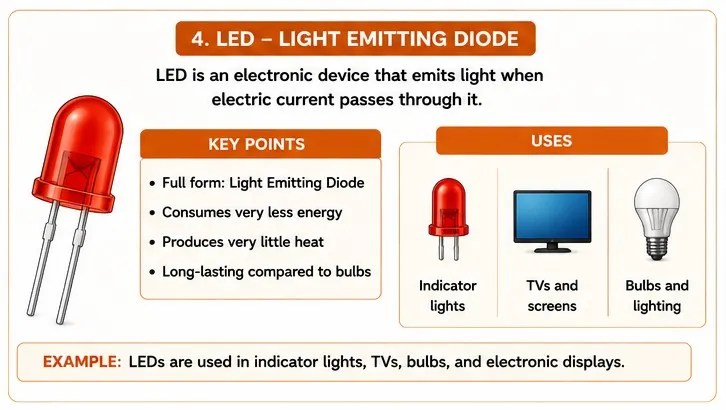
Full form: Light Emitting Diode
Features:
- Consumes very less energy
- Produces very little heat
- Long-lasting compared to bulbs
Uses:
- Indicator lights
- TVs, bulbs, and displays
5. Gas Formed at Anode – Oxygen
When electric current is passed through acidified water, it splits into gases.

Process: Electrolysis of water
At electrodes:
- Cathode (negative terminal) → Hydrogen gas
- Anode (positive terminal) → Oxygen gas
Reason:
Water (H₂O) breaks into hydrogen and oxygen during electrolysis.
Example:
Used in experiments to demonstrate decomposition of water.

