
Class 8 Science MCQ | Earthquake, Electric Charges & Earthing

Earthquake, Electric Charges & Earthing

Earthquake, Electric Charges & Earthing

Welcome To My School Study

Practice Class 8 Science MCQ Questions with Answers based on NCERT concepts. Learn about earthquakes, magnitude, electric charges, attraction and repulsion of charges, charging by friction, and earthing with original explanations and exam-focused revision notes.

Quiz Class 8th Science 07-05-2026

Total 5 Question Included in this quiz

1 / 5

The process of transferring charge from a charged object to the earth is called?

(किसी आवेशित वस्तु से आवेश को पृथ्वी में भेजने की प्रक्रिया कहलाती है?)

2 / 5

Which of the following can be charged easily by friction?

(निम्नलिखित में से किसे घर्षण द्वारा आसानी से आवेशित किया जा सकता है?)

3 / 5

Like charges (e.g., positive and positive)?

(समान आवेश (जैसे धनात्मक और धनात्मक) क्या करते हैं?)

4 / 5

The power of an earthquake is expressed in terms of magnitude on a scale called?

(भूकंप की शक्ति के परिमाण को किस पैमाने पर व्यक्त किया जाता है?)

5 / 5

The sudden shaking or trembling of the earth is called?

(पृथ्वी के अचानक हिलने या कांपने को क्या कहते हैं?)

Your score is

The average score is 20%

0%

Chapter Information

Subject: Science
Class: 8
Topics: Some Natural Phenomena & Electric Charges
Question Type: Multiple Choice Questions (MCQs)
Difficulty Level: Easy to Moderate
Based On: NCERT Concepts


Introduction

Natural phenomena such as earthquakes can cause sudden changes in the Earth’s surface, while electric charges produce interesting effects such as attraction, repulsion, and sparks. Understanding these concepts helps students connect classroom science with events observed in everyday life.

This practice set covers important concepts related to earthquakes, electric charges, charging by friction, and earthing in a simple and exam-oriented manner.


What You Will Learn

✔ Earthquakes
✔ Magnitude of earthquakes
✔ Richter scale
✔ Like and unlike electric charges
✔ Charging by friction
✔ Earthing


Why This Topic Is Important?

Earthquakes and electrical phenomena are important parts of everyday science. Understanding how earthquakes are measured and how electric charges behave helps students answer conceptual questions in school examinations and develop a better understanding of natural and physical phenomena.


Exam Relevance

These questions are useful for:

✔ CBSE Exams
✔ State Board Exams
✔ School Tests
✔ Unit Tests
✔ Half-Yearly Exams
✔ Annual Exams
✔ Olympiad Preparation
✔ Scholarship Examinations


Q1. The sudden shaking or trembling of the Earth is called?

A) Flood

B) Cyclone

C) Tsunami

D) Earthquake

Answer

Earthquake

Concept

An earthquake is a sudden movement or shaking of the Earth’s surface caused by movements within the Earth’s crust.

Explanation

The Earth’s outer layer is made up of large sections that can move relative to one another. Sudden movements beneath the surface can release energy, producing vibrations that travel through the Earth. These vibrations may cause the ground to shake.

Exam Focus

Remember: Sudden shaking of the Earth’s surface → Earthquake


Q2. Like charges, such as positive and positive, do what?

A) No effect

B) Attract each other

C) Repel each other

D) None of these

Answer

Repel each other

Concept

Electric charges interact with one another through electric forces.

Explanation

Two charges of the same kind push each other away. Thus, two positive charges repel each other, and two negative charges also repel each other.

On the other hand, unlike charges attract each other.

Exam Focus

Remember:

Like charges → Repel

Unlike charges → Attract


Q3. The power of an earthquake is expressed in terms of magnitude on a scale called?

A) Decibel scale

B) Richter scale

C) Celsius scale

D) Newton scale

Answer

Richter scale

Concept

The magnitude of an earthquake indicates the amount of energy associated with the earthquake.

Explanation

The Richter scale is a commonly taught scale used to express the magnitude of earthquakes. A greater magnitude indicates a stronger earthquake.

Exam Focus

Remember:

Earthquake magnitude → Richter scale


Q4. Which of the following can be charged easily by friction?

A) A plastic scale
B) An inflated balloon
C) Both A and B
D) A copper rod

Answer

Both A and B

Concept

Certain insulating materials can acquire electric charge when they are rubbed against another material. This process is called charging by friction.

Explanation

Both a plastic scale and an inflated balloon can be charged by rubbing them with suitable materials.

When two different materials are rubbed together, some electrons may transfer from one material to the other. As a result, the objects can acquire electric charges.

Therefore:

  • Plastic scale → Can be charged by friction
  • Inflated balloon → Can be charged by friction

Hence, the correct answer is:

Both A and B

Exam Focus

Remember: A plastic scale and an inflated balloon are common examples of objects that can be charged by friction.


Q5. The process of transferring charge from a charged object to the Earth is called?

A) Earthing

B) Sparking

C) Lighting

D) Charging

Answer

Earthing

Concept

The Earth can receive excess electric charge from a charged object.

Explanation

Earthing is the process in which excess electric charge is transferred from a charged body to the Earth. It is an important safety measure used in electrical systems to reduce the risk associated with unwanted electric charge.

Exam Focus

Remember: Transfer of excess charge to Earth → Earthing


Important Concepts

1. Earthquake

An earthquake is the sudden shaking of the Earth’s surface caused by movements and disturbances beneath the Earth’s crust.


2. Earthquake Magnitude

Magnitude represents the strength or size of an earthquake.

Important term:

Richter scale → Earthquake magnitude


3. Electric Charges

There are two types of electric charges:

  • Positive charge
  • Negative charge

Their basic interaction is:

$$
\text{Like charges} \rightarrow \text{Repel}
$$

$$
\text{Unlike charges} \rightarrow \text{Attract}
$$


4. Charging by Friction

When certain materials are rubbed together, electrons may transfer from one material to another.

Examples include:

  • Rubbing a plastic scale with a suitable material.
  • Rubbing an inflated balloon against hair or cloth.

5. Earthing

Earthing provides a path through which excess electric charge can flow safely into the Earth.

It is widely used as an electrical safety measure.


Related Practice Questions

  1. What causes the shaking of the Earth during an earthquake?
  2. What happens when two negative charges are brought close together?
  3. What is meant by charging by friction?
  4. Why is earthing important for electrical safety?
  5. What is the difference between like and unlike electric charges?

Mini Quiz Challenge

Fill in the blanks:

  1. Like charges ______ each other.
  2. Unlike charges ______ each other.
  3. The sudden shaking of the Earth is called an ______.
  4. The magnitude of an earthquake is commonly expressed using the ______ scale.
  5. The transfer of excess electric charge to the Earth is called ______.

Exam Tips

✔ Remember the difference between attraction and repulsion.

✔ Learn the relationship: Like → Repel, Unlike → Attract.

✔ Do not confuse the Richter scale with the decibel scale.

✔ Revise examples of charging by friction.

✔ Remember that earthing is related to the safe transfer of excess electric charge to Earth.


Quick Revision Notes

✔ Sudden shaking of Earth → Earthquake

✔ Earthquake magnitude → Richter scale

✔ Like charges → Repel

✔ Unlike charges → Attract

✔ Plastic objects and balloons can be charged by friction.

✔ Transfer of excess charge to Earth → Earthing


Common Mistakes Students Make

❌ Thinking like charges attract each other.

❌ Confusing Richter scale with Celsius or decibel scales.

❌ Assuming every material behaves in exactly the same way when rubbed.

❌ Confusing earthing with charging.

❌ Forgetting that electric charges can be positive or negative.


Key Takeaways

  • Earthquakes cause sudden shaking of the Earth’s surface.
  • Earthquake magnitude is commonly expressed using the Richter scale in school-level study.
  • Like electric charges repel one another.
  • Unlike electric charges attract one another.
  • Some insulating objects can be charged through friction.
  • Earthing transfers excess electric charge safely to the Earth.

FAQs

1. What is an earthquake?

An earthquake is the sudden shaking or trembling of the Earth’s surface caused by disturbances beneath the Earth’s crust.

2. What happens between two like charges?

Like charges repel each other.

3. What happens between unlike charges?

Unlike charges attract each other.

4. What is charging by friction?

It is the process in which an object becomes electrically charged through rubbing, generally because electrons are transferred between materials.

5. What is earthing?

Earthing is the process of transferring excess electric charge from a charged object to the Earth.


Conclusion

The concepts of earthquakes and electric charges help students understand both natural phenomena and everyday electrical effects. Knowing how earthquake magnitude is represented, how electric charges interact, how objects can become charged by friction, and how earthing provides electrical safety makes these topics easier to understand and remember.


NCERT Reference

Book: NCERT Science Class 8

Relevant NCERT Topics: Some Natural Phenomena and Electric Current and Its Effects

Based On: NCERT Concepts and Class 8 Science Curriculum


1. Good Conductor of Electricity – Copper

A good conductor is a material that allows electric current to pass through it easily.

class 8.1good conductor of electricity, myschoolstudy.com

Why copper is a good conductor:

  • It has free electrons that move easily
  • It offers very low resistance to electric current

Other materials:

  • Rubber, plastic, and wood are insulators (they do not allow current to pass)

Example:
Copper wires are used in household wiring and electrical devices.


2. Distilled Water – Poor Conductor

Pure or distilled water is a poor conductor of electricity.

class 8.2 pure or distilled water is myschoolstudy.com

Reason:

  • It does not contain free ions (charged particles)
  • Electricity needs ions to flow through a liquid

Important point:

  • Normal tap water conducts electricity because it contains dissolved salts and minerals

Example:
Distilled water is used in batteries to avoid unwanted conduction.


3. Electroplating (Deposition of Metal Layer)

Electroplating is the process of depositing a thin layer of one metal on another material using electricity.

class 8.3 deposition of metal layer myschoolstudy.com

How it works:

  • Electric current is passed through a solution
  • Metal ions get deposited on the object

Why it is used:

  • To prevent rusting
  • To improve appearance (shine)
  • To increase durability

Examples:

  • Gold plating on jewelry
  • Chromium plating on taps and car parts

4. LED (Light Emitting Diode)

LED is an electronic device that emits light when electric current passes through it.
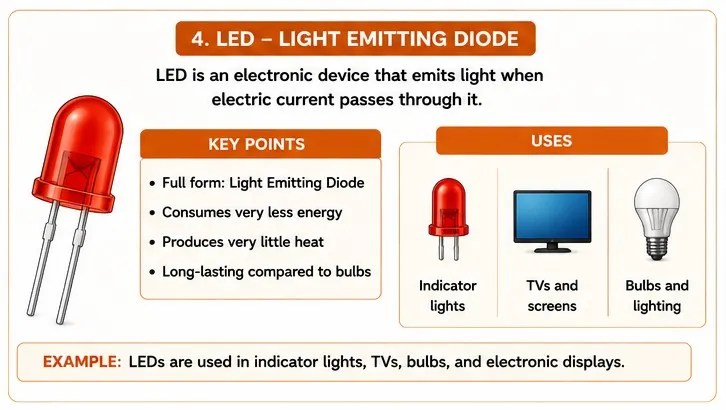
class 8.4 led, myschoolstudy.com

Full form: Light Emitting Diode

Features:

  • Consumes very less energy
  • Produces very little heat
  • Long-lasting compared to bulbs

Uses:

  • Indicator lights
  • TVs, bulbs, and displays

5. Gas Formed at Anode – Oxygen

When electric current is passed through acidified water, it splits into gases.

class 8.5 gas form at anode, myschoolstudy.com (1)

Process: Electrolysis of water

At electrodes:

  • Cathode (negative terminal) → Hydrogen gas
  • Anode (positive terminal) → Oxygen gas

Reason:
Water (H₂O) breaks into hydrogen and oxygen during electrolysis.

Example:
Used in experiments to demonstrate decomposition of water.


Related Links


Latest Post


Instagram , Youtube , Facebook


myschoolstudy.com-Thanks-for-visit

Leave a Comment

Your email address will not be published. Required fields are marked *

Scroll to Top