

Welcome To My School Study
Do You Know
Q1. Which of the following is a leading producer of Petroleum in India?
Comprehensive Description
Petroleum is one of the most important energy resources in India and plays a crucial role in transportation, industries, and economic development.
India produces petroleum from several important oil fields and offshore regions. Major petroleum-producing areas include:
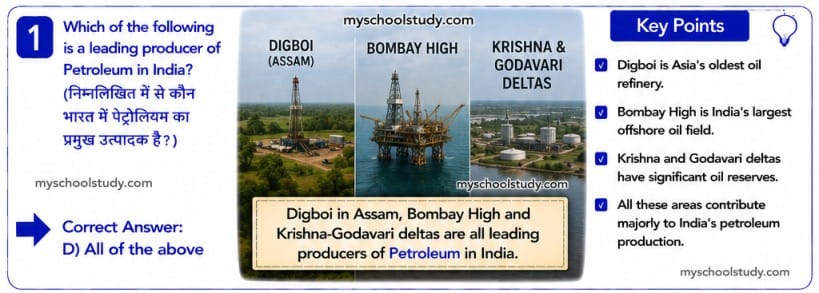
• Digboi in Assam
• Bombay High offshore oil field
• Krishna-Godavari Basin
• Gujarat oil fields
• Assam-Arakan Basin
Among these, Bombay High is one of India’s most significant petroleum-producing regions and has contributed greatly to domestic oil production.
Petroleum is often called:
• Black Gold
because of its high economic value and wide range of uses.
Petroleum is refined into products such as:
• Petrol
• Diesel
• Kerosene
• LPG
• Aviation fuel
• Lubricants
The discovery and development of petroleum resources have helped:
• Industrial growth
• Transportation development
• Energy security
• Employment generation
Since petroleum is a non-renewable resource, its conservation and efficient use are very important.
Features of Petroleum
• Non-renewable resource
• Major source of energy
• Used in industries and transport
• Refined into many useful products
Importance of Petroleum
• Supports economic growth
• Powers transportation systems
• Provides industrial fuel
• Generates government revenue
Options Analysis
A) Digboi in Assam
One of India’s oldest petroleum-producing regions.
B) Bombay High
Major offshore petroleum field.
C) Krishna and Godavari Deltas
Important petroleum and natural gas producing area.
D) All of the above
The Correct Answer. All are important petroleum-producing regions.
Key Points to Remember
• Petroleum is called Black Gold.
• Bombay High is a major oil-producing area.
• Digboi is one of India’s oldest oil fields.
• Krishna-Godavari Basin is important for oil and gas.
• Petroleum is a non-renewable resource.
Real-Life Importance
Petroleum fuels vehicles, industries, and transportation systems that support everyday life and economic activities.
Learning Enrichment
Students should understand:
• Energy resources of India
• Petroleum production regions
• Importance of energy security
• Conservation of non-renewable resources
Q2. Who was the leader of the ‘Salt Satyagraha’ in the South (Vedaranyam)?
Comprehensive Description
The Salt Satyagraha in South India, particularly the Vedaranyam March, was led by C. Rajagopalachari.
The movement was inspired by:
• Mahatma Gandhi’s Dandi March
The purpose of the movement was:
• To protest British salt laws
• To challenge colonial rule
• To encourage civil disobedience
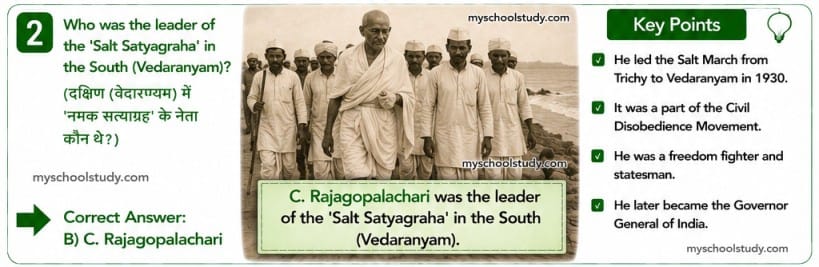
C. Rajagopalachari was a prominent freedom fighter, political leader, and close associate of Mahatma Gandhi.
The Vedaranyam Salt March took place in:
• Tamil Nadu
Participants marched to the coastal town of Vedaranyam and symbolically broke the British salt laws.
The movement demonstrated:
• National unity
• Non-violent resistance
• Public participation in the freedom struggle
The Salt Satyagraha became an important chapter in India’s independence movement because it involved ordinary citizens in political action.
Features of the Vedaranyam March
• Led by C. Rajagopalachari
• Inspired by Dandi March
• Based on non-violent protest
• Opposed British salt regulations
Importance of the Movement
• Spread nationalist ideas
• Encouraged public participation
• Challenged colonial policies
• Strengthened the freedom struggle
Options Analysis
A) K. Kelappan
Associated with similar activities in Kerala.
B) C. Rajagopalachari
The Correct Answer. Leader of the Vedaranyam Salt Satyagraha.
C) P. Sriramulu
Known for linguistic state movement.
D) Kamaraj
Prominent political leader of a later period.
Key Points to Remember
• Vedaranyam Salt March occurred in Tamil Nadu.
• Led by C. Rajagopalachari.
• Inspired by Gandhi’s Salt March.
• Part of the Civil Disobedience Movement.
• Challenged British salt laws.
Real-Life Importance
The movement highlights the power of peaceful protest in bringing social and political change.
Learning Enrichment
Students should understand:
• Regional participation in the freedom struggle
• Non-violent resistance methods
• Civil Disobedience Movement
• Contributions of national leaders
Q3. In India, who appoints the Chief Justice of the Supreme Court?
Comprehensive Description
The President of India appoints the Chief Justice of the Supreme Court.
The Supreme Court is:
• The highest judicial authority in India
• Guardian of the Constitution
• Protector of fundamental rights
The Chief Justice of India (CJI) is the head of:
• Supreme Court of India

The Chief Justice performs several important functions, including:
• Presiding over constitutional matters
• Supervising judicial administration
• Allocating cases to benches
• Upholding constitutional values
The appointment process aims to maintain:
• Judicial independence
• Fairness
• Rule of law
The Supreme Court plays a crucial role in:
• Interpreting the Constitution
• Resolving disputes
• Protecting citizens’ rights
Features of the Supreme Court
• Highest court in India
• Constitutional authority
• Independent judiciary
• Protects fundamental rights
Importance of the Chief Justice
• Leads the judiciary
• Protects constitutional principles
• Ensures justice delivery
• Strengthens democracy
Options Analysis
A) Prime Minister
Does not appoint the Chief Justice.
B) Vice-President
Not responsible for judicial appointments.
C) President
The Correct Answer. Appoints the Chief Justice of India.
D) Law Minister
Does not make the appointment.
Key Points to Remember
• President appoints the Chief Justice.
• Supreme Court is India’s highest court.
• Judiciary safeguards constitutional values.
• Chief Justice heads the Supreme Court.
• Judicial independence is essential for democracy.
Real-Life Importance
An independent judiciary helps protect citizens’ rights and ensures equal justice under the law.
Learning Enrichment
Students should understand:
• Structure of Indian judiciary
• Constitutional governance
• Separation of powers
• Importance of judicial independence
Q4. Which resources are derived from non-living things?
Comprehensive Description
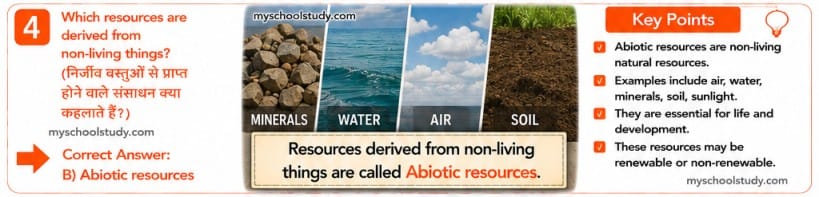
Resources obtained from non-living components of nature are known as Abiotic Resources.
The term “abiotic” means:
• Non-living
These resources come from physical elements found in nature, such as:
• Air
• Water
• Minerals
• Rocks
• Metals
• Sunlight
Abiotic resources are essential for:
• Agriculture
• Industry
• Transportation
• Energy production
Examples include:
• Iron ore
• Copper
• Gold
• Petroleum
• Natural gas
Some abiotic resources are renewable, while others are non-renewable.
Proper management of these resources is important because:
• Many are limited in quantity
• Overuse can create environmental problems
• Sustainable development requires conservation
Abiotic resources support almost every aspect of modern life and economic development.
Features of Abiotic Resources
• Derived from non-living things
• Essential for industry and development
• Include minerals and metals
• Available in nature
Importance of Abiotic Resources
• Support economic growth
• Provide raw materials
• Generate energy
• Aid infrastructure development
Options Analysis
A) Biotic Resources
Obtained from living organisms.
B) Abiotic Resources
The Correct Answer. Derived from non-living things.
C) Human Resources
Related to people’s skills and abilities.
D) Renewable Resources
Resource category, not based on living or non-living origin.
Key Points to Remember
• Abiotic means non-living.
• Includes minerals, water, and metals.
• Important for industries and infrastructure.
• Some are renewable, others non-renewable.
• Need sustainable management.
Real-Life Importance
Abiotic resources provide the raw materials needed for homes, roads, industries, and energy production.
Learning Enrichment
Students should understand:
• Classification of resources
• Natural resource management
• Sustainable development
• Environmental conservation
Q5. The ‘Indian National Anthem’ was written by?
Comprehensive Description
The Indian National Anthem, “Jana Gana Mana,” was written by Rabindranath Tagore.
Rabindranath Tagore was:
• Poet
• Philosopher
• Writer
• Educator
He was one of the most influential literary figures in Indian history.
The anthem reflects:
• National unity
• Cultural diversity
• Collective identity
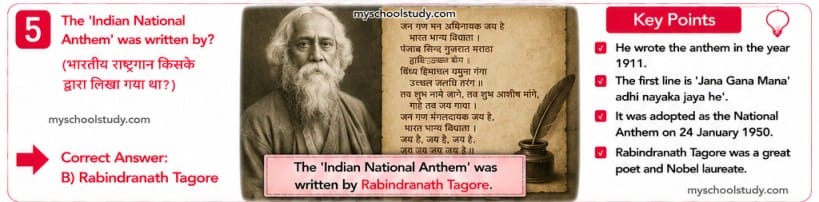
“Jana Gana Mana” was later adopted as the National Anthem of India and is sung on important national occasions.
The anthem represents:
• Patriotism
• Respect for the nation
• Unity in diversity
Rabindranath Tagore also made significant contributions to:
• Literature
• Education
• Music
• Social thought
He became the first Asian recipient of the Nobel Prize in Literature.
The National Anthem remains an important symbol of India’s sovereignty and democratic values.
Features of the National Anthem
• Written by Rabindranath Tagore
• Symbol of national unity
• Sung during national ceremonies
• Reflects India’s diversity
Importance of the National Anthem
• Promotes patriotism
• Strengthens national identity
• Represents unity and respect
• Symbolizes sovereignty
Options Analysis
A) Bankim Chandra Chattopadhyay
Associated with “Vande Mataram.”
B) Rabindranath Tagore
The Correct Answer. Author of the Indian National Anthem.
C) Sarojini Naidu
Prominent poet and freedom fighter.
D) Subhash Chandra Bose
Nationalist leader, not the author.
Key Points to Remember
• “Jana Gana Mana” was written by Rabindranath Tagore.
• It is India’s National Anthem.
• Represents national unity and diversity.
• Sung during official national functions.
• Tagore was a Nobel Prize-winning writer.
Real-Life Importance
The National Anthem inspires a sense of unity, respect, and national pride among citizens.
Related Links
- Quiz Class 8th Social Science 29-05-2026
- Quiz Class 8th Social Science ncert MCQs 24-05-2026
- Quiz Class 8th Social Science ncert MCQs 23-05-2026
- Quiz Class 8th Social Science ncert MCQs 22-05-2026
- Quiz Class 8th Social Science ncert MCQs 21-05-2026
