
Welcome To My School Study
Class 9 Social Science NCERT-based quiz explanations with detailed answers, important points, exam facts, and quick revision notes for students.
Do You Know
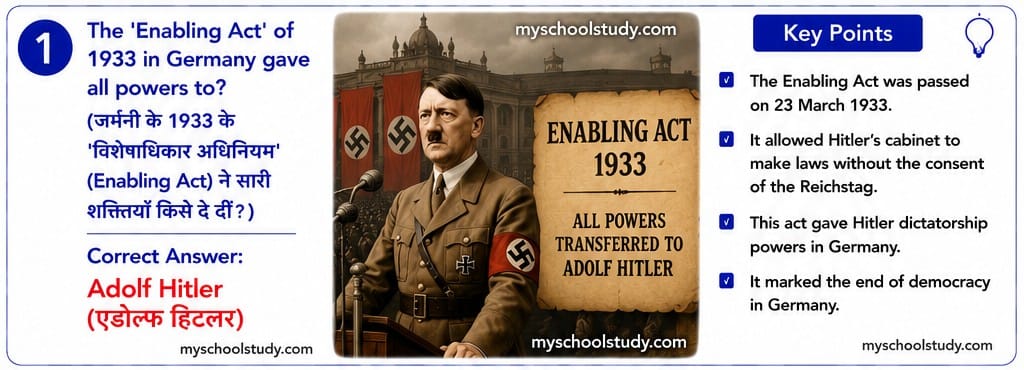
Q1. The ‘Enabling Act’ of 1933 in Germany gave all powers to?
Correct Answer: Adolf Hitler
Detailed Explanation
The Enabling Act was passed in Germany in March 1933. This law allowed Adolf Hitler and his cabinet to make laws without seeking approval from Parliament. It significantly increased Hitler’s authority and weakened democratic institutions. The Act became a major step in establishing Nazi dictatorship in Germany.
Important NCERT Points
- Passed in March 1933.
- Strengthened Hitler’s authority.
- Reduced the role of Parliament.
- Helped establish Nazi dictatorship.
Exam-Oriented Fact
The Enabling Act is often regarded as the legal basis of Hitler’s dictatorship.
Quick Revision Line
The Enabling Act (1933) gave Adolf Hitler extraordinary powers.
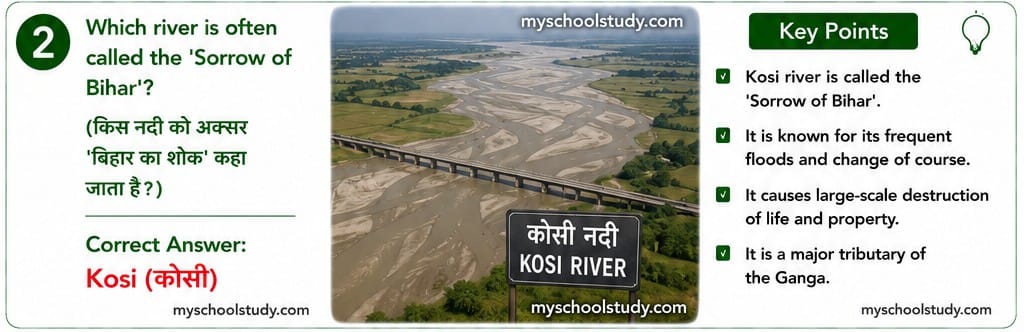
Q2. Which river is often called the ‘Sorrow of Bihar’?
Correct Answer: Kosi
Detailed Explanation
The Kosi River is known for its frequent floods and changing river channels. These floods cause extensive damage to crops, settlements, and infrastructure in Bihar. Due to its destructive impact, the river is popularly known as the “Sorrow of Bihar.” It is a major tributary of the Ganga River system.
Important NCERT Points
- A major Himalayan river.
- Causes severe flooding in Bihar.
- Carries a heavy silt load.
- Frequently changes its course.
Exam-Oriented Fact
The Kosi River is one of the most flood-prone rivers in India.
Quick Revision Line
Kosi River is called the ‘Sorrow of Bihar’ because of frequent floods.
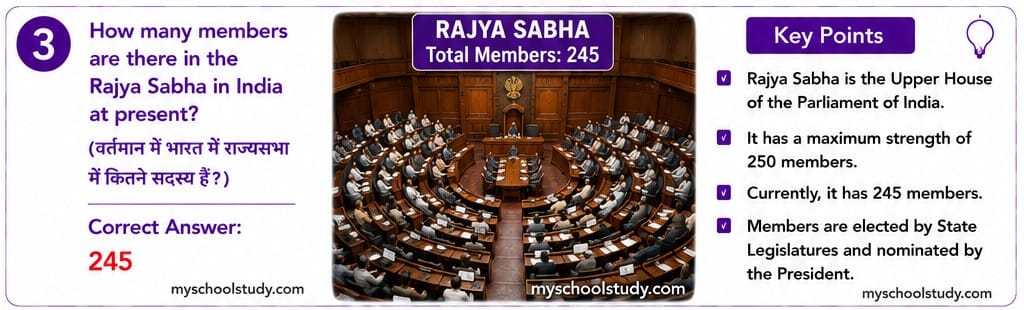
Q3. How many members are there in the Rajya Sabha in India at present?
Correct Answer: 245
Detailed Explanation
The Rajya Sabha is the Upper House of the Indian Parliament. At present, it has 245 members, including elected and nominated members. It represents the states and union territories of India. Rajya Sabha is a permanent body and is not dissolved like the Lok Sabha.
Important NCERT Points
- Known as the Council of States.
- Permanent House of Parliament.
- Members serve a six-year term.
- One-third members retire every two years.
Exam-Oriented Fact
The Constitution allows a maximum strength of 250 members in the Rajya Sabha.
Quick Revision Line
The present strength of the Rajya Sabha is 245 members.
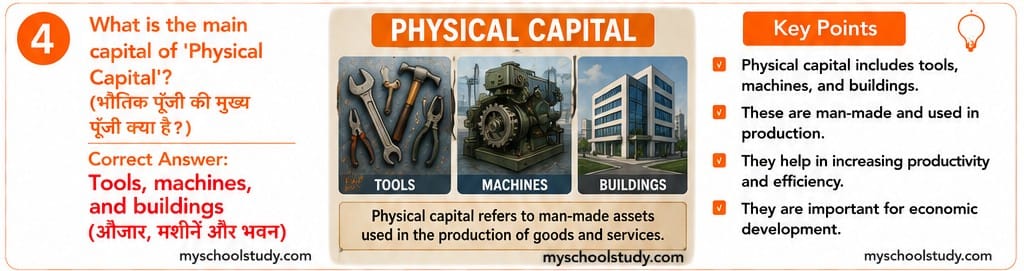
Q4. What is the main capital of ‘Physical Capital’?
Correct Answer: Tools, machines, and buildings
Detailed Explanation
Physical capital refers to the man-made resources used in the production of goods and services. It includes tools, machinery, equipment, buildings, and other infrastructure. These resources help improve productivity and support economic activities. Physical capital is different from human capital, which refers to knowledge and skills.
Important NCERT Points
- Used in production activities.
- Includes tools and machinery.
- Supports economic growth.
- Divided into fixed and working capital.
Exam-Oriented Fact
Physical capital is considered an important factor of production in economics.
Quick Revision Line
Tools, machines, and buildings are examples of physical capital.
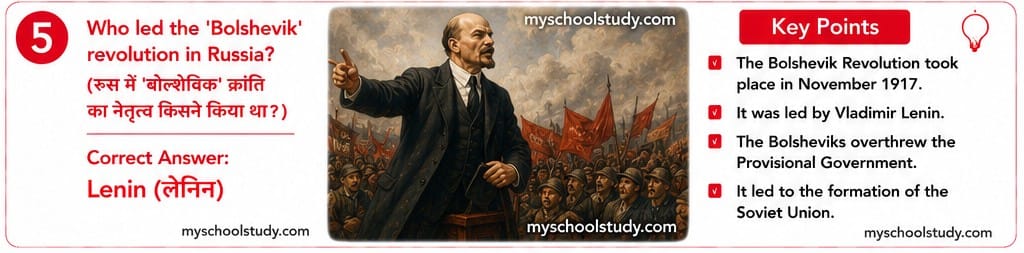
Q5. Who led the ‘Bolshevik’ revolution in Russia?
Correct Answer: Lenin
Detailed Explanation
The Bolshevik Revolution took place in Russia in 1917 under the leadership of Vladimir Lenin. The Bolsheviks overthrew the Provisional Government and established a socialist government. This revolution transformed Russia’s political and economic structure. It later led to the formation of the Soviet Union.
Important NCERT Points
- Also known as the October Revolution.
- Took place in 1917.
- Led by Vladimir Lenin.
- Established socialist rule in Russia.
Exam-Oriented Fact
The Bolshevik Revolution is one of the most important topics in Class 9 NCERT History.
Quick Revision Line
Lenin led the Bolshevik Revolution in Russia in 1917.
One-Line Revision Sheet
- The Enabling Act of 1933 gave Adolf Hitler extensive powers in Germany.
- Kosi River is called the “Sorrow of Bihar” because of its frequent floods.
- The present strength of the Rajya Sabha is 245 members.
- Physical capital includes tools, machines, and buildings used in production.
- Lenin led the Bolshevik Revolution in Russia in 1917.
Exam Tip
- Focus on important NCERT keywords such as Enabling Act, Kosi River, Rajya Sabha, Physical Capital, and Bolshevik Revolution.
- Read the Quick Revision Lines before examinations for rapid revision.
- These facts are frequently asked in MCQs, school tests, and competitive examinations.
Related Links
- Quiz Class 9th Social Science 02-06-2026
- Quiz Class 9th Social Science 01-06-2026
- Quiz Class 9th Social Science 29-05-2026
- Quiz Class 9th Social Science 26-05-2026
- Quiz Class 9th Social Science NCERT MCQs 22-05-2026
- Quiz Class 9th Social Science NCERT MCQs 21-05-2026
- Quiz Class 9th Social Science NCERT MCQs 20-05-2026
Latest Posts
- Class 8 MCQ Questions Answers– History, Civics, Geography
- Class 9 MCQ Questions Answers– History, Geography, Civics
- Class 7 MCQ Questions Answers– Markets Around Us 10-6-26
- Class 10 SST MCQs with Detailed Black Soil, Sri Lanka
- Class 10 SST MCQs with Detailed Explanations 9-6-26