
Welcome To My School Study
Class 8 Social Science MCQs with detailed explanations on Bauxite, Aligarh Movement, Parliament, Human-made Resources and Vernacular Press Act.
Do You Konw
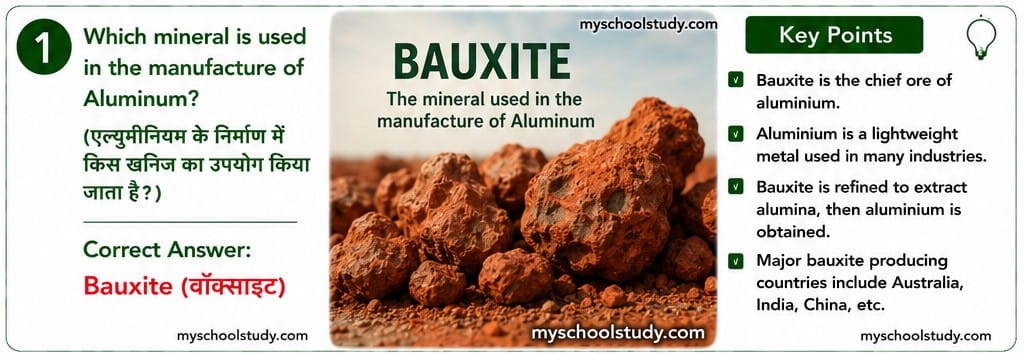
Q1. Which mineral is used in the manufacture of Aluminum?
Correct Answer: Bauxite
Detailed Explanation
Bauxite is the principal ore used for the production of aluminum. It is processed to extract alumina, which is then converted into aluminum metal. Due to its lightweight and corrosion-resistant properties, aluminum is widely used in transport, construction, and electrical industries.
Important NCERT Points
- Bauxite is the main ore of aluminum.
- Aluminum is a non-ferrous metal.
- It is lightweight and durable.
- India has significant reserves of bauxite.
Exam-Oriented Fact
Bauxite → Alumina → Aluminum is the basic production sequence often asked in exams.
Quick Revision Line
Bauxite is the chief mineral used for manufacturing aluminum.
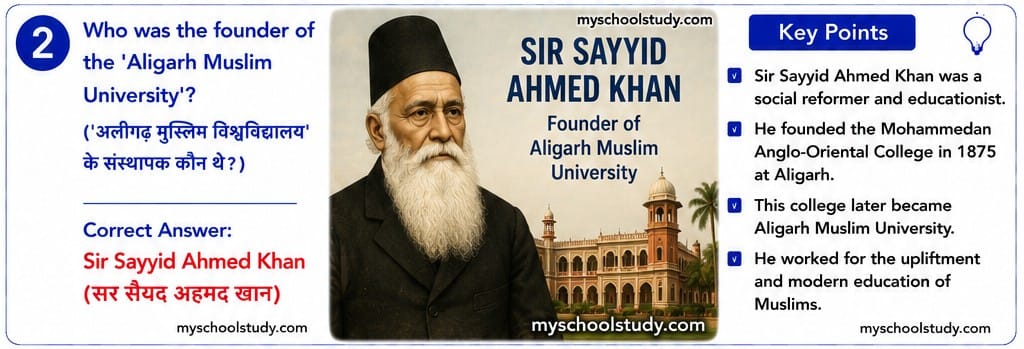
Q2. Who was the founder of the ‘Aligarh Muslim University’?
Correct Answer:Sir Sayyid Ahmed Khan
Detailed Explanation
Sir Sayyid Ahmed Khan was a social reformer and educationist who worked for the educational advancement of Muslims in India. He established the Muhammadan Anglo-Oriental College at Aligarh in 1875, which later developed into Aligarh Muslim University (AMU). His efforts promoted modern education and scientific thinking.
Important NCERT Points
- Sir Sayyid Ahmed Khan led the Aligarh Movement.
- He promoted modern education among Indian Muslims.
- The Muhammadan Anglo-Oriental College was founded in 1875.
- The institution later became Aligarh Muslim University.
Exam-Oriented Fact
The Aligarh Movement is closely associated with Sir Sayyid Ahmed Khan.
Quick Revision Line
Sir Sayyid Ahmed Khan founded the institution that later became AMU.
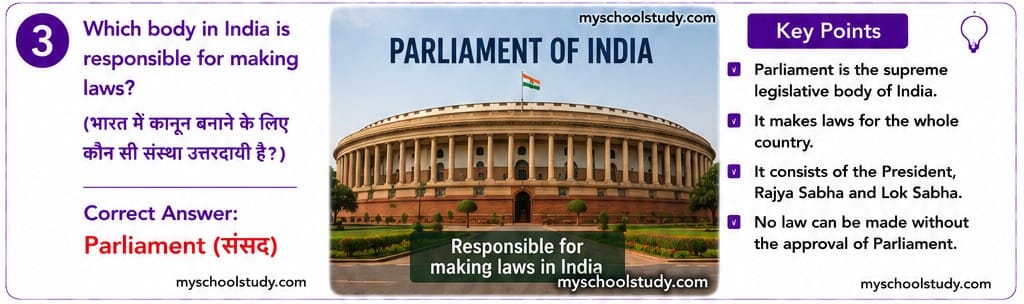
Q3. Which body in India is responsible for making laws?
Correct Answer: Parliament
Detailed Explanation
The Parliament of India is the supreme legislative body responsible for making laws for the country. It consists of the President, the Lok Sabha, and the Rajya Sabha. Bills are discussed, debated, and passed through Parliament before becoming laws.
Important NCERT Points
- Parliament is the legislative organ of the Union Government.
- It consists of Lok Sabha and Rajya Sabha.
- Laws are enacted through the parliamentary process.
- Parliament represents the people of India.
Exam-Oriented Fact
Legislature makes laws, Executive implements them, and Judiciary interprets them.
Quick Revision Line
The Parliament of India is responsible for making laws.
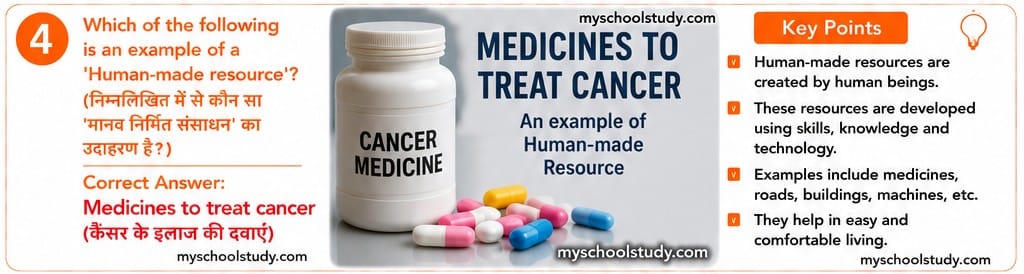
Q4. Which of the following is an example of a ‘Human-made resource’?
Correct Answer: Medicines to treat cancer
Detailed Explanation
Human-made resources are created by people using natural resources, knowledge, and technology. Medicines are developed through scientific research and manufacturing processes. Therefore, medicines used to treat diseases are considered human-made resources.
Important NCERT Points
- Human-made resources are created by humans.
- Technology and knowledge help in their creation.
- Buildings, roads, machines, and medicines are examples.
- Natural resources are transformed into useful products.
Exam-Oriented Fact
Natural resources + Human skill + Technology = Human-made resources.
Quick Revision Line
Medicines are examples of human-made resources.
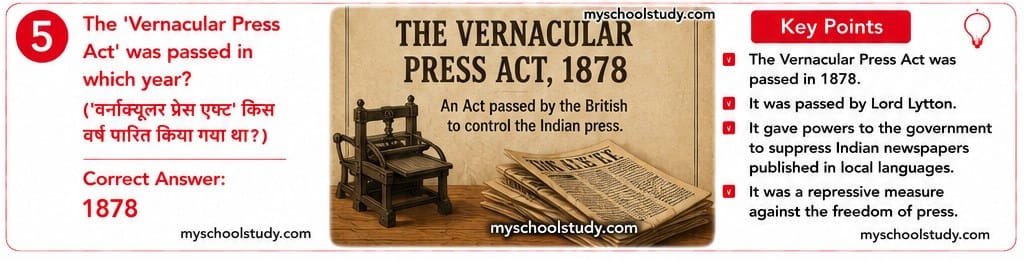
Q5. The ‘Vernacular Press Act’ was passed in which year?
Correct Answer: 1878
Detailed Explanation
The Vernacular Press Act was passed by the British government in 1878 to control newspapers published in Indian languages. The law aimed to suppress criticism of colonial policies. It became a symbol of restrictions on freedom of the press during British rule.
Important NCERT Points
- The Vernacular Press Act was enacted in 1878.
- It targeted newspapers published in Indian languages.
- The British government used it to control public opinion.
- The Act faced criticism from Indian nationalists.
Exam-Oriented Fact
Lord Lytton’s administration is associated with the Vernacular Press Act of 1878.
Quick Revision Line
The Vernacular Press Act was passed in 1878 to control the Indian-language press.
One-Line Revision Sheet
- Bauxite is the main ore used to manufacture aluminum.
- Sir Sayyid Ahmed Khan founded the institution that became AMU.
- The Parliament is responsible for making laws in India.
- Medicines are examples of human-made resources.
- The Vernacular Press Act was passed in 1878.
Related Links
- Quiz Class 8th Social Science 01-06-2026
- Quiz Class 8th Social Science 29-05-2026
- Quiz Class 8th Social Science ncert MCQs 24-05-2026
- Quiz Class 8th Social Science ncert MCQs 23-05-2026
- Quiz Class 8th Social Science ncert MCQs 22-05-2026
- Quiz Class 8th Social Science ncert MCQs 21-05-2026
Latest posts
- Class 8 MCQ Questions Answers– History, Civics, Geography
- Class 9 MCQ Questions Answers– History, Geography, Civics
- Class 7 MCQ Questions Answers– Markets Around Us 10-6-26
- Class 10 SST MCQs with Detailed Black Soil, Sri Lanka
- Class 10 SST MCQs with Detailed Explanations 9-6-26