

Welcome To My School Study
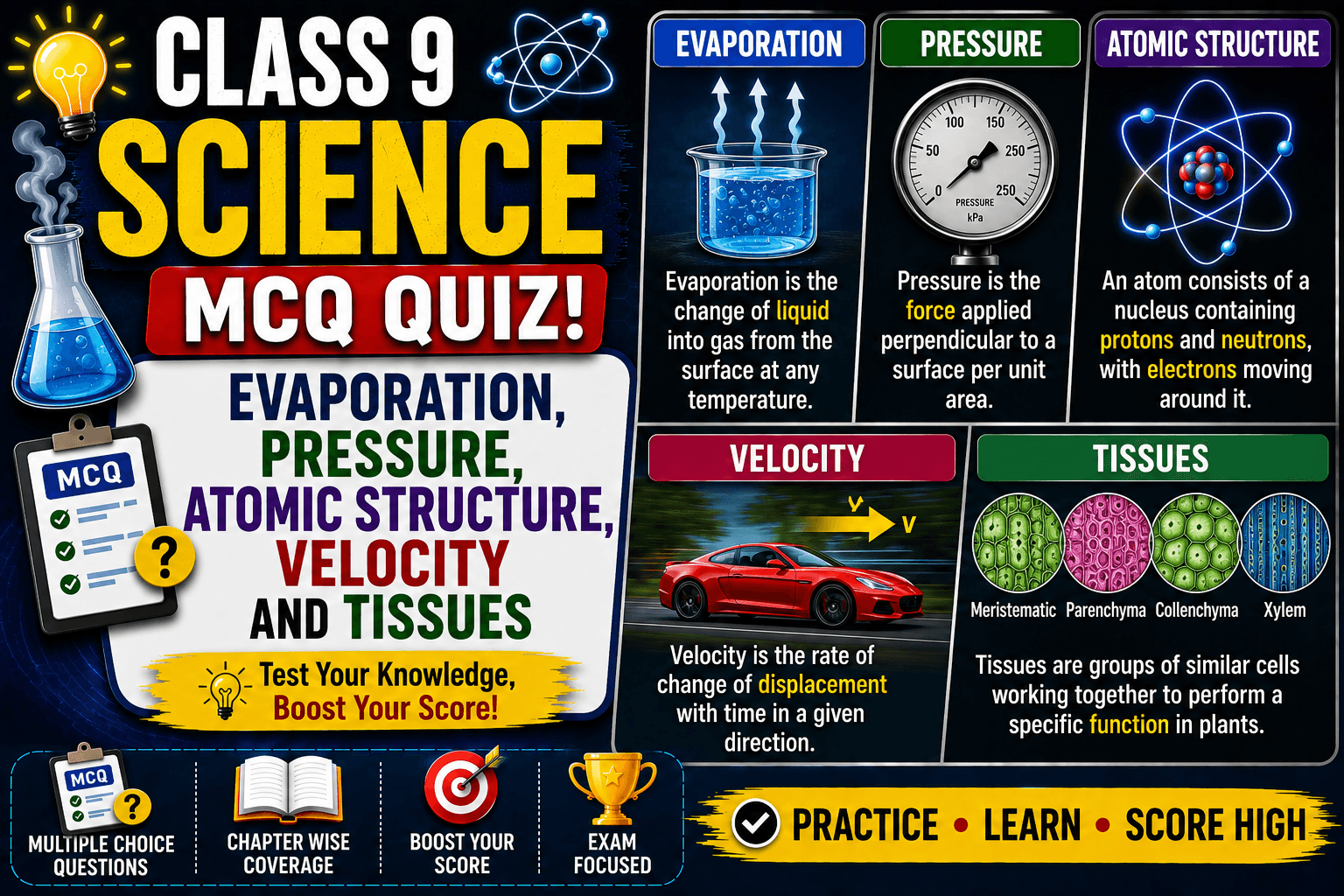
Practice Class 9 Science MCQs on evaporation, pressure, mass number, velocity, muscle tissue, matter, motion, atoms and tissues with detailed explanations, examples, NCERT facts and revision notes.
Do You Know
Q1. Evaporation causes:
Correct Answer: Cooling
Detailed Explanation:
Evaporation is the process in which a liquid changes into vapour from its surface at any temperature below its boiling point. During evaporation, the particles present at the surface of the liquid gain enough energy to escape into the air as vapour. Since the higher-energy particles leave first, the average energy of the remaining liquid decreases. As a result, the temperature of the liquid falls and a cooling effect is produced.
Evaporation is a very common phenomenon that we observe in our daily lives. It occurs continuously whenever a liquid is exposed to the atmosphere. The rate of evaporation depends on factors such as temperature, surface area, humidity, and wind speed. Higher temperatures increase evaporation because particles gain more kinetic energy. A larger surface area exposes more particles to the air, leading to faster evaporation. Low humidity and strong winds also increase the rate of evaporation.
The cooling effect of evaporation plays an important role in nature and in human life. Living organisms use evaporation to regulate body temperature. For example, sweating helps cool the body during hot weather because the sweat evaporates from the skin surface and carries away heat energy.
This concept is an important topic in the Class 9 NCERT chapter “Matter in Our Surroundings” and frequently appears in examinations.
Real-Life Examples:
- Sweat evaporating from the skin cools the body.
- Water kept in an earthen pot remains cool.
- Wet clothes dry due to evaporation.
- Perfume feels cool when sprayed on the skin.
Important NCERT Points:
- Evaporation occurs from the surface of a liquid.
- It can occur at any temperature.
- Evaporation causes cooling.
- Temperature, humidity, wind speed and surface area affect evaporation.
Exam-Oriented Fact:
The cooling effect during sweating is caused by evaporation.
Quick Revision Line:
Evaporation removes heat from a liquid and produces a cooling effect.
Q2. Unit of pressure:
Correct Answer: Pascal
Detailed Explanation:
Pressure is defined as the force acting per unit area of a surface. When a force is applied over a particular area, pressure is produced. The SI unit of pressure is Pascal (Pa), named after the French scientist Blaise Pascal.
Pressure is represented by the formula:
$$Pressure = \frac{Force}{Area}$$
A pressure of one Pascal is produced when a force of one Newton acts on an area of one square metre.
Pressure plays an important role in many natural and technological processes. It helps explain how hydraulic machines work, why sharp knives cut easily, and why broad foundations are used for buildings. Pressure is inversely proportional to area, meaning that if the area decreases while force remains constant, pressure increases.
Atmospheric pressure is another important concept. The air surrounding Earth exerts pressure in all directions. Human beings do not feel this pressure because the pressure inside our bodies balances the atmospheric pressure outside.
Pressure is used in weather forecasting, engineering, medicine, aviation, and underwater exploration. Understanding pressure helps students connect scientific concepts with practical applications in daily life.
Real-Life Examples:
- Sharp needles pierce easily because they exert high pressure.
- School bags have broad straps to reduce pressure on shoulders.
- Hydraulic brakes work using pressure transmission.
- Building foundations are made wide to reduce pressure on the ground.
Important NCERT Points:
- Pressure = Force ÷ Area.
- SI unit of pressure is Pascal (Pa).
- Pressure increases when area decreases.
- Atmospheric air exerts pressure.
Exam-Oriented Fact:
1 Pascal = 1 Newton per square metre.
Quick Revision Line:
Pressure is force acting per unit area and its SI unit is Pascal.
Q3. Mass number =
Correct Answer: Protons + Neutrons
Detailed Explanation:
The mass number of an atom represents the total number of protons and neutrons present in its nucleus. It is one of the most important concepts in atomic structure because it helps identify different atoms and isotopes.
Atoms consist of three main subatomic particles: protons, neutrons, and electrons. Protons carry a positive charge, neutrons have no charge, and electrons carry a negative charge. Protons and neutrons are located in the nucleus, while electrons move around the nucleus.
The mass number is calculated using the formula:
$$Mass\ Number = Number\ of\ Protons + Number\ of\ Neutrons$$
Since electrons have very little mass compared to protons and neutrons, they are not included in the calculation of mass number.
For example, a carbon atom contains 6 protons and 6 neutrons. Therefore, its mass number is:
$$6 + 6 = 12$$
Different isotopes of the same element have the same number of protons but different numbers of neutrons. Therefore, isotopes have different mass numbers.
Understanding mass number helps scientists study atomic structure, radioactive elements, nuclear reactions, and chemical behavior.
Real-Life Examples:
- Carbon-12 has a mass number of 12.
- Carbon-14 has a mass number of 14.
- Medical isotopes are identified using mass numbers.
- Nuclear energy studies use mass number calculations.
Important NCERT Points:
- Mass number includes protons and neutrons.
- Electrons are not included.
- It is represented by A.
- Isotopes have different mass numbers.
Exam-Oriented Fact:
Atomic number = Number of protons, while Mass number = Protons + Neutrons.
Quick Revision Line:
Mass number is the total number of protons and neutrons in an atom.
Q4. Velocity is:
Correct Answer: Vector
Detailed Explanation:
Velocity is defined as the rate of change of displacement with time. Unlike speed, velocity includes both magnitude and direction. Because it has both magnitude and direction, velocity is classified as a vector quantity.
The formula for velocity is:
$$Velocity = \frac{Displacement}{Time}$$
Many students confuse speed and velocity. Speed tells us how fast an object moves, while velocity tells us both how fast and in which direction it moves.
For example, if a car moves at 60 km/h toward the north, its velocity is 60 km/h northward. If only “60 km/h” is given without direction, it represents speed, not velocity.
Velocity can change even when speed remains constant. If a vehicle moves around a circular track at constant speed, its direction continuously changes. Therefore, its velocity changes even though its speed remains the same.
Velocity is important in transportation, sports, aviation, and space science. Scientists use velocity to describe the motion of planets, satellites, rockets, and moving vehicles.
Real-Life Examples:
- A train moving east at 80 km/h has velocity.
- An airplane flying northward has velocity.
- A football changes velocity when its direction changes.
- Satellites orbit Earth with continuously changing velocity.
Important NCERT Points:
- Velocity is a vector quantity.
- It depends on displacement.
- Direction is essential in velocity.
- SI unit is metre per second (m/s).
Exam-Oriented Fact:
Speed is scalar, whereas velocity is vector.
Quick Revision Line:
Velocity is the displacement covered per unit time in a specific direction.
Q5. Heart is made of:
Correct Answer: Muscle Tissue
Detailed Explanation:
The human heart is primarily made of a special type of muscle tissue called cardiac muscle tissue. These muscles are responsible for the continuous contraction and relaxation of the heart throughout a person’s life.
Cardiac muscles are unique because they work automatically without conscious control. They contract rhythmically to pump blood to every part of the body. Unlike skeletal muscles, which become tired after prolonged activity, cardiac muscles can function continuously without fatigue under normal conditions.
The heart contains millions of cardiac muscle cells that work together to maintain blood circulation. These muscles receive oxygen and nutrients through coronary arteries and use energy to perform their pumping action.
The continuous pumping of the heart supplies oxygen, nutrients, hormones, and other essential substances to body tissues. At the same time, it removes carbon dioxide and waste products from cells.
A healthy heart is essential for maintaining life. Regular exercise, a balanced diet, and healthy habits help keep cardiac muscles strong and efficient.
The study of muscle tissues is an important part of the Class 9 Science chapter “Tissues.”
Real-Life Examples:
- The heart beats continuously day and night.
- Exercise strengthens cardiac muscles.
- Doctors monitor heart muscle activity using ECG machines.
- Blood circulation depends on cardiac muscle contractions.
Important NCERT Points:
- The heart contains cardiac muscle tissue.
- Cardiac muscles are involuntary.
- They contract rhythmically.
- They help pump blood throughout the body.
Exam-Oriented Fact:
Cardiac muscles are found only in the heart.
Quick Revision Line:
The heart is made of specialized cardiac muscle tissue that pumps blood continuously.
Related Links
- Class 9 Science: Boiling, Momentum, Electron, Speed and Parenchyma
- Class 9 Science MCQ Quiz: Force, Mole Concept, Motion and Plant Tissues
- Class 9 MCQ Questions Answers– History, Geography, Civics
- Class 9 SST MCQs with Detailed Explanations
Latest Posts
- NCERT Class 7 Maths Chapter 1 Integers,addition, subtraction
- Class 10 Maths Chapter-1 Real Numbers-Rational numbers-MCQ
- Class9 Maths- Number Systems, decimal expansion, exponents
- Class 8 Maths Chapter 1 Rational Numbers, multiplicative
- Class 10 Maths Chapter 1 Real Numbers MCQ Questions with Solutions
Join Our Other Communities
Instagram , Youtube , Facebook