

Welcome To My School Study
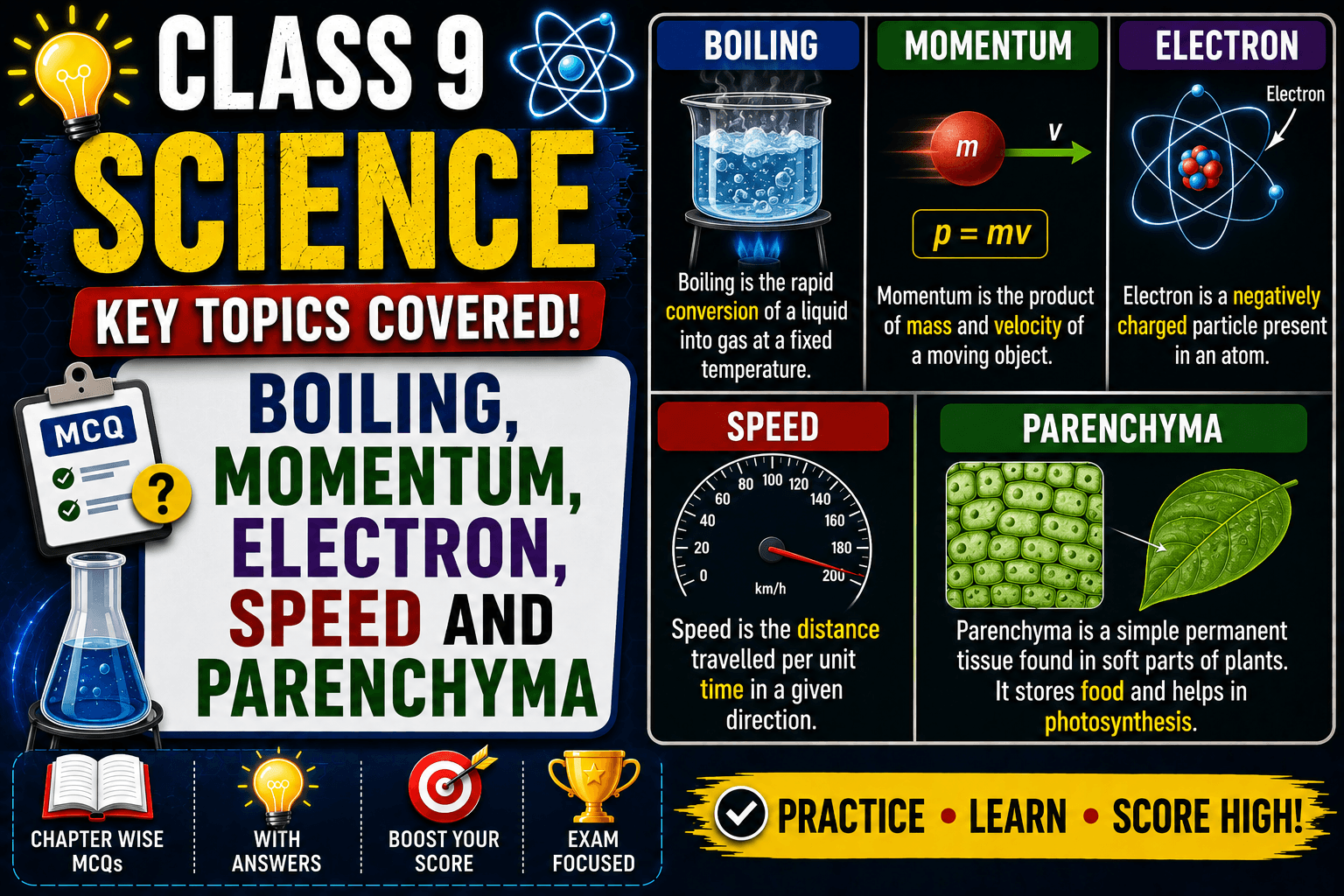
Practice Class 9 Science MCQs on boiling, momentum, electron charge, speed formula, parenchyma tissue, matter, motion and plant tissues with detailed explanations, real-life examples, NCERT concepts and exam-oriented facts.
Do You Know
Q1. Boiling is a:
Correct Answer: Bulk phenomenon
Detailed Explanation:
Boiling is a physical process in which a liquid changes into a gas throughout its entire volume. Unlike evaporation, which occurs only at the surface of a liquid, boiling takes place in every part of the liquid. Therefore, boiling is known as a bulk phenomenon.
When a liquid is heated, its particles gain kinetic energy and begin moving faster. As the temperature reaches the boiling point, the particles have enough energy to overcome the intermolecular forces that hold them together. At this stage, bubbles of vapor form inside the liquid and rise to the surface. This process continues until the liquid is converted into gas.
For water under normal atmospheric pressure, the boiling point is 100°C. However, the boiling point may change depending on atmospheric pressure. For example, at high altitudes where air pressure is lower, water boils at a temperature below 100°C.
Boiling is an important concept in daily life and industry. Cooking food, generating steam in power plants, sterilizing medical instruments, and producing distilled water all involve boiling. Since the entire liquid participates in the process, boiling happens much faster than evaporation.
Students often confuse boiling with evaporation. The key difference is that evaporation occurs only from the surface and can happen at any temperature, while boiling occurs throughout the liquid at a fixed boiling point.
Real-Life Examples:
- Water boiling in a kitchen utensil.
- Steam generation in thermal power plants.
- Boiling milk before consumption.
Important NCERT Points:
- Boiling is a bulk phenomenon.
- It occurs throughout the liquid.
- It takes place at a fixed temperature called the boiling point.
- Particles gain enough energy to change into vapor.
Exam-Oriented Fact:
Evaporation is a surface phenomenon, whereas boiling is a bulk phenomenon.
Quick Revision Line:
Boiling is the conversion of a liquid into vapor throughout the entire liquid.
Q2. SI unit of momentum:
Correct Answer: kg m/s
Detailed Explanation:
Momentum is the quantity of motion possessed by a moving object. It depends on both the mass and velocity of the object. A heavier object moving at the same speed as a lighter object will have greater momentum.
The formula for momentum is:
$$p = mv$$
where:
- (p) = momentum
- (m) = mass
- (v) = velocity
Since mass is measured in kilograms (kg) and velocity in meters per second (m/s), the SI unit of momentum becomes kg m/s.
Momentum is a vector quantity because it has both magnitude and direction. Any change in velocity causes a change in momentum. This concept is very important in understanding collisions, motion of vehicles, sports activities, and rocket launches.
According to Newton’s Second Law of Motion, the rate of change of momentum is directly proportional to the applied force. This relationship forms the basis of many engineering and scientific applications.
Objects moving at higher speeds possess greater momentum. Similarly, increasing the mass of an object also increases its momentum.
Real-Life Examples:
- A moving truck has more momentum than a bicycle.
- A cricket ball moving at high speed has significant momentum.
- Rockets gain momentum during launch.
Important NCERT Points:
- Momentum = Mass × Velocity.
- Momentum is a vector quantity.
- SI unit is kg m/s.
- Momentum depends on mass and velocity.
Exam-Oriented Fact:
A stationary object has zero momentum because its velocity is zero.
Quick Revision Line:
Momentum is the product of mass and velocity.
Q3. Electron charge:
Correct Answer: Negative
Detailed Explanation:
The electron is one of the three fundamental subatomic particles present in an atom. The other two are protons and neutrons. Electrons carry a negative electric charge, which is equal in magnitude but opposite in sign to the positive charge carried by protons.
The discovery of the electron was made by J. J. Thomson through cathode ray experiments. This discovery revolutionized the understanding of atomic structure and led to the development of modern atomic theory.
Electrons revolve around the nucleus of an atom in different energy levels or shells. The movement and arrangement of electrons determine many properties of elements, including chemical reactivity and electrical conductivity.
The charge on one electron is approximately:
$$-1.6 \times 10^{-19} , C$$
where C represents coulomb, the SI unit of electric charge.
In a neutral atom, the number of electrons equals the number of protons. If an atom gains or loses electrons, it becomes an ion.
Electrons play a major role in electricity. Electric current in conductors is produced due to the movement of electrons from one point to another.
Real-Life Examples:
- Electric current in wires is due to moving electrons.
- Batteries create electron flow in circuits.
- Electronic devices work because of electron movement.
Important NCERT Points:
- Electron carries a negative charge.
- It was discovered by J. J. Thomson.
- Electrons are present outside the nucleus.
- Their movement causes electric current.
Exam-Oriented Fact:
The electron is the lightest charged particle in an atom.
Quick Revision Line:
Electrons are negatively charged particles present around the nucleus.
Q4. Speed formula:
Correct Answer: Distance/Time
Detailed Explanation:
Speed is the distance traveled by an object in a given amount of time. It is one of the most basic concepts in motion and helps describe how fast an object moves.
The formula for speed is:
$$\text{Speed} = \frac{\text{Distance}}{\text{Time}}$$
This means speed is calculated by dividing the total distance traveled by the total time taken.
The SI unit of speed is meter per second (m/s). In daily life, speed is often expressed in kilometers per hour (km/h).
Speed is a scalar quantity because it has only magnitude and no direction. When direction is included along with speed, the quantity is called velocity.
Understanding speed helps us compare different motions. Faster objects cover more distance in less time, while slower objects cover less distance in the same period.
Speed calculations are widely used in transportation, sports, navigation, and scientific experiments.
Real-Life Examples:
- A car traveling at 60 km/h.
- A runner completing a race.
- An airplane covering long distances quickly.
Important NCERT Points:
- Speed = Distance ÷ Time.
- SI unit is m/s.
- Speed is a scalar quantity.
- Higher speed means faster motion.
Exam-Oriented Fact:
Average speed is equal to total distance divided by total time.
Quick Revision Line:
Speed tells us how much distance is covered in a unit time.
Q5. Parenchyma stores:
Correct Answer: All of these
Detailed Explanation:
Parenchyma is one of the most common types of simple permanent tissue found in plants. It consists of living cells with thin cell walls and is present in roots, stems, leaves, fruits, and seeds.
Parenchyma performs several important functions. One of its primary functions is storage. These cells can store food, water, and even air depending on their location and specialization.
In many fruits and vegetables, parenchyma cells store starch, sugars, and other nutrients. In desert plants, specialized parenchyma tissues store water, helping plants survive in dry conditions. Some aquatic plants contain large air spaces in parenchyma tissues called aerenchyma, which help them float.
Parenchyma also participates in photosynthesis when chloroplasts are present. Such tissues are called chlorenchyma. In addition, parenchyma helps in wound healing and regeneration of plant tissues.
Because of its versatility, parenchyma is considered one of the most important plant tissues studied in Class 9 Science.
Real-Life Examples:
- Potato stores food in parenchyma tissue.
- Cactus stores water in specialized parenchyma cells.
- Aquatic plants store air in aerenchyma.
Important NCERT Points:
- Parenchyma consists of living cells.
- It stores food, water, and air.
- It may perform photosynthesis.
- It is widely distributed in plant parts.
Exam-Oriented Fact:
Aerenchyma is a specialized parenchyma tissue that contains large air spaces.
Quick Revision Line:
Parenchyma is a living plant tissue that stores food, water, and air.
Related Links
- Class 9 Science MCQ Quiz: Force, Mole Concept, Motion and Plant Tissues
- Class 9 MCQ Questions Answers– History, Geography, Civics
- Class 9 SST MCQs with Detailed Explanations
Latest Posts
- NCERT Class 7 Maths Chapter 1 Integers,addition, subtraction
- Class 10 Maths Chapter-1 Real Numbers-Rational numbers-MCQ
- Class9 Maths- Number Systems, decimal expansion, exponents
- Class 8 Maths Chapter 1 Rational Numbers, multiplicative
- Class 10 Maths Chapter 1 Real Numbers MCQ Questions with Solutions
Join Our Other Communities