
Welcome To My School Study
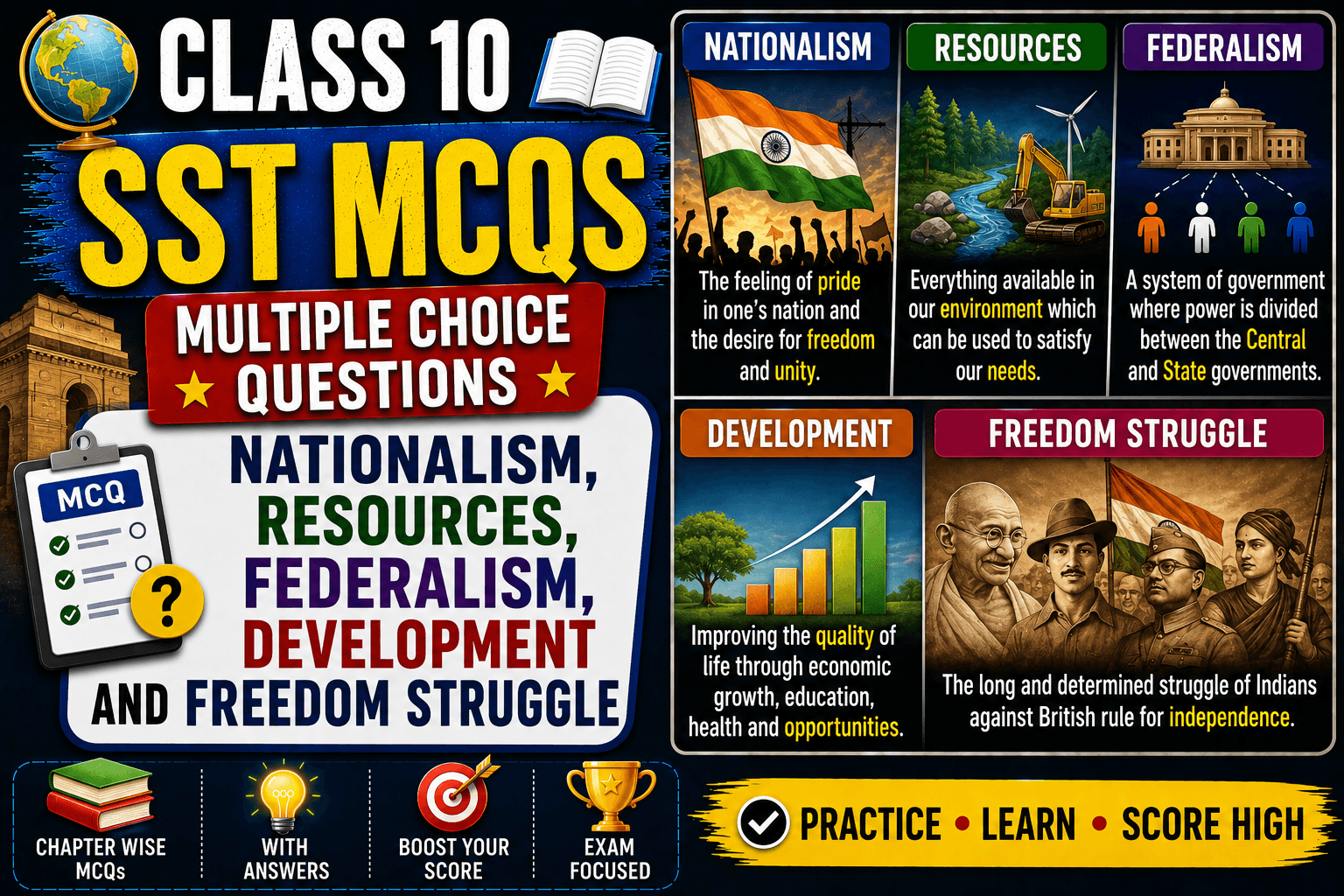
Practice Class 10 Social Science MCQs on Bharat Mata, solar energy, concurrent list, HDI, Simon Commission, nationalism in India, resources and development, federalism, development, and Indian freedom movement with detailed explanations.
Do You Know
Q1. Who painted the image of ‘Bharat Mata’ for the first time?
Correct Answer: Abanindranath Tagore
Detailed Explanation:
The famous image of Bharat Mata was first painted by Abanindranath Tagore in 1905 during the period of the Swadeshi Movement. This painting became an important symbol of Indian nationalism and inspired people during the struggle against British rule.
In the painting, Bharat Mata is depicted as a calm and spiritual woman dressed in saffron-colored clothing. She is shown with four hands, each holding symbolic objects such as a book, sheaves of paddy, a piece of white cloth, and a garland. These objects represented knowledge, food, clothing, and spiritual strength.
The image was not intended to represent a goddess in the traditional religious sense alone. Instead, it symbolized the nation as a mother who nurtures and cares for her children. Nationalist leaders and artists used such symbols to unite people from different regions, languages, and communities under a common national identity.
The Bharat Mata image played a significant role in creating patriotic feelings among Indians. It encouraged people to think of India as a united nation rather than a collection of separate provinces and kingdoms.
Art and literature became powerful tools during the freedom struggle. Through paintings, songs, poems, and stories, nationalist ideas spread to a larger audience. Abanindranath Tagore’s Bharat Mata became one of the most recognized symbols of India’s nationalist movement.
This topic is important in Class 10 History because it explains how cultural symbols contributed to the growth of nationalism in India.
Real-Life Examples:
- Bharat Mata images were used during nationalist meetings.
- Patriotic posters often featured Bharat Mata.
- Freedom fighters used national symbols to inspire unity.
Important NCERT Points:
- Painted by Abanindranath Tagore in 1905.
- Associated with the Swadeshi Movement.
- Symbolized India as a mother figure.
- Promoted national unity and patriotism.
Exam-Oriented Fact:
The Bharat Mata painting became a powerful symbol of Indian nationalism.
Quick Revision Line:
Abanindranath Tagore painted the first famous image of Bharat Mata.
Q2. Which type of resource is ‘Solar Energy’?
Correct Answer: Renewable/Replenishable
Detailed Explanation:
Solar energy is classified as a renewable or replenishable resource because it is continuously supplied by the Sun and does not get exhausted through human use. Unlike fossil fuels such as coal and petroleum, solar energy can be used repeatedly without significantly reducing its availability.
The Sun releases enormous amounts of energy every day. Only a small fraction of this energy reaches Earth, but it is sufficient to meet global energy needs many times over. Solar panels and solar cells are used to capture sunlight and convert it into electricity.
Renewable resources are important because they help reduce dependence on non-renewable resources. Fossil fuels take millions of years to form and can eventually run out. In contrast, solar energy is naturally replenished and available almost everywhere.
Solar energy is also environmentally friendly. It produces electricity without releasing harmful pollutants or greenhouse gases. Therefore, it plays a significant role in reducing air pollution and combating climate change.
Many countries, including India, are investing heavily in solar power projects. Solar street lights, solar water heaters, solar cookers, and rooftop solar panels are becoming increasingly common.
The use of renewable energy supports sustainable development because it meets present needs without compromising the ability of future generations to meet their own needs.
Understanding renewable resources is essential for learning about environmental conservation and responsible resource management.
Real-Life Examples:
- Solar panels installed on rooftops.
- Solar-powered street lights.
- Solar water heating systems.
Important NCERT Points:
- Solar energy is renewable.
- It is environmentally friendly.
- It reduces dependence on fossil fuels.
- Supports sustainable development.
Exam-Oriented Fact:
Solar energy is one of the most widely used renewable energy resources.
Quick Revision Line:
Solar energy is a renewable resource because it is continuously supplied by the Sun.
Q3. Which list contains subjects like ‘Marriage’ and ‘Adoption’?
Correct Answer: Concurrent List
Detailed Explanation:
India follows a federal system of government in which powers are divided between the Union Government and the State Governments. To clearly define these powers, the Constitution provides three lists: the Union List, State List, and Concurrent List.
The Concurrent List contains subjects on which both the Central Government and State Governments can make laws. Matters such as marriage, adoption, education, forests, trade unions, and criminal law are included in this list.
The purpose of the Concurrent List is to allow cooperation between the Centre and the States on issues that affect the entire nation as well as individual states. This ensures uniformity while also giving states flexibility in implementation.
If a conflict arises between a law made by Parliament and a law made by a State Legislature on a Concurrent List subject, the law made by Parliament generally prevails.
The Concurrent List is an important feature of Indian federalism because it promotes coordination and shared responsibility. It helps maintain national unity while preserving the federal structure.
Subjects like marriage and adoption often require common legal standards throughout the country. Therefore, they are placed in the Concurrent List instead of being assigned exclusively to either the Centre or the States.
Understanding these constitutional lists is essential for learning how power is distributed in India.
Real-Life Examples:
- Marriage laws applicable across India.
- Adoption regulations.
- Educational policies implemented by both Centre and States.
Important NCERT Points:
- Concurrent List allows both Centre and States to legislate.
- Marriage and adoption are included in this list.
- Promotes cooperative federalism.
- Parliamentary law prevails during conflicts.
Exam-Oriented Fact:
The Concurrent List contains subjects of common national and state importance.
Quick Revision Line:
Marriage and adoption are subjects included in the Concurrent List.
Q4. What is ‘Human Development Index’ (HDI) based on?
Correct Answer: Health, Education, and Income
Detailed Explanation:
The Human Development Index (HDI) is a composite measure developed by the United Nations Development Programme (UNDP) to assess the overall development of countries. It goes beyond income and focuses on improving people’s quality of life.
HDI is based on three major dimensions:
- Health – measured through life expectancy at birth.
- Education – measured through years of schooling and literacy-related indicators.
- Income – measured through per capita income or Gross National Income per person.
The idea behind HDI is that development should not be judged only by economic growth. A country may have a high income but still face problems related to education and healthcare. Therefore, HDI provides a broader understanding of human well-being.
Countries with better healthcare systems, higher literacy rates, and higher standards of living generally achieve higher HDI rankings. Governments use HDI data to identify development gaps and improve public policies.
The concept emphasizes that people are the real wealth of a nation. Development should focus on expanding opportunities and improving living conditions rather than merely increasing national income.
In Class 10 Economics, HDI is an important indicator because it helps compare development levels among countries more effectively than income alone.
Real-Life Examples:
- Countries with high literacy often have higher HDI.
- Better healthcare improves life expectancy.
- Higher income supports better living standards.
Important NCERT Points:
- HDI was developed by UNDP.
- Measures overall human development.
- Based on health, education, and income.
- Provides a broader measure than income alone.
Exam-Oriented Fact:
HDI is widely used to compare development levels among countries.
Quick Revision Line:
HDI measures development using health, education, and income indicators.
Q5. The ‘Simon Commission’ was boycotted in India because?
Correct Answer: It had no Indian member
Detailed Explanation:
The Simon Commission was appointed by the British Government in 1927 to review the working of constitutional reforms introduced in India and suggest future political changes. The commission arrived in India in 1928.
The major reason for its boycott was that all seven members of the commission were British, and there was not a single Indian member included. Indians considered this deeply insulting because decisions regarding India’s future were being discussed without Indian representation.
Political leaders across the country strongly opposed the commission. Various political parties, including the Indian National Congress, organized protests and demonstrations. Wherever the commission went, people greeted it with black flags and the slogan “Simon Go Back.”
The boycott united many groups in the national movement and strengthened demands for self-government. The widespread opposition demonstrated that Indians wanted a greater role in determining their own political future.
During one such protest in Lahore, police brutally lathi-charged demonstrators, leading to serious injuries to Lala Lajpat Rai, who later died. His death further intensified anti-British sentiments across the country.
The Simon Commission became a turning point in India’s freedom struggle because it highlighted the growing demand for independence and democratic participation.
This topic is frequently asked in Class 10 History examinations and is an important part of the chapter on Nationalism in India.
Real-Life Examples:
- Nationwide “Simon Go Back” protests.
- Black flag demonstrations across India.
- Increased participation in the freedom movement.
Important NCERT Points:
- Appointed in 1927 by the British Government.
- Arrived in India in 1928.
- Contained no Indian member.
- Faced nationwide boycott and protests.
Exam-Oriented Fact:
The absence of Indian members was the primary reason for the boycott of the Simon Commission.
Quick Revision Line:
The Simon Commission was boycotted because it did not include any Indian member.
Chapter Summary:
Abanindranath Tagore’s Bharat Mata painting became a symbol of Indian nationalism. Solar energy is a renewable resource that supports sustainable development. Marriage and adoption are subjects in the Concurrent List under India’s federal system. HDI measures development using health, education, and income indicators. The Simon Commission was boycotted because it had no Indian members, making it a significant event in India’s freedom struggle. These topics are important for Class 10 Social Science examinations and competitive tests.
Related links
- Class 10 Science MCQs with Answers | Biology & Physics
- Class 10 SST MCQs with Answers | Federalism & Freedom
- Class 10 SST MCQs with Detailed Black Soil, Sri Lanka
- Quiz Class 10th Social Science NCERT 26-05-2026
- Quiz Class 10th Social Science, NCERT MCQs 23-05-2026
- Quiz Class 10th Social Science, NCERT MCQs , 22-05-2026
Latest Posts
- NCERT Class 7 Maths Chapter 1 Integers,addition, subtraction
- Class 10 Maths Chapter-1 Real Numbers-Rational numbers-MCQ
- Class9 Maths- Number Systems, decimal expansion, exponents
- Class 8 Maths Chapter 1 Rational Numbers, multiplicative
- Class 10 Maths Chapter 1 Real Numbers MCQ Questions with Solutions
Join Our Other Communities