

Welcome To My School Study
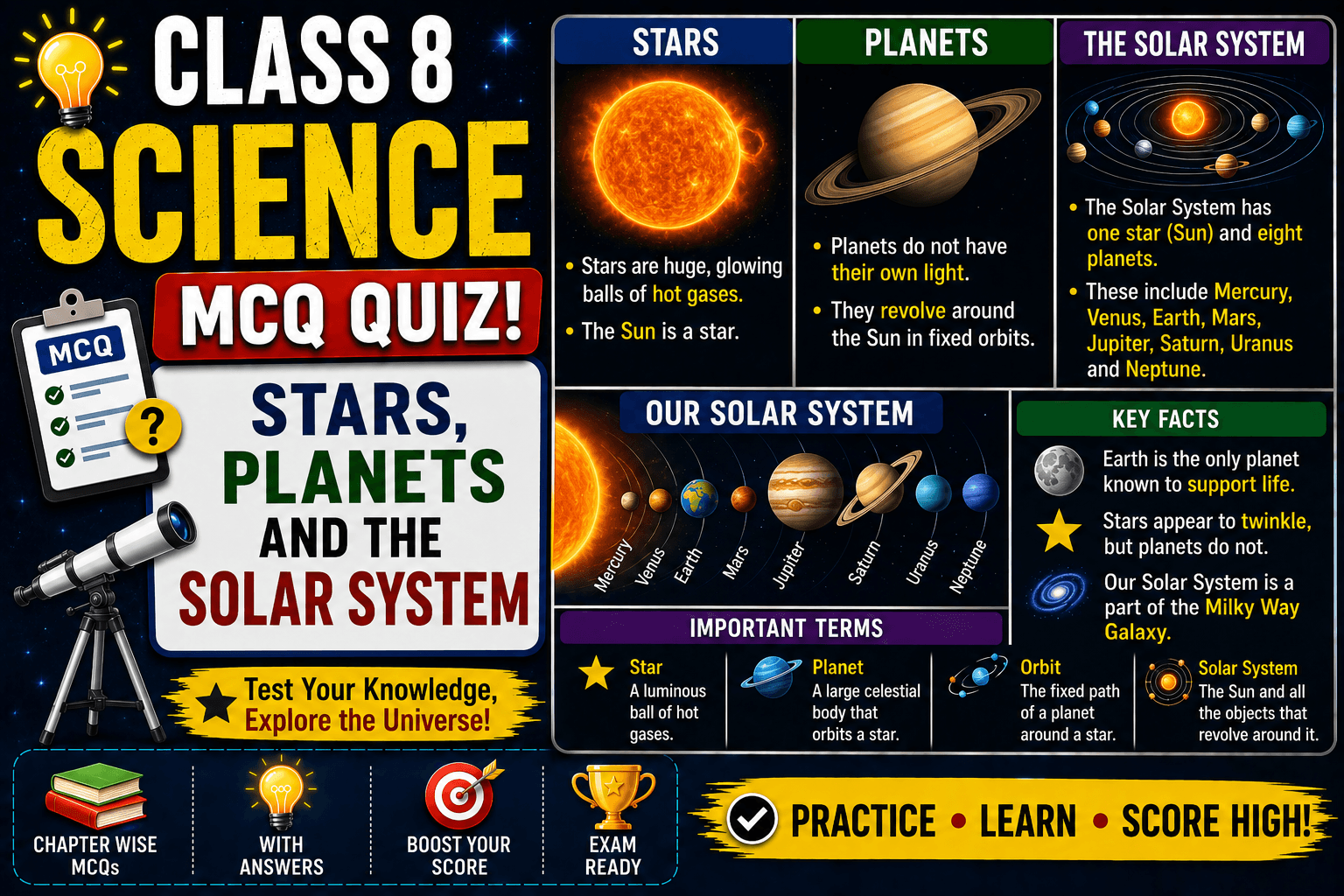
Practice Class 8 Science MCQs on planets, satellites, light years, Halley’s Comet, constellations, Pole Star, and the solar system with detailed explanations and real-life examples.
Do You Know
Q1. Which planet has no satellite (moon) of its own?
Correct Answer: Venus
Detailed Explanation:
Venus is one of the two planets in our Solar System that do not have any natural satellites or moons. The other planet without a moon is Mercury. Most planets in the Solar System have one or more satellites orbiting around them. For example, Earth has one natural satellite called the Moon, while Jupiter has dozens of known moons.
Venus is often called Earth’s “sister planet” because its size and structure are similar to Earth. However, unlike Earth, Venus has an extremely dense atmosphere made mostly of carbon dioxide, creating a powerful greenhouse effect. This makes Venus the hottest planet in the Solar System, even hotter than Mercury, despite being farther from the Sun.
Scientists believe that the absence of moons around Venus may be related to its formation history and gravitational interactions in the early Solar System. Although Venus has no natural satellites, it remains one of the brightest objects visible in the night sky and is often called the “Morning Star” or “Evening Star.”
Venus completes one rotation very slowly and rotates in the opposite direction compared to most planets. This unusual motion makes Venus a fascinating object of study for astronomers.
Understanding planets and their satellites helps students learn about the structure and diversity of our Solar System.
Real-Life Examples:
- Earth has one moon, but Venus has none.
- Jupiter possesses many natural satellites.
- Venus is visible as the Morning Star in the sky.
Important NCERT Points:
- Venus has no natural satellite.
- Mercury also has no moon.
- Venus is Earth’s nearest planetary neighbor.
- It is one of the brightest objects in the night sky.
Exam-Oriented Fact:
Mercury and Venus are the only planets without natural satellites.
Quick Revision Line:
Venus is a planet that has no moon of its own.
Q2. The distance between celestial bodies is measured in?
Correct Answer: Light Years
Detailed Explanation:
The distances between stars, galaxies, and other celestial bodies are extremely large. Measuring such enormous distances in kilometres would result in very large numbers that are difficult to understand. Therefore, astronomers use a special unit called the light year.
A light year is the distance travelled by light in one year. Light travels at a speed of approximately 300,000 kilometres per second. In one year, light covers about 9.46 trillion kilometres. This enormous distance makes the light year a convenient unit for measuring distances in space.
For example, the nearest star to Earth after the Sun is Proxima Centauri, which is about 4.24 light years away. This means the light we see from that star today actually left the star more than four years ago.
Light years help astronomers study the universe more effectively. When scientists observe distant stars and galaxies, they are often looking into the past because light takes time to travel across space.
The concept of a light year not only helps measure distance but also provides information about the age and history of celestial objects. It is one of the most important units used in astronomy.
Real-Life Examples:
- Distances between stars are measured in light years.
- Galaxies are often millions of light years apart.
- Astronomers use light years instead of kilometres for space measurements.
Important NCERT Points:
- A light year is a unit of distance.
- It is not a unit of time.
- Light travels about 9.46 trillion kilometres in one year.
- Used for measuring vast distances in space.
Exam-Oriented Fact:
One light year equals approximately 9.46 × 10¹² kilometres.
Quick Revision Line:
A light year is the distance travelled by light in one year.
Q3. Halley’s Comet appears after nearly every?
Correct Answer: 76 Years
Detailed Explanation:
Halley’s Comet is one of the most famous comets in human history. It was named after the English astronomer Edmond Halley, who correctly predicted that the same comet would return at regular intervals.
A comet is a celestial body made of ice, dust, rock, and frozen gases. As a comet approaches the Sun, heat causes some of its materials to vaporize, creating a glowing head and a long tail. This spectacular appearance makes comets fascinating objects in the night sky.
Halley’s Comet returns to the inner Solar System approximately every 76 years. It was last visible from Earth in 1986 and is expected to return again around 2061. Because of its long orbital period, many people get the chance to see it only once in their lifetime.
Historical records show that Halley’s Comet has been observed for thousands of years. Ancient civilizations often considered its appearance a special event. Today, scientists study comets to learn about the early Solar System because comets contain materials that have remained largely unchanged since its formation.
Halley’s Comet remains one of the best-known examples of periodic comets.
Real-Life Examples:
- Halley’s Comet was visible in 1986.
- It is expected to reappear around 2061.
- Astronomers track its orbit using telescopes.
Important NCERT Points:
- Halley’s Comet is a periodic comet.
- It appears approximately every 76 years.
- Comets are made of ice, dust, and gases.
- They develop tails when approaching the Sun.
Exam-Oriented Fact:
Halley’s Comet is one of the most frequently discussed comets in school examinations.
Quick Revision Line:
Halley’s Comet returns to Earth’s vicinity about every 76 years.
Q4. Which of the following is not a member of the solar system?
Correct Answer: Constellations
Detailed Explanation:
The Solar System consists of the Sun and all objects that revolve around it due to its gravitational pull. These include planets, dwarf planets, moons, asteroids, meteoroids, and comets.
A constellation is not a member of the Solar System. A constellation is a group of stars that appear to form a recognizable pattern in the sky when viewed from Earth. These stars are actually located at different distances from Earth and are not physically connected to each other.
Examples of famous constellations include Orion, Ursa Major, and Cassiopeia. People have used constellations for navigation and identifying seasons for thousands of years.
In contrast, planets, asteroids, and comets are actual members of the Solar System because they are gravitationally bound to the Sun. Constellations lie far beyond the Solar System and belong to our galaxy, the Milky Way.
Learning the difference between Solar System objects and constellations helps students understand the organization of the universe more clearly.
Real-Life Examples:
- Orion is a constellation.
- Asteroids orbit the Sun.
- Earth is a member of the Solar System.
Important NCERT Points:
- Constellations are groups of stars.
- They are not Solar System members.
- Planets, comets, and asteroids belong to the Solar System.
- Constellations help identify stars in the sky.
Exam-Oriented Fact:
Ursa Major is one of the most famous constellations discussed in NCERT.
Quick Revision Line:
Constellations are star patterns and are not members of the Solar System.
Q5. The Pole Star appears to be stationary because?
Correct Answer: It is on the axis of rotation of the Earth
Detailed Explanation:
The Pole Star, also known as Polaris, appears almost stationary in the night sky because it lies very close to the direction of Earth’s rotational axis. As Earth rotates from west to east, most stars appear to move across the sky. However, the Pole Star remains nearly fixed at the same position.
This unique characteristic has made the Pole Star extremely useful for navigation throughout history. Sailors, travelers, and explorers used it to determine direction, especially north. By locating the Pole Star, one can easily identify the northern direction.
The apparent motion of stars around the Pole Star is actually caused by Earth’s rotation. Since Polaris lies nearly above the North Pole, its position changes very little during the night.
The Pole Star is not the brightest star in the sky, but it is one of the most important stars for navigation. It belongs to the constellation Ursa Minor and serves as a reliable guide for observers in the Northern Hemisphere.
Understanding the Pole Star helps students connect astronomy with practical applications such as navigation and orientation.
Real-Life Examples:
- Sailors used the Pole Star for navigation.
- Travelers locate north using Polaris.
- Other stars appear to circle around the Pole Star.
Important NCERT Points:
- The Pole Star is also called Polaris.
- It lies near Earth’s rotational axis.
- It helps in finding the north direction.
- It appears nearly stationary in the sky.
Exam-Oriented Fact:
The Pole Star is a key navigation star in the Northern Hemisphere.
Quick Revision Line:
The Pole Star appears stationary because it lies near Earth’s axis of rotation.
Related links
- Class 8 Science MCQ Quiz: Light, Human Eye & Multiple Reflections
- Class 8 Science MCQ Quiz: Some Natural Phenomena
- Class 8 Science MCQ Quiz: Reproduction & Hormones
- Class 8 MCQ Questions Answers – History, Civics, Geography
- Class 8 MCQ Questions with Answers– History, Civics, Geography
Latest Posts
- NCERT Class 7 Maths Chapter 1 Integers,addition, subtraction
- Class 10 Maths Chapter-1 Real Numbers-Rational numbers-MCQ
- Class9 Maths- Number Systems, decimal expansion, exponents
- Class 8 Maths Chapter 1 Rational Numbers, multiplicative
- Class 10 Maths Chapter 1 Real Numbers MCQ Questions with Solutions
Join Our Other Communities
Instagram , Youtube , Facebook