
Welcome To My School Study
Class 10 Social Science quiz explanations based on NCERT topics covering Union List, Gulamgiri, liberalization, iron ore resources, and Indian industries.
Do You Know
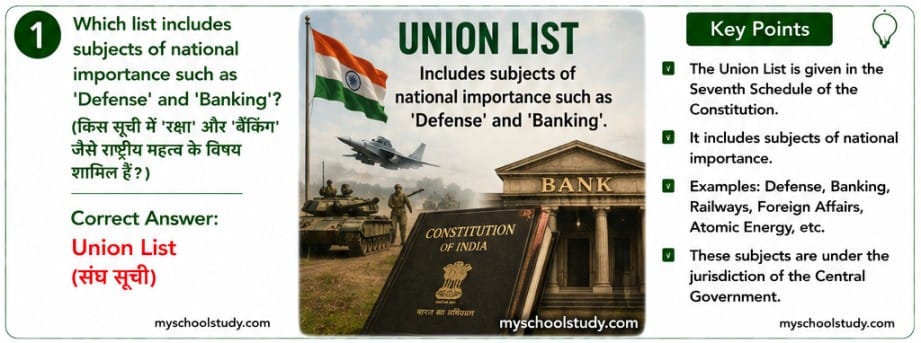
Q1. Which list includes subjects of national importance such as ‘Defense’ and ‘Banking’?
Correct Answer: Union List
Detailed Explanation
The Union List contains subjects that are of national importance and require uniform laws throughout the country. Only the Parliament has the power to make laws on these subjects. Defense, banking, foreign affairs, currency, and communication are some examples included in the Union List. This arrangement helps maintain national unity and efficient governance.
Important NCERT Points
The Constitution divides powers between the Union and State governments through different lists.
Exam-Oriented Fact
Subjects like defense, foreign affairs, and banking belong to the Union List.
Quick Revision Line
Defense and banking are subjects of the Union List.
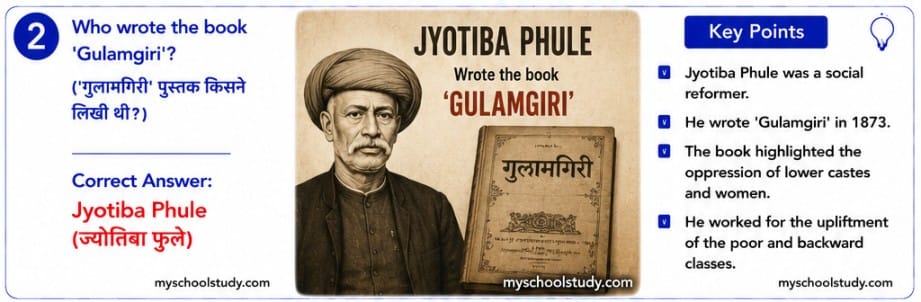
Q2. Who wrote the book ‘Gulamgiri’?
Correct Answer: Jyotiba Phule
Detailed Explanation
Jyotiba Phule wrote the book Gulamgiri in 1873. In this work, he criticized caste discrimination and social inequality. The book highlighted the difficulties faced by lower castes and emphasized the need for social reform. Phule was one of the leading social reformers of nineteenth-century India.
Important NCERT Points
Jyotiba Phule worked for social justice, education, and equality.
Exam-Oriented Fact
Gulamgiri means “Slavery” and is considered an important work in Indian social reform history.
Quick Revision Line
Jyotiba Phule wrote Gulamgiri in 1873.
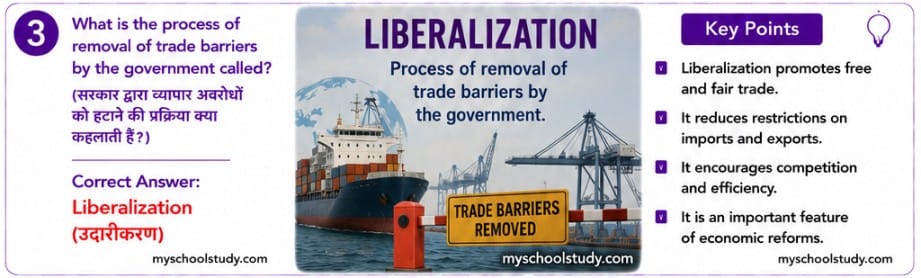
Q3. What is the process of removal of trade barriers by the government called?
Correct Answer: Liberalization
Detailed Explanation
Liberalization refers to the removal or reduction of government restrictions on trade and business activities. It allows companies greater freedom to operate and compete in the market. Liberalization encourages investment, economic growth, and international trade. In India, major liberalization reforms were introduced in 1991.
Important NCERT Points
Liberalization is an important factor promoting globalization.
Exam-Oriented Fact
The economic reforms of 1991 marked the beginning of large-scale liberalization in India.
Quick Revision Line
Liberalization means removing trade and business restrictions.
Q4. Which type of resource is ‘Iron Ore’?
Correct Answer: Non-renewable
Detailed Explanation
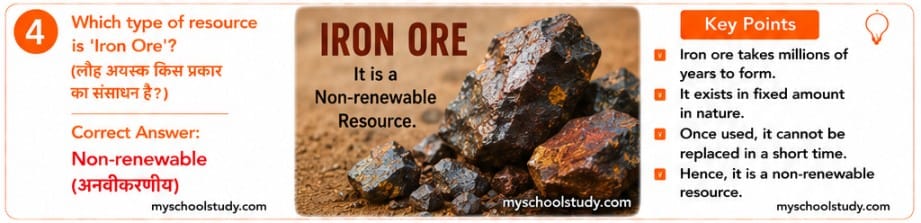
Iron ore is a mineral resource that takes millions of years to form naturally. Since it cannot be replenished within a human lifetime, it is classified as a non-renewable resource. Iron ore is an essential raw material for the iron and steel industry. Proper conservation and efficient use of such resources are important for sustainable development.
Important NCERT Points
Mineral resources are generally considered non-renewable because they are exhaustible.
Exam-Oriented Fact
Iron ore is the basic raw material used in steel production.
Quick Revision Line
Iron ore is a non-renewable mineral resource.
Q5. Who among the following set up the first ‘Indian Jute Mill’ in Calcutta in 1917?
Correct Answer: Seth Hukumchand
Detailed Explanation
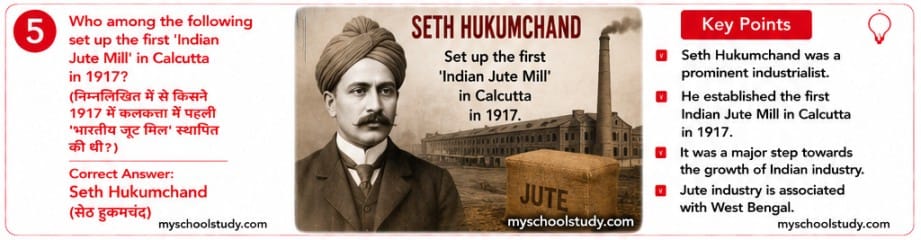
Seth Hukumchand, a prominent Indian industrialist, established the first Indian-owned jute mill in Calcutta in 1917. Before this, the jute industry was largely controlled by British entrepreneurs. His contribution marked an important step in the growth of Indian-owned industries during the colonial period. The development of indigenous industries supported economic nationalism.
Important NCERT Points
Indian entrepreneurs gradually entered industries that had earlier been dominated by Europeans.
Exam-Oriented Fact
Seth Hukumchand is remembered as a pioneer of Indian industrial enterprise.
Quick Revision Line
Seth Hukumchand established the first Indian-owned jute mill in 1917.
One-Line Revision Sheet
- Defense and banking are subjects of the Union List.
- Jyotiba Phule wrote Gulamgiri in 1873.
- Liberalization means removing trade barriers and restrictions.
- Iron ore is a non-renewable resource.
- Seth Hukumchand established the first Indian-owned jute mill in 1917.
Related Links
- Class 10 SST MCQ Quiz with Answers | NCERT Revision 3-6-26
- Quiz Class 10 Math NCERT 2-6-2026
- Quiz Class 10th Science 13-05-2026
- Quiz Class 10th Science 12-05-2026
Latest Posts
- Class 8 MCQ Questions Answers– History, Civics, Geography
- Class 9 MCQ Questions Answers– History, Geography, Civics
- Class 7 MCQ Questions Answers– Markets Around Us 10-6-26
- Class 10 SST MCQs with Detailed Black Soil, Sri Lanka
- Class 10 SST MCQs with Detailed Explanations 9-6-26
Join Our Other Communities