

Welcome To My School Study
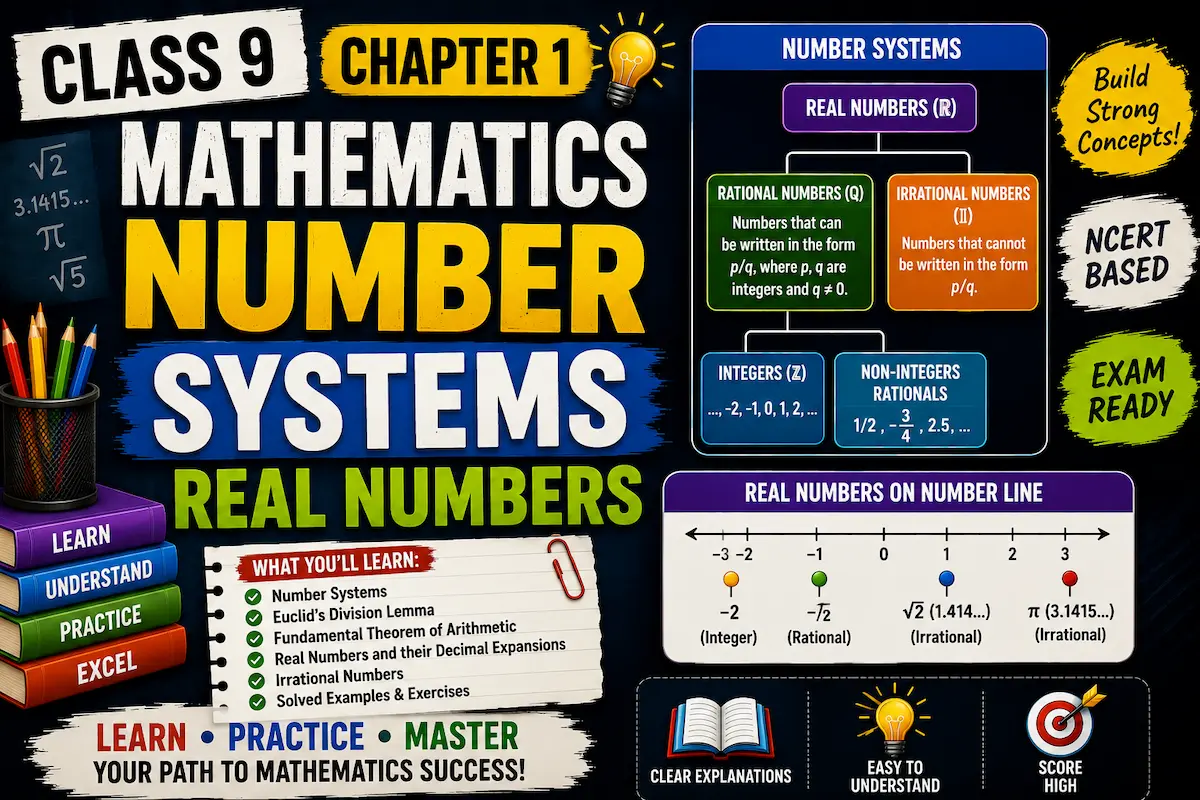
ractice Class 9 Maths Chapter 1 Number Systems MCQ Questions with Answers based on NCERT syllabus. Learn rational numbers, irrational numbers, decimal expansion, exponents, and real numbers with detailed solutions for CBSE board exams.
Do You Know
Chapter Information
Subject: Mathematics
Class: 9
Chapter: Number Systems
Question Type: Multiple Choice Questions (MCQs)
Difficulty Level: Moderate
Based On: NCERT Latest Syllabus
Introduction:
Number Systems is a fundamental chapter in Class 9 Mathematics that introduces students to rational numbers, irrational numbers, real numbers, decimal expansions, and laws of exponents. These concepts form the basis of higher mathematics and help students solve a variety of mathematical problems efficiently.
What You Will Learn?
✔ Rational Numbers
✔ Irrational Numbers
✔ Real Numbers
✔ Decimal Expansion of Rational Numbers
✔ Laws of Exponents
✔ Representation of Numbers on the Number Line
✔ Board Exam Preparation
Why This Topic Is Important?
Number Systems play a crucial role in mathematics. Understanding different types of numbers and their properties helps students build logical reasoning skills and solve complex problems with ease.
Exam Relevance
These questions are useful for:
✔ CBSE Board Exams
✔ State Board Exams
✔ School Tests
✔ Unit Tests
✔ Half-Yearly Exams
✔ Annual Exams
✔ Scholarship Examinations
Q1. Which of the following numbers is irrational?
A) $$\frac{5}{12}$$
B) $$0.2$$
C) $$\sqrt{45}$$
D) $$0.818181\ldots$$
Answer:
$$\sqrt{45}$$
Useful Formula for this Question:
An irrational number cannot be expressed in the form:
$$\frac{p}{q}, \quad q \ne 0$$
Concept Behind This Question:
Students should identify irrational numbers among different representations.
Step-by-Step Solution:
- $$\frac{5}{12}$$ is rational.
- $$0.2 = \frac{1}{5}$$ is rational.
- $$0.818181\ldots$$ is recurring and hence rational.
- $$\sqrt{45} = 3\sqrt{5}$$ and $$\sqrt{5}$$ is irrational.
Therefore:
$$\sqrt{45}$$ is irrational.
Hence, the correct answer is:
$$\sqrt{45}$$
Exam Tip:
The square root of a non-perfect square is always irrational.
Q2. Which of the following fractions has a terminating decimal expansion?
A) $$\frac{7}{18}$$
B) $$\frac{13}{40}$$
C) $$\frac{11}{24}$$
D) $$\frac{5}{27}$$
Answer:
$$\frac{13}{40}$$
Useful Formula for this Question:
A rational number has a terminating decimal expansion only if the denominator contains prime factors 2 and/or 5.
Concept Behind This Question:
Students should determine the nature of decimal expansions using denominator factorization.
Step-by-Step Solution:
Prime factorization of denominators:
- $$18 = 2 \times 3^2$$
- $$40 = 2^3 \times 5$$
- $$24 = 2^3 \times 3$$
- $$27 = 3^3$$
Only $$40$$ contains prime factors 2 and 5 only.
Therefore:
$$\frac{13}{40}$$ has a terminating decimal expansion.
Hence, the correct answer is:
$$\frac{13}{40}$$
Exam Tip:
Always simplify the fraction before checking the denominator.
Q3. Evaluate:
$$10^4 \div 10^2$$
A) $$10^6$$
B) $$10^2$$
C) $$100^2$$
D) $$20^2$$
Answer:
$$10^2$$
Useful Formula for this Question:
$$\frac{a^m}{a^n} = a^{m-n}$$
Concept Behind This Question:
This question checks the application of exponent laws.
Step-by-Step Solution:
$$10^4 \div 10^2 = 10^{4-2}$$
$$= 10^2$$
$$= 100$$
Therefore, the correct answer is:
$$10^2$$
Exam Tip:
Subtract exponents while dividing powers with the same base.
Q4. Which of the following numbers is rational?
A) $$\sqrt{7}$$
B) $$\pi$$
C) $$\sqrt{36}$$
D) $$\sqrt{15}$$
Answer:
$$\sqrt{36}$$
Useful Formula for this Question:
The square root of a perfect square is rational.
Concept Behind This Question:
Students should distinguish between rational and irrational numbers.
Step-by-Step Solution:
- $$\sqrt{7}$$ is irrational.
- $$\pi$$ is irrational.
- $$\sqrt{36} = 6$$ is rational.
- $$\sqrt{15}$$ is irrational.
Therefore, the correct answer is:
$$\sqrt{36}$$
Exam Tip:
Square roots of perfect squares are rational numbers.
Q5. Simplify:
$$2^5 \times 2^3$$
A) $$2^8$$
B) $$2^{15}$$
C) $$4^8$$
D) $$2^2$$
Answer:
$$2^8$$
Useful Formula for this Question:
$$a^m \times a^n = a^{m+n}$$
Concept Behind This Question:
Students should apply exponent laws correctly.
Step-by-Step Solution:
$$2^5 \times 2^3 = 2^{5+3}$$
$$= 2^8$$
$$= 256$$
Therefore, the correct answer is:
$$2^8$$
Exam Tip:
When multiplying powers with the same base, add the exponents.
Important Formulas & Concepts
1. Rational Numbers
$$\frac{p}{q}, \quad q \ne 0$$
2. Irrational Numbers
Numbers that cannot be expressed as:
$$\frac{p}{q}$$
3. Real Numbers
$$\text{Real Numbers = Rational Numbers + Irrational Numbers}$$
4. Laws of Exponents
$$a^m \times a^n = a^{m+n}$$
$$\frac{a^m}{a^n} = a^{m-n}$$
$$(a^m)^n = a^{mn}$$
5. Decimal Expansion Rule
A rational number has a terminating decimal expansion if its denominator contains only prime factors 2 and/or 5.
FAQs
1. What is an irrational number?
An irrational number cannot be expressed in the form $$\frac{p}{q}$$.
2. Is $$\sqrt{36}$$ rational?
Yes, because $$\sqrt{36} = 6$$.
3. Which fractions have terminating decimals?
Fractions whose simplified denominators contain only 2 and/or 5.
4. Is $$\pi$$ a real number?
Yes, $$\pi$$ is an irrational real number.
5. Are all integers rational?
Yes, every integer can be written in fractional form.
Common Mistakes
❌ Assuming every square root is irrational.
❌ Forgetting to simplify fractions before checking decimal expansion.
❌ Applying exponent rules incorrectly.
❌ Confusing irrational numbers with non-real numbers.
❌ Ignoring denominator factorization.
Quick Revision Notes
✔ Rational numbers can be expressed as fractions.
✔ Non-perfect square roots are irrational.
✔ Perfect square roots are rational.
✔ Denominators with only 2 and/or 5 give terminating decimals.
✔ Use exponent laws carefully.
Conclusion
Number Systems is an important chapter that forms the foundation of higher mathematics. Understanding rational numbers, irrational numbers, decimal expansions, and exponents helps students improve their problem-solving abilities and perform well in examinations. Regular practice of MCQs strengthens concepts and boosts confidence.
Related Links
- Class 9 Maths Chapter 1 Number Systems, irrational & rational numbers
- Class 9 Maths Decimal Expansion, Exponents
- Class9 Maths- Number Systems, decimal expansion, exponents
- Class 9 Maths Chapter 1 Number Systems MCQ with Solutions
- Class 9 Maths Chapter 1 Number Systems MCQ Q&A, Solutions
- Class 9 SST: Deccan Plateau, Fundamental Rights
- Class 9 Science: Evaporation, Pressure, Atomic Structure
- Class 9 Science: Boiling, Momentum, Electron, Speed and Parenchyma
- Class 9 Science MCQ Quiz: Force, Mole Concept, Motion and Plant Tissues
- Class 9 MCQ Questions Answers– History, Geography, Civics
- Class 9 SST MCQs with Detailed Explanations
Latest Posts
- Class 7 Maths Chapter 1 Integers, number line, subtraction
- Class 8 Maths additive inverse, multiplicative inverse MCQ
- Class 9 Maths Chapter 1 Number Systems laws of exponents
- Class 10 Maths Chapter 2 Polynomials MCQ linear polynomial
- Class 10 Maths Chapter 2 Polynomials, linear polynomial
Join Our Other Communities
Instagram , Youtube , Facebook