

Welcome To My School Study
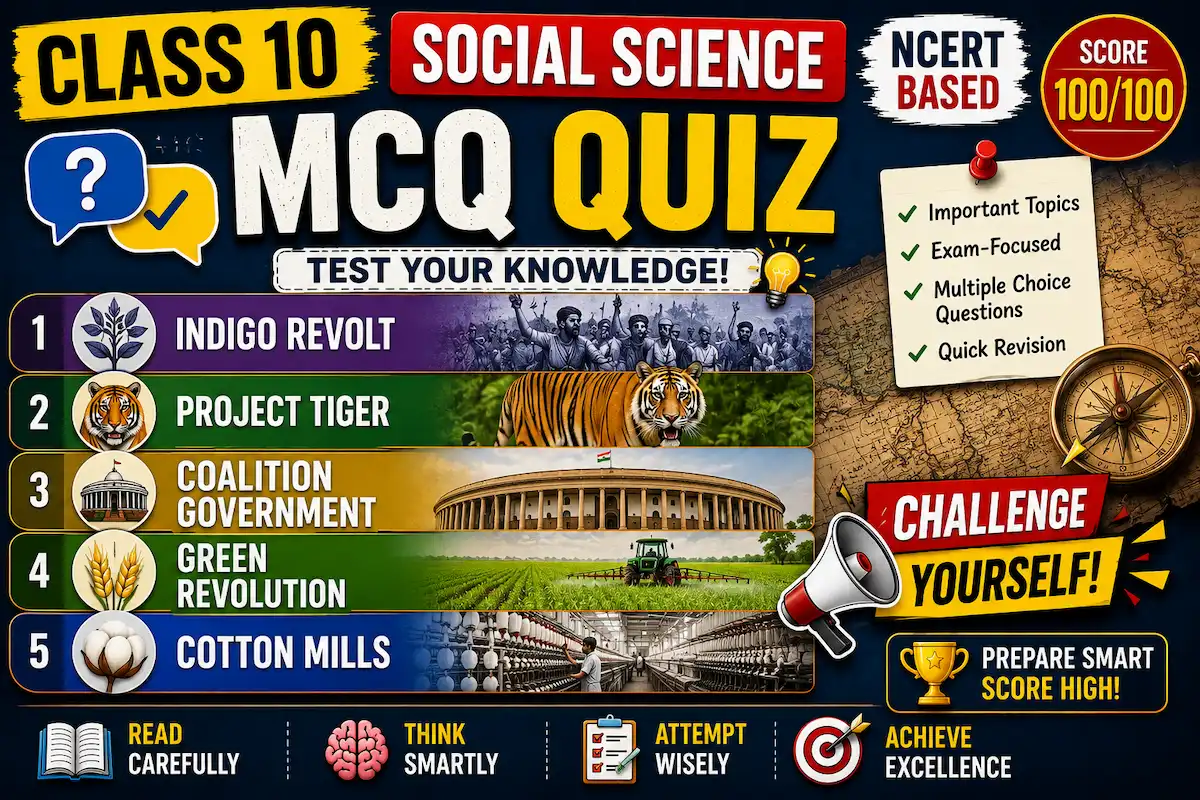
Practice Class 10 Social Science MCQs on Indigo Revolt, Project Tiger, coalition government, Green Revolution, and the first cotton mill in India with detailed explanations, NCERT points, memory tricks, revision notes, FAQs, and exam-oriented facts.
Do You Know
Introduction
Class 10 Social Science covers important topics from History, Geography, Political Science, and Economics that help students understand India’s development and democratic structure. Topics such as the Indigo Revolt, Project Tiger, Coalition Government, Green Revolution, and industrial development frequently appear in board examinations and competitive tests.
These concepts highlight India’s freedom struggle, environmental conservation efforts, agricultural transformation, democratic governance, and industrial growth. Understanding not only the correct answer but also the background behind each topic helps students perform better in exams and build stronger conceptual knowledge.
The following MCQs include detailed explanations, real-life relevance, NCERT-based facts, memory tricks, revision lines, and related questions for effective preparation.
Q1. Which city was the main center of the ‘Indigo Revolt’ in India?
(भारत में ‘नील विद्रोह’ का मुख्य केंद्र कौन सा शहर था?)
A) Champaran (चंपारण)
B) Ahmedabad (अहमदाबाद)
C) Kheda (खेड़ा)
D) Nadia (नदिया)
Correct Answer:
A) Champaran (चंपारण)
Detailed Explanation
The Indigo Revolt was one of the earliest organized movements by Indian farmers against the exploitative policies of European indigo planters. During British rule, many farmers were forced to cultivate indigo instead of food crops. Indigo was used to produce blue dye, which had a high demand in European markets.
Farmers suffered greatly because indigo cultivation exhausted soil fertility and reduced food production. The prices paid by British planters were extremely low, leaving cultivators trapped in poverty and debt. The situation became unbearable, leading to widespread protests.
Champaran, located in present-day Bihar, became one of the most significant centers of resistance against forced indigo cultivation. The struggles of indigo farmers later attracted the attention of Mahatma Gandhi. In 1917, Gandhi launched the famous Champaran Satyagraha to investigate the grievances of farmers and challenge the oppressive plantation system.
The Champaran movement marked Gandhi’s first major satyagraha in India and became a turning point in the Indian freedom struggle. It demonstrated the power of peaceful resistance and encouraged people to fight against injustice through non-violent means.
The Indigo Revolt and Champaran Satyagraha are important topics because they show how farmers united against exploitation and contributed to India’s national movement.
Real-Life Examples
- Farmers protesting unfair agricultural policies.
- Champaran Satyagraha led by Mahatma Gandhi.
- Collective action against economic exploitation.
Important NCERT Points
- Indigo was grown for blue dye production.
- Farmers were forced to cultivate indigo.
- Champaran became a major center of protest.
- Gandhi led Champaran Satyagraha in 1917.
Why Other Options Are Wrong
- B) Ahmedabad – Known for textile industries and labor movements.
- C) Kheda – Associated with the Kheda Satyagraha.
- D) Nadia – Had indigo cultivation but is not the answer here.
Exam-Oriented Fact
Champaran Satyagraha was Gandhi’s first major movement in India.
Memory Trick
“Champaran = Farmers + Gandhi”
Quick Revision Line
Champaran became the major center of resistance against forced indigo cultivation.
Related Questions
- What was Champaran Satyagraha?
- Why did farmers oppose indigo cultivation?
- Who led the Champaran movement?
Q2. ‘Project Tiger’ was started in which year in India?
Correct Answer:
B) 1973
Detailed Explanation
Project Tiger is one of India’s most important wildlife conservation programs. It was launched by the Government of India in 1973 to protect the rapidly declining tiger population. During the mid-20th century, excessive hunting, poaching, habitat destruction, and deforestation caused a significant reduction in tiger numbers across the country.
Recognizing the urgent need for conservation, the government established protected tiger reserves under Project Tiger. These reserves provided safe habitats where tigers could breed and live without human interference.
The project initially covered a small number of reserves but later expanded to many states. Strict anti-poaching measures, scientific monitoring, habitat protection, and community participation became major components of the program.
Project Tiger is widely regarded as one of the most successful wildlife conservation efforts in the world. It has helped increase tiger populations and strengthened awareness about biodiversity conservation.
The program also benefits ecosystems because tigers are apex predators. Protecting tigers indirectly protects forests, rivers, and countless other species that depend on the same habitats.
Real-Life Examples
- Tiger reserves such as Corbett and Kanha.
- Wildlife monitoring programs.
- Anti-poaching patrols.
Important NCERT Points
- Started in 1973.
- Aimed to protect tigers.
- Helps conserve biodiversity.
- Created protected tiger reserves.
Why Other Options Are Wrong
- A) 1970 – Project Tiger had not started.
- C) 1980 – Started earlier.
- D) 1985 – Incorrect year.
Exam-Oriented Fact
Project Tiger was launched on 1 April 1973.
Memory Trick
“Tiger = 73”
Quick Revision Line
Project Tiger was launched in 1973 to protect India’s tiger population.
Related Questions
- What is biodiversity conservation?
- Why are tigers important in ecosystems?
Q3. Which of the following is a ‘Coalition Government’?
Correct Answer:
B) Government of two or more parties
Detailed Explanation
A coalition government is formed when two or more political parties come together to govern a country or state. This situation usually occurs when no single party wins a clear majority in an election.
In a democratic system, political parties contest elections to gain representation. If one party secures more than half the seats, it can form a government independently. However, when no party obtains a majority, multiple parties may join together and form a coalition government.
Coalition governments are common in countries with diverse populations and multiple political parties. Such governments encourage cooperation, negotiation, and power-sharing among different groups.
India has witnessed several coalition governments at both the national and state levels. Coalition governments can provide broader representation but may also face challenges in decision-making because participating parties often have different ideologies and priorities.
Despite challenges, coalition governments play an important role in democratic systems by ensuring that multiple viewpoints are represented in governance.
Real-Life Examples
- Multi-party governments in India.
- Political alliances before elections.
- Coalition governments in parliamentary democracies.
Important NCERT Points
- Formed by two or more parties.
- Common when no party gets a majority.
- Encourages power-sharing.
- Important feature of democracy.
Why Other Options Are Wrong
- A) One-party government is not a coalition.
- C) Dictatorship is not democratic.
- D) Monarchy is rule by a king or queen.
Exam-Oriented Fact
Coalition politics became common in India after the 1980s.
Memory Trick
“Coalition = Cooperation of Parties”
Quick Revision Line
A coalition government is formed by two or more political parties.
Related Questions
- What is a majority government?
- Why are coalition governments formed?
Q4. Who is the father of the ‘Green Revolution’ in India?
Correct Answer:
B) M.S. Swaminathan
Detailed Explanation
Dr. M.S. Swaminathan is known as the Father of the Green Revolution in India because of his significant contribution to increasing agricultural production. During the 1960s, India faced severe food shortages and depended heavily on food imports.
To improve food security, scientists introduced high-yielding varieties (HYV) of seeds, modern irrigation methods, chemical fertilizers, pesticides, and improved farming techniques. Dr. Swaminathan played a leading role in adapting these agricultural innovations to Indian conditions.
The Green Revolution dramatically increased the production of wheat and rice, particularly in states such as Punjab, Haryana, and Uttar Pradesh. As a result, India moved closer to self-sufficiency in food grain production.
The Green Revolution not only improved agricultural output but also strengthened rural development and economic growth. However, it also raised concerns regarding excessive use of fertilizers, groundwater depletion, and environmental sustainability.
Dr. Swaminathan’s contributions continue to influence agricultural research and food security policies in India.
Real-Life Examples
- High-yield wheat cultivation.
- Modern irrigation systems.
- Increased food grain production.
Important NCERT Points
- M.S. Swaminathan led Green Revolution efforts.
- Increased wheat and rice production.
- Improved food security.
- Introduced scientific farming methods.
Why Other Options Are Wrong
- A) Verghese Kurien – Father of White Revolution.
- C) Norman Borlaug – Global Green Revolution pioneer.
- D) Sam Pitroda – Known for telecom development.
Exam-Oriented Fact
M.S. Swaminathan is called the Father of the Green Revolution in India.
Memory Trick
“Green = Swaminathan Seen in Fields”
Quick Revision Line
M.S. Swaminathan led India’s Green Revolution.
Related Questions
- What is the Green Revolution?
- What are HYV seeds?
Q5. Where was the first ‘Cotton Mill’ established in India?
Correct Answer:
B) Mumbai
Detailed Explanation
The first successful cotton textile mill in India was established in Mumbai (then Bombay) in 1854. The city became the center of India’s textile industry due to its favorable location, availability of labor, access to ports, and proximity to cotton-growing regions.
The establishment of cotton mills marked the beginning of modern industrialization in India. Textile production gradually shifted from traditional handloom methods to machine-based manufacturing. This increased production efficiency and supported industrial growth.
Mumbai’s humid climate was also suitable for textile manufacturing because it reduced thread breakage during spinning and weaving. Easy transportation through ports allowed raw materials and finished products to be moved efficiently.
Over time, Mumbai became known as the “Cottonopolis of India” because of its large concentration of textile mills. The growth of the textile industry created employment opportunities and contributed significantly to India’s economic development.
The history of cotton mills is important because it reflects the beginning of industrial growth during colonial India.
Real-Life Examples
- Mumbai textile industry.
- Growth of industrial cities.
- Development of factory-based production.
Important NCERT Points
- First cotton mill established in 1854.
- Located in Mumbai.
- Beginning of modern textile industry.
- Supported industrialization in India.
Why Other Options Are Wrong
- A) Surat – Important textile center but not the first mill.
- C) Ahmedabad – Later became a major textile hub.
- D) Kolkata – Known more for jute industries.
Exam-Oriented Fact
Mumbai’s first cotton mill was established in 1854.
Memory Trick
“Mumbai = Mill Begins”
Quick Revision Line
India’s first cotton mill was established in Mumbai in 1854.
Final Revision Notes
✅ Champaran was the major center of the Indigo Revolt.
✅ Project Tiger was launched in 1973.
✅ Coalition governments are formed by two or more political parties.
✅ M.S. Swaminathan is known as the Father of the Green Revolution in India.
✅ India’s first cotton mill was established in Mumbai in 1854.
FAQ Section
Q1. Why was the Indigo Revolt important?
It highlighted the exploitation of farmers and inspired future freedom movements.
Q2. Why was Project Tiger launched?
To protect the declining tiger population and conserve wildlife habitats.
Q3. What is a coalition government?
A government formed by two or more political parties working together.
Q4. Why is M.S. Swaminathan famous?
He played a major role in India’s Green Revolution.
Q5. Why did Mumbai become a textile center?
Because of its port facilities, climate, labor availability, and proximity to cotton-growing regions.
Related links
- Class 10 Maths Chapter 1 Real Numbers, HCF, LCM,
- Class 10 Maths Chapter 1 Real Numbers prime factorization
- Class 10 Maths Chapter 1 Real Numbers Euclid Division Lemma
- Class 10 Maths Chapter-1 Real Numbers-Rational numbers-MCQ
- Class 10 Maths Chapter 1 Real Numbers MCQ Questions with Solution
- Class 10 Maths Chapter 1 Real Numbers MCQ for Board Exams
- Class 10 SST MCQs with Answers | Federalism & Freedom
Latest Posts
- Class 7 Maths Chapter 1 Integers, number line, subtraction
- Class 8 Maths additive inverse, multiplicative inverse MCQ
- Class 9 Maths Chapter 1 Number Systems laws of exponents
- Class 10 Maths Chapter 2 Polynomials MCQ linear polynomial
- Class 10 Maths Chapter 2 Polynomials, linear polynomial
Join Our Other Communities
Instagram , Youtube , Facebook