

Welcome To My School Study
Do You Know
Q1. Where was the first ‘Jute Mill’ set up in India?
Comprehensive Description
The first jute mill in India was established at Rishra in Bengal in 1855. This marked the beginning of the modern jute industry in India, which later became one of the most important industries during British rule.
Jute is a natural fiber popularly known as the “Golden Fiber” because of its golden color and economic importance. It is mainly used to manufacture ropes, bags, carpets, mats, sacks, and packaging materials.
The jute industry developed rapidly in Bengal because the region had favorable climatic conditions, fertile soil, abundant water from the Ganga delta, and easy transportation through rivers and ports. Kolkata soon became the major center of the jute industry.
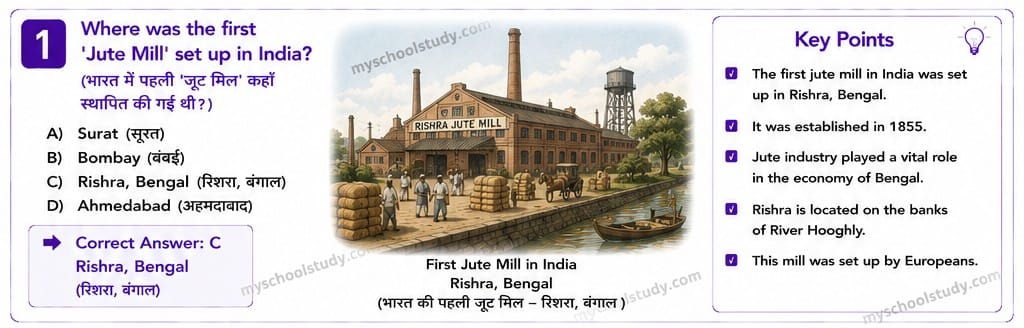
During the British period, Indian jute products were exported to many countries around the world. The industry provided employment to thousands of workers and played an important role in India’s industrial development.
Important Facts About Jute Industry
- First Jute Mill in India → Rishra, Bengal
- Established in → 1855
- Main center of Jute Industry → West Bengal
- Jute is called → Golden Fiber
- Major use → Bags, ropes, sacks, carpets
Options Analysis
A) Surat
Surat became famous mainly for the textile and diamond industries, not jute mills.
B) Bombay
Bombay (Mumbai) was an important cotton textile center, not the first jute mill location.
C) Rishra, Bengal
The Correct Answer. India’s first jute mill was established here in 1855.
D) Ahmedabad
Ahmedabad is known as the “Manchester of India” because of its cotton textile industry.
Key Points to Remember
- Jute is an important cash crop.
- West Bengal is the leading producer of jute in India.
- The jute industry mainly developed near the Hooghly River.
- Jute is biodegradable and eco-friendly.
- India is one of the world’s largest jute producers.
Real-Life Importance
Today, jute bags are increasingly used as eco-friendly alternatives to plastic bags because they are biodegradable and environmentally safe.
Q2. Which movement was started against the ‘Rowlatt Act’?
Comprehensive Description
The Rowlatt Satyagraha was launched by Mahatma Gandhi in 1919 against the unpopular Rowlatt Act introduced by the British government.
The Rowlatt Act gave the British authorities extraordinary powers to arrest and imprison people without trial. It was officially known as the Anarchical and Revolutionary Crimes Act of 1919. Indians strongly opposed this law because it violated basic civil rights and freedoms.
Mahatma Gandhi called this law the “Black Act” and organized a nationwide protest through satyagraha, hartals, and peaceful demonstrations. This movement became one of the first large-scale nationwide protests led by Gandhi.
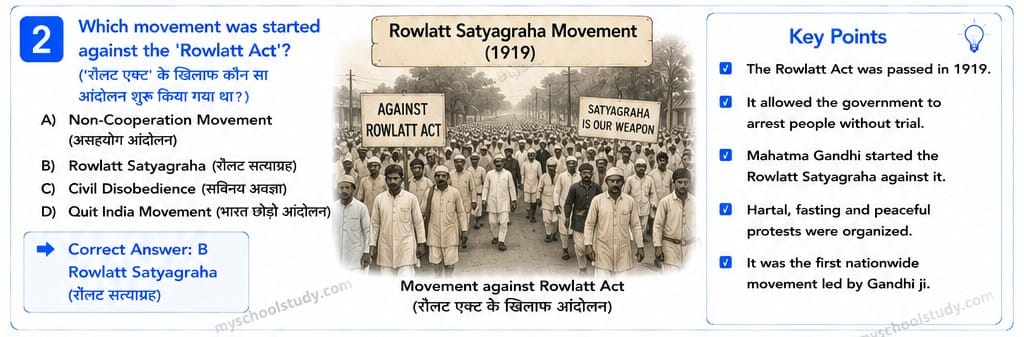
The agitation against the Rowlatt Act eventually led to the tragic Jallianwala Bagh Massacre in Amritsar on 13 April 1919, where British troops opened fire on unarmed civilians.
Background of the Rowlatt Act
- Passed in → 1919
- Introduced by → British Government
- Purpose → Suppress revolutionary activities
- Allowed arrest without trial
- Strongly opposed across India
Options Analysis
A) Non-Cooperation Movement
This movement started later in 1920 against British policies and the Jallianwala Bagh incident.
B) Rowlatt Satyagraha
The Correct Answer. Gandhi launched this movement against the Rowlatt Act in 1919.
C) Civil Disobedience
This movement began in 1930 with the Dandi March.
D) Quit India Movement
This movement was launched in 1942 demanding immediate independence.
Key Points to Remember
- Rowlatt Act was called the “Black Act.”
- Gandhi launched the Rowlatt Satyagraha in 1919.
- The movement used peaceful protest methods.
- It led to widespread public anger against British rule.
- Jallianwala Bagh Massacre happened during this period.
Real-Life Importance
The Rowlatt Satyagraha united people from different regions and communities, making India’s freedom struggle stronger and more organized.
Q3. Which is the only country in the world to have a ‘Dual Citizenship’ system like the USA?
Comprehensive Description
Switzerland is considered one of the few countries with a strong dual citizenship structure similar to the federal system of the United States. In this system, citizens enjoy citizenship at both the national and regional levels.
In federal countries, power is divided between the central government and regional governments such as states or cantons. Switzerland follows a federal structure where people are citizens of both Switzerland and their respective canton or commune.
This system helps balance national unity with regional autonomy. Citizens participate actively in local governance, and Swiss democracy is known for direct public participation through referendums.
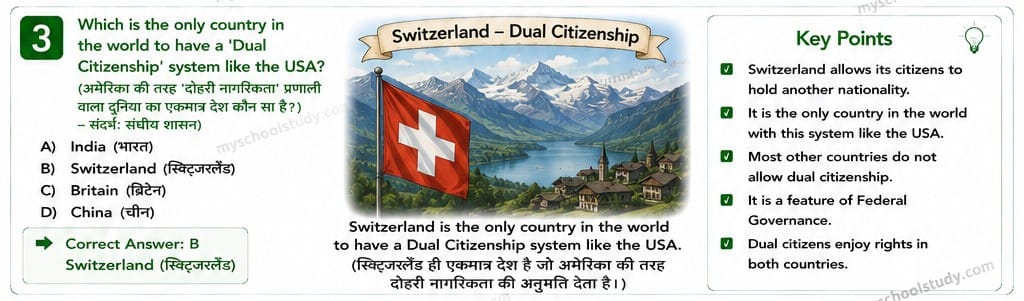
India, on the other hand, follows a system of single citizenship where every citizen is only an Indian citizen, regardless of the state in which they live.
Federal System Overview
- USA → Dual citizenship system
- Switzerland → Similar federal citizenship structure
- India → Single citizenship system
- Federalism → Division of powers between center and states
Options Analysis
A) India
India follows single citizenship under the Constitution.
B) Switzerland
The Correct Answer. Switzerland has a federal system similar to the USA with multiple citizenship levels.
C) Britain
Britain follows a unitary system, not a dual citizenship federal structure like the USA.
D) China
China also follows a unitary political system.
Key Points to Remember
- Switzerland follows a federal structure.
- Citizens belong to both local and national levels.
- India has single citizenship.
- Federalism promotes regional autonomy.
- Switzerland is famous for direct democracy.
Real-Life Importance
The Swiss model is often studied worldwide because it successfully balances local independence with national unity.
Q4. What is the full form of GDP?
Comprehensive Description
GDP stands for Gross Domestic Product. It is one of the most important indicators used to measure the economic performance of a country.
GDP represents the total monetary value of all final goods and services produced within a country during a specific period, usually one year.
Economists use GDP to understand whether a country’s economy is growing or slowing down. A rising GDP generally indicates economic growth, more production, employment opportunities, and better business activity.
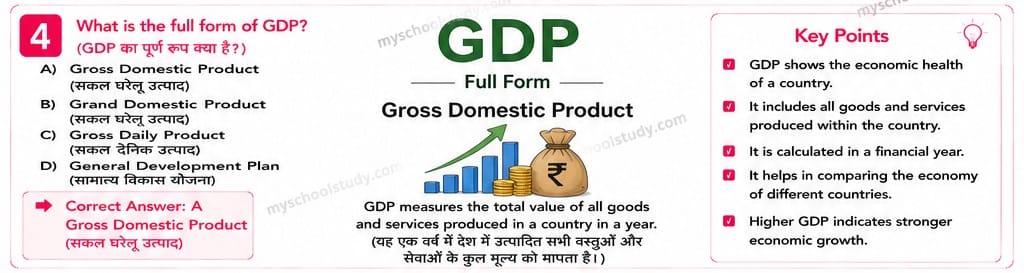
GDP includes production from sectors such as agriculture, industry, and services. Governments and international organizations use GDP data for planning economic policies and development programs.
Main Sectors Included in GDP
- Agriculture Sector
- Industrial Sector
- Service Sector
Types of GDP
- Nominal GDP → Calculated using current market prices
- Real GDP → Adjusted for inflation
- Per Capita GDP → GDP divided by total population
Options Analysis
A) Gross Domestic Product
The Correct Answer. GDP measures the total value of goods and services produced within a country.
B) Grand Domestic Product
This is not the correct expansion of GDP.
C) Gross Daily Product
GDP is not measured daily.
D) General Development Plan
This term is unrelated to economics.
Key Points to Remember
- GDP is an economic indicator.
- It measures national income and production.
- Higher GDP usually indicates economic growth.
- GDP is calculated annually or quarterly.
- India’s GDP is measured by the National Statistical Office (NSO).
Real-Life Importance
When GDP grows, it often leads to better employment opportunities, higher business activity, and improved living standards for people.
Q5. ‘Project Tiger’ was launched in India in which year?
Comprehensive Description
Project Tiger was launched in India in 1973 to protect the rapidly declining population of tigers in the country.
During the 1960s and early 1970s, excessive hunting, deforestation, and habitat destruction caused a sharp decline in tiger numbers. To save the national animal of India, the Government of India started Project Tiger under the leadership of Prime Minister Indira Gandhi.
The project aimed to conserve tigers and their natural habitats by creating protected tiger reserves across the country. Initially, the project began with 9 tiger reserves, but today the number has increased significantly.
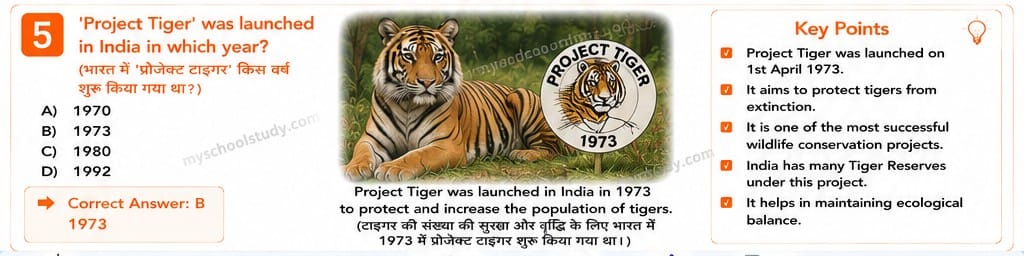
India is currently home to the largest tiger population in the world, and Project Tiger is considered one of the most successful wildlife conservation programs globally.
Objectives of Project Tiger
- Protect tiger population
- Prevent poaching and illegal hunting
- Conserve forest ecosystems
- Maintain ecological balance
Options Analysis
A) 1970
The project had not yet started in this year.
B) 1973
The Correct Answer. Project Tiger was officially launched in 1973.
C) 1980
By this time, the project was already functioning.
D) 1992
This year is associated with other environmental initiatives, not the launch of Project Tiger.
Key Points to Remember
- Project Tiger started in 1973.
- India’s national animal is the tiger.
- The project was launched by the Government of India.
- Jim Corbett National Park became an important tiger reserve.
- India has the world’s largest tiger population.
Real-Life Importance
Tiger conservation also protects forests, rivers, and biodiversity because tigers are apex predators and maintain ecological balance in nature.
