

Welcome To My School Study
Do You Know
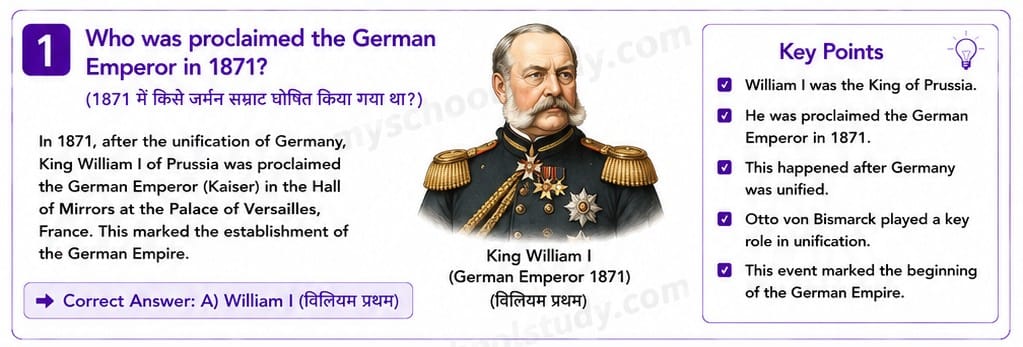
Q1. Who was proclaimed the German Emperor in 1871?
Description
In January 1871, following a historic victory in the Franco-Prussian War, King William I of Prussia was proclaimed the German Emperor. The grand ceremony took place in the bitterly cold Hall of Mirrors at the Palace of Versailles in France. This monumental event redrew the map of Europe, marking the birth of a unified and powerful German Empire.
Step-by-Step Solution
- Background of Division: Before unification, Germany was not a single country but a collection of 39 independent states, collectively known as the German Confederation.
- Leadership of Prussia: Prussia was the largest and most powerful state in the region, and it took on the leadership of the movement for national unification.
- Three Strategic Wars: Under the leadership of Chief Minister Otto von Bismarck, Prussia fought three wars over seven years—against Denmark, Austria, and France—emerging victorious in all of them.
- The Culmination (1871): The defeat of France completed the process of unification, and King William I of Prussia was universally accepted as the head of the newly unified Germany.
Options Analysis
- A) William I: This is the correct answer. He was the King of Prussia who became the first Emperor of a unified Germany.
- B) William II: He was the grandson of William I. He became the Emperor much later in 1888 and was the ruler of Germany during World War I (WWI).
- C) Friedrich Wilhelm IV: He was an earlier King of Prussia. During the Revolutions of 1848, when the assembly offered him the crown of a unified Germany under a democratic constitution, he rejected it.
- D) Otto von Bismarck: He was the Chief Minister (Chancellor) of Prussia. He was the mastermind who used his policy of “Blood and Iron” and the military to unify Germany; he did not become the Emperor himself.
Key Points
- The proclamation ceremony took place on January 18, 1871, at the Palace of Versailles in France.
- Otto von Bismarck is regarded as the real “architect” of German unification.
- Following unification, the new German Empire placed a strong emphasis on modernizing the currency, banking, legal, and judicial systems.
Real-Life & Historical Examples
- Example 1: Just as Sardar Vallabhbhai Patel used his immense willpower and diplomacy to integrate over 500 princely states into a strong, united India, Otto von Bismarck played a very similar role in German history.
- Example 2: Consider a corporate merger where the owner of the most powerful and largest merging company automatically becomes the CEO of the new corporate group. Similarly, Prussia was the dominant force, so its king, William I, became the Emperor of unified Germany.
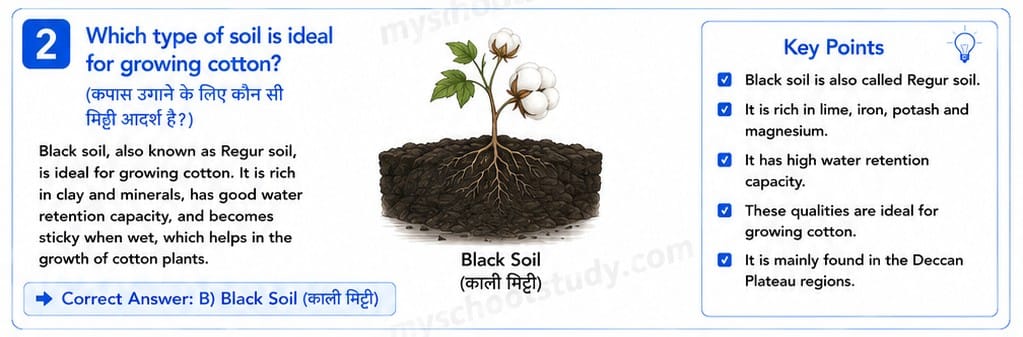
Q2. Which type of soil is ideal for growing cotton?
Description
Black soil is locally known as ‘Regur Soil’ or ‘Black Cotton Soil’. This soil is made up of extremely fine clayey material, which gives it an extraordinary capacity to retain moisture for a very long period. During hot weather, this soil develops deep cracks, which helps in proper aeration (the mixing of air into the soil), making it naturally self-fertile.
Formula & Geographical Conditions
To ensure a successful and high-yield cotton harvest, the following environmental conditions must be met:
$$\text{Black Soil} + \text{High Temperature} + \text{Light Rainfall/Irrigation} + 210 \text{ Frost-free days} + \text{Bright Sunshine}$$
Options Analysis
- A) Alluvial Soil: This is the most fertile and widespread soil type in India (predominant in the Northern Plains). It is ideal for growing crops like wheat, rice, and sugarcane.
- B) Black Soil: This is the correct answer. Its unique nutrient profile and moisture-retention properties make it the perfect match for cotton cultivation.
- C) Red Soil: This soil develops a reddish color due to a high diffusion of iron in crystalline and metamorphic rocks. It is found in low rainfall areas and is highly suitable for pulses and coarse grains.
- D) Laterite Soil: Formed in areas with high temperatures and heavy rainfall, this soil is a result of intense leaching. It is highly suitable for growing cashew nuts, tea, and coffee.
Key Points
- Black soil is formed by the weathering and breaking down of lava rocks (Basalt) formed during volcanic eruptions.
- Chemically, this soil is rich in soil nutrients such as calcium carbonate, magnesium, potash, and lime, but is generally poor in phosphoric content.
- In India, it is characteristically found in the Deccan Trap region, covering states like Maharashtra, western Madhya Pradesh, Gujarat, and parts of Karnataka.
Real-Life Examples
- Example 1 (The Sponge Property): Black soil acts exactly like a kitchen sponge. When it rains, it absorbs water, swells up, and becomes sticky. It then holds onto that moisture for months, slowly feeding the roots of the cotton plant so they don’t dry out even without daily watering.
- Example 2 (Industrial Geography): Cities like Ahmedabad (Gujarat) and Mumbai (Maharashtra) became massive hubs for textile mills primarily because the surrounding agricultural lands naturally consist of black soil, ensuring an abundant supply of raw cotton.
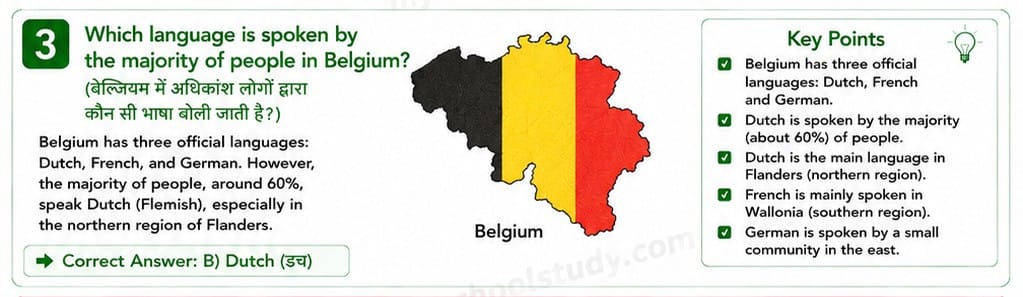
Q3. Which language is spoken by the majority of people in Belgium?
Description
Belgium, a small country in Europe, has a highly complex and unique ethnic and linguistic composition. While the Dutch-speaking community forms the majority at the national level, the situation is completely reversed in the capital city of Brussels, where the French-speaking population is in the majority.
Step-by-Step Distribution
The population distribution of Belgium is divided into distinct regions:
- Flemish Region: 59% of the country’s total population lives here and speaks the Dutch language.
- Wallonia Region: 40% of the population lives in this region and speaks French.
- The Remaining 1%: Lives in the eastern part of the country and speaks German.
- Capital City (Brussels): Here, 80% of the people speak French, while only 20% speak Dutch.
Options Analysis
- A) French: It is the second most spoken language (40%) in the country. Although smaller in number, the French-speaking community was relatively rich, powerful, and economically dominant compared to the Dutch.
- B) Dutch: This is the correct answer. It is the language spoken by the absolute majority (59%) of the nation’s population.
- C) German: This is the smallest linguistic minority in Belgium, spoken by just 1% of the population living on the eastern border.
- D) English: It is not an official or native regional language of Belgium; it is used primarily as a global language for international business and tourism.
Key Points
- During the 1950s and 1960s, severe tensions grew between the Dutch-speaking and French-speaking communities because the Dutch community got the benefit of economic development and education much later.
- To avoid an ethnic conflict or civil war, Belgium’s leaders showed great wisdom and amended their constitution 4 times between 1970 and 1993.
- They established a unique Power-Sharing Model where the number of Dutch and French-speaking ministers is equal in the central government, ensuring equal respect for both communities.
Real-Life Examples
- Example 1 (Family Accommodation): Imagine a house with two brothers. The older brother (Dutch) is greater in number but less well-off, while the younger brother (French) is wealthy and influential. If they fight, the house is ruined. Wisdom lies in sitting down and making a rule that both will have an equal say in all household decisions. That is exactly what Belgium did.
- Example 2 (The Sri Lanka Contrast): In sharp contrast, Sri Lanka chose a majoritarian path by forcing the ‘Sinhala’ language on everyone and ignoring the Tamil minority. This led to a devastating, decades-long civil war. The Belgian model proves that respecting diversity preserves peace and unity.
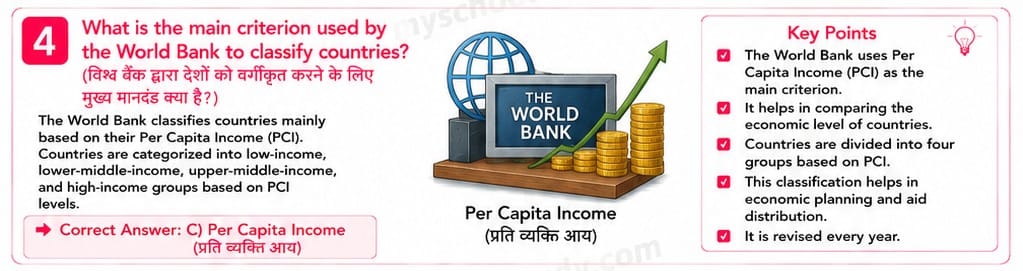
Q4. What is the main criterion used by the World Bank to classify countries?
Description
The World Bank publishes the ‘World Development Report’ every year. To compare and classify different countries based on their economic development, the World Bank relies primarily on a single economic yardstick known as Per Capita Income or Average Income.
Options Analysis
- A) Literacy Rate & B) Health Status: These human development attributes (education and health) are used by the UNDP (United Nations Development Programme) to publish the ‘Human Development Index’ (HDI), not by the World Bank.
- C) Per Capita Income: This is the correct answer. It acts as a baseline macroeconomic indicator for the World Bank’s economic grouping.
- D) Population: Total population on its own is not a measure of development; instead, it is used as the divisor (denominator) to calculate the average income.
Key Points
- To make accurate international comparisons, the Per Capita Income of all countries is calculated and expressed in US Dollars ($).
- Limitations: The major flaw of this criterion is that it hides disparities. An average does not tell us how the income is actually distributed among the citizens of a country.
- Due to its massive population, India currently falls under the category of ‘Low-Middle Income Countries’.
Real-Life Examples
- Example 1 (The Cricket Team Analogy): Imagine a cricket match where one star batsman scores 100 runs, and the other 10 players score just 1 run each. The team’s total is 110 runs, making the average score per player 10 runs. To an outsider, it looks like everyone contributed equally, but the reality is hidden by the average. Per Capita Income similarly hides the wealth gap between the ultra-rich and the poor.
- Example 2 (Rich vs Developed): Certain oil-rich countries in the Middle East (like Saudi Arabia or the UAE) have an incredibly high Per Capita Income, placing them in the high-income category of the World Bank, even though their broader social or democratic development might still be evolving.
Q5. In which year did the Jallianwala Bagh incident take place?
Description
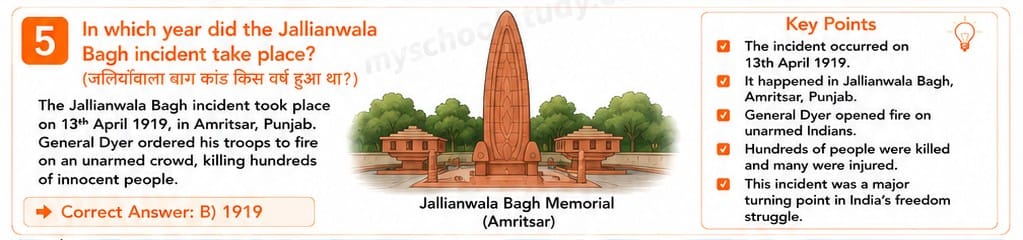
The Jallianwala Bagh massacre is remembered as one of the darkest and most tragic days in Indian history. On April 13, 1919, thousands of people gathered in the enclosed ground of Jallianwala Bagh in Amritsar, Punjab. Some came to peacefully protest against the British government’s repressive Rowlatt Act and the arrest of popular leaders (Dr. Saifuddin Kitchlew and Dr. Satyapal), while many villagers had gathered simply to celebrate the annual Baisakhi fair. British military officer General Dyer blocked the only narrow exit of the ground and ordered his troops to open fire on the unarmed, innocent crowd without any warning.
Step-by-Step Timeline
- March 1919 (The Trigger): The British government passed the Rowlatt Act. Indian leaders called it a ‘Black Law’ because it gave the police the power to detain any political prisoner without a trial for up to 2 years.
- April 6–10, 1919: Mahatma Gandhi called for a nationwide strike (hartal). Tensions escalated in Amritsar, leading the British administration to impose Martial Law (military rule), which many rural people visiting the city were completely unaware of.
- April 13, 1919 (The Massacre): A public meeting assembled at Jallianwala Bagh. General Dyer entered with armored vehicles and troops. As he stated later, his objective was to “produce a moral effect” and strike terror into the hearts of satyagrahis.
Options Analysis
- A) 1917: This was the year Mahatma Gandhi launched his first highly successful satyagraha movement in India at Champaran (Bihar) to support indigo farmers.
- B) 1919: This is the correct answer. The tragedy unfolded on April 13th of this year.
- C) 1921: This marks the year when the Non-Cooperation Movement launched by Mahatma Gandhi was operating at its full peak across the nation.
- D) 1929: During the Lahore session of the Indian National Congress in December 1929, under the presidency of Jawaharlal Nehru, the historic resolution for ‘Purna Swaraj’ (Complete Independence) was formally passed.
Key Points
- Deeply pained and outraged by the sheer brutality of the massacre, Rabindranath Tagore renounced his British ‘Knighthood’ (the title of ‘Sir’) in protest.
- The incident completely shattered Mahatma Gandhi’s faith in the British sense of justice, leading him to launch the formal nationwide Non-Cooperation Movement in January 1921.
- To investigate the incident, the British government set up the ‘Hunter Committee’, which ultimately downplayed Dyer’s cruelty, further infuriating the Indian public.
🇮🇳 Historical Impact Examples
- Example 1 (The Fire of Revolution): This tragedy sparked an unstoppable wave of nationalism among Indian youths. Stories tell of how thousands visited the site just to collect the blood-soaked soil. A 12-year-old boy named Bhagat Singh rushed to Amritsar from his village, collected the soil in a glass bottle, and kept it as a constant reminder to fuel his revolutionary spirit.
- Example 2 (Revenge in London): Michael O’Dyer was the Lieutenant Governor of Punjab at the time who approved General Dyer’s actions. An eyewitness to the aftermath, Udham Singh, waited 21 years for justice. In 1940, he traveled to London and assassinated Michael O’Dyer at Caxton Hall, avenging the national humiliation.
