

Welcome To My School Study
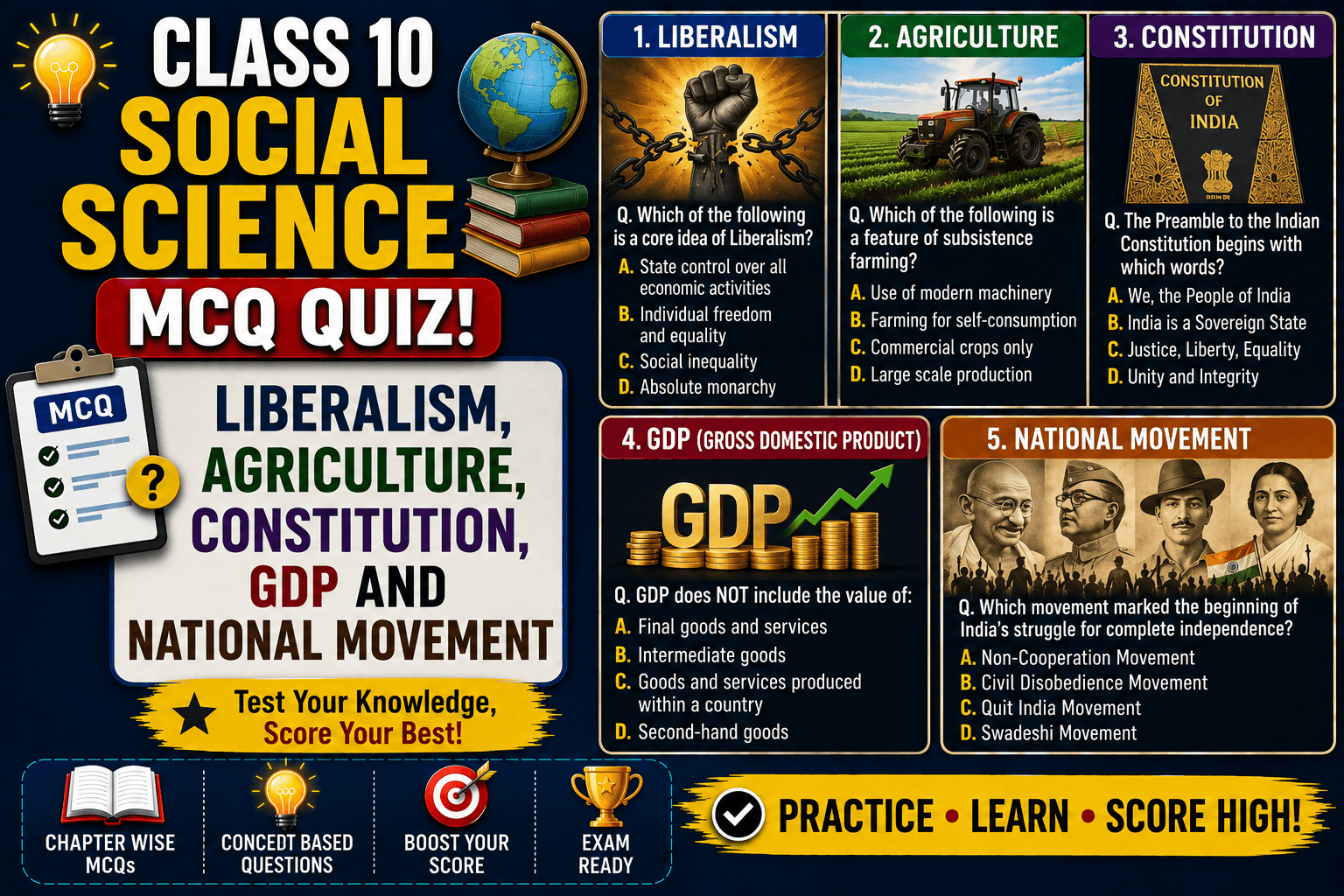
Practice Class 10 Social Science MCQs on Liberalism, food crops of India, Eighth Schedule languages, GDP, and the Jallianwala Bagh Massacre with detailed explanations.
Do You Know
Q1. Who was the first person to use the term ‘Liberalism’?
Correct Answer: John Locke
Detailed Explanation:
Liberalism is a political and social philosophy that emphasizes individual freedom, equality before the law, protection of rights, and representative government. In modern political thought, the ideas associated with liberalism were strongly developed by John Locke, who is often regarded as one of the most influential thinkers behind liberal democratic values.
Locke argued that every individual possesses natural rights, including the right to life, liberty, and property. According to him, governments are created by the consent of the people and must protect these rights. If a government fails to do so, citizens have the right to oppose it.
The growth of liberal ideas influenced many important historical events, including democratic reforms in Europe, the American Revolution, and the French Revolution. Liberalism challenged absolute monarchy and promoted constitutional government, freedom of expression, and equal legal rights.
In the Class 10 Social Science curriculum, liberalism is connected with the rise of nationalism and democratic movements in Europe. Liberal thinkers believed that citizens should enjoy civil liberties and participate in government through elected representatives.
The principles of liberalism continue to influence modern democracies around the world. Many constitutional rights enjoyed today, such as freedom of speech and equality before law, reflect liberal values.
Real-Life Examples:
- Citizens voting in democratic elections.
- Freedom of speech and expression.
- Equal treatment of people before the law.
Important NCERT Points:
- Liberalism supports individual freedom.
- It opposes absolute monarchy.
- It promotes constitutional government.
- Natural rights include life, liberty, and property.
Exam-Oriented Fact:
John Locke is widely known for promoting ideas of liberty, equality, and natural rights.
Quick Revision Line:
John Locke’s ideas laid the foundation of modern liberalism and democracy.
Q2. Which is the main ‘Food Crop’ of India?
Correct Answer: Rice
Detailed Explanation:
Rice is the most important food crop of India and serves as a staple food for a large portion of the country’s population. It is cultivated extensively across different states and forms a major part of daily meals in many regions.
Rice is primarily a kharif crop and requires high temperature, high humidity, and abundant rainfall during its growing season. Areas with fertile soil and adequate water supply are especially suitable for rice cultivation. States such as West Bengal, Uttar Pradesh, Punjab, Andhra Pradesh, and Tamil Nadu are major rice-producing regions.
Rice plays a crucial role in India’s food security because it provides a significant source of carbohydrates and energy. Millions of farmers depend on rice cultivation for their livelihood.
Advances in irrigation, fertilizers, improved seeds, and modern farming techniques have increased rice production over time. The Green Revolution also contributed to higher agricultural productivity in several parts of the country.
Since rice is consumed by people across various social and economic groups, it remains one of the most important agricultural products in India.
Real-Life Examples:
- Rice used in daily meals.
- Cultivation in paddy fields.
- Production during the monsoon season.
Important NCERT Points:
- Rice is India’s major food crop.
- It is mainly a kharif crop.
- Requires high rainfall and temperature.
- Supports food security and livelihoods.
Exam-Oriented Fact:
Rice occupies one of the largest cultivated areas among food crops in India.
Quick Revision Line:
Rice is the principal food crop and staple diet for millions of Indians.
Q3. How many languages are included in the ‘8th Schedule’ of the Indian Constitution?
Correct Answer: 22
Detailed Explanation:
The Eighth Schedule of the Indian Constitution contains the officially recognized languages of India. At present, 22 languages are included in this schedule, reflecting the country’s rich linguistic and cultural diversity.
When the Constitution came into effect in 1950, only 14 languages were included. Over time, additional languages were added through constitutional amendments. This expansion recognized the importance of preserving and promoting India’s various linguistic traditions.
The languages listed in the Eighth Schedule receive official recognition and support for their development. They may be used in competitive examinations, official communications, literature promotion, and educational activities.
India is home to hundreds of languages and dialects spoken by different communities. The inclusion of languages in the Eighth Schedule helps strengthen national unity while respecting regional identities and cultural heritage.
The constitutional recognition of multiple languages demonstrates India’s commitment to diversity and democratic inclusion. It also ensures that speakers of different languages receive opportunities for representation and cultural preservation.
Knowledge of the Eighth Schedule is important for understanding India’s federal structure and multilingual character.
Real-Life Examples:
- Government publications in various languages.
- Competitive examinations offered in multiple languages.
- Promotion of regional literature and culture.
Important NCERT Points:
- The Eighth Schedule currently contains 22 languages.
- It recognizes India’s linguistic diversity.
- Languages have been added through amendments.
- Promotes preservation of cultural heritage.
Exam-Oriented Fact:
The Constitution initially recognized 14 languages, which later increased to 22.
Quick Revision Line:
The Eighth Schedule of the Indian Constitution currently includes 22 languages.
Q4. What is the full form of ‘GDP’?
Correct Answer: Gross Domestic Product
Detailed Explanation:
GDP stands for Gross Domestic Product. It is one of the most important indicators used to measure the economic performance of a country.
GDP represents the total monetary value of all final goods and services produced within a country’s borders during a specific period, usually one year. It helps economists, governments, and organizations assess the size and growth of an economy.
A rising GDP generally indicates increased economic activity, production, employment opportunities, and income generation. However, GDP alone does not fully reflect people’s quality of life because factors such as education, health, and environmental conditions are not directly included.
Governments use GDP data for planning economic policies, budgeting, infrastructure development, and evaluating economic progress. International organizations also compare GDP figures to understand the relative economic strength of different countries.
In Class 10 Economics, GDP is used as an important measure of national income and development. Students learn how economic growth contributes to improving living standards and expanding opportunities for citizens.
While GDP is an essential economic indicator, modern development studies also consider measures such as education, healthcare, and human development.
Real-Life Examples:
- Measuring national economic growth.
- Comparing economies of different countries.
- Planning government development programs.
Important NCERT Points:
- GDP means Gross Domestic Product.
- Measures total value of final goods and services.
- Calculated annually in most cases.
- Indicates economic performance.
Exam-Oriented Fact:
GDP includes production occurring within a country’s geographical boundaries.
Quick Revision Line:
GDP is the total value of all final goods and services produced within a country.
Q5. When did the ‘Jallianwala Bagh Massacre’ take place?
Correct Answer: 13 April 1919
Detailed Explanation:
The Jallianwala Bagh Massacre took place on 13 April 1919 in the city of Amritsar. It is remembered as one of the most tragic and significant events in India’s struggle for independence.
On the day of the Baisakhi festival, a large number of people had gathered at Jallianwala Bagh. Some were attending a public meeting, while others were visiting the area for the festival. The gathering was largely peaceful.
British officer Reginald Dyer ordered troops to fire on the unarmed crowd without warning. Because the garden had limited exits, many people were unable to escape. The incident resulted in heavy loss of life and injuries.
The massacre shocked people across India and led to widespread anger against British rule. It became a turning point in the national movement and strengthened the demand for independence.
Many Indian leaders strongly condemned the incident. It also encouraged greater participation in future freedom movements led by national leaders. The event remains an important chapter in Indian history and is studied to understand the sacrifices made during the freedom struggle.
Real-Life Examples:
- Commemoration ceremonies at Jallianwala Bagh.
- Historical lessons on India’s freedom movement.
- Memorials honoring the victims.
Important NCERT Points:
- Occurred on 13 April 1919.
- Took place in Amritsar.
- Happened during British colonial rule.
- Became a turning point in the freedom struggle.
Exam-Oriented Fact:
The Jallianwala Bagh Massacre intensified opposition to British rule across India.
Quick Revision Line:
The Jallianwala Bagh Massacre occurred on 13 April 1919 and became a major turning point in India’s freedom struggle.
Related links
- Class 10 Maths Chapter 1 Real Numbers MCQ for Board Exams
- Class 10-Maths Chapter 1–Real Numbers NCERT
- Class 10 Science MCQs with Answers | Biology & Physics
- Class 10 SST MCQs with Answers | Federalism & Freedom
- Class 10 SST MCQs with Detailed Black Soil, Sri Lanka
- Quiz Class 10th Social Science NCERT 26-05-2026
- Quiz Class 10th Social Science, NCERT MCQs 23-05-2026
- Quiz Class 10th Social Science, NCERT MCQs , 22-05-2026
Latest Posts
- NCERT Class 7 Maths Chapter 1 Integers,addition, subtraction
- Class 10 Maths Chapter-1 Real Numbers-Rational numbers-MCQ
- Class9 Maths- Number Systems, decimal expansion, exponents
- Class 8 Maths Chapter 1 Rational Numbers, multiplicative
- Class 10 Maths Chapter 1 Real Numbers MCQ Questions with Solutions
Join Our Other Communities
Instagram , Youtube , Facebook