

Welcome To My School Study
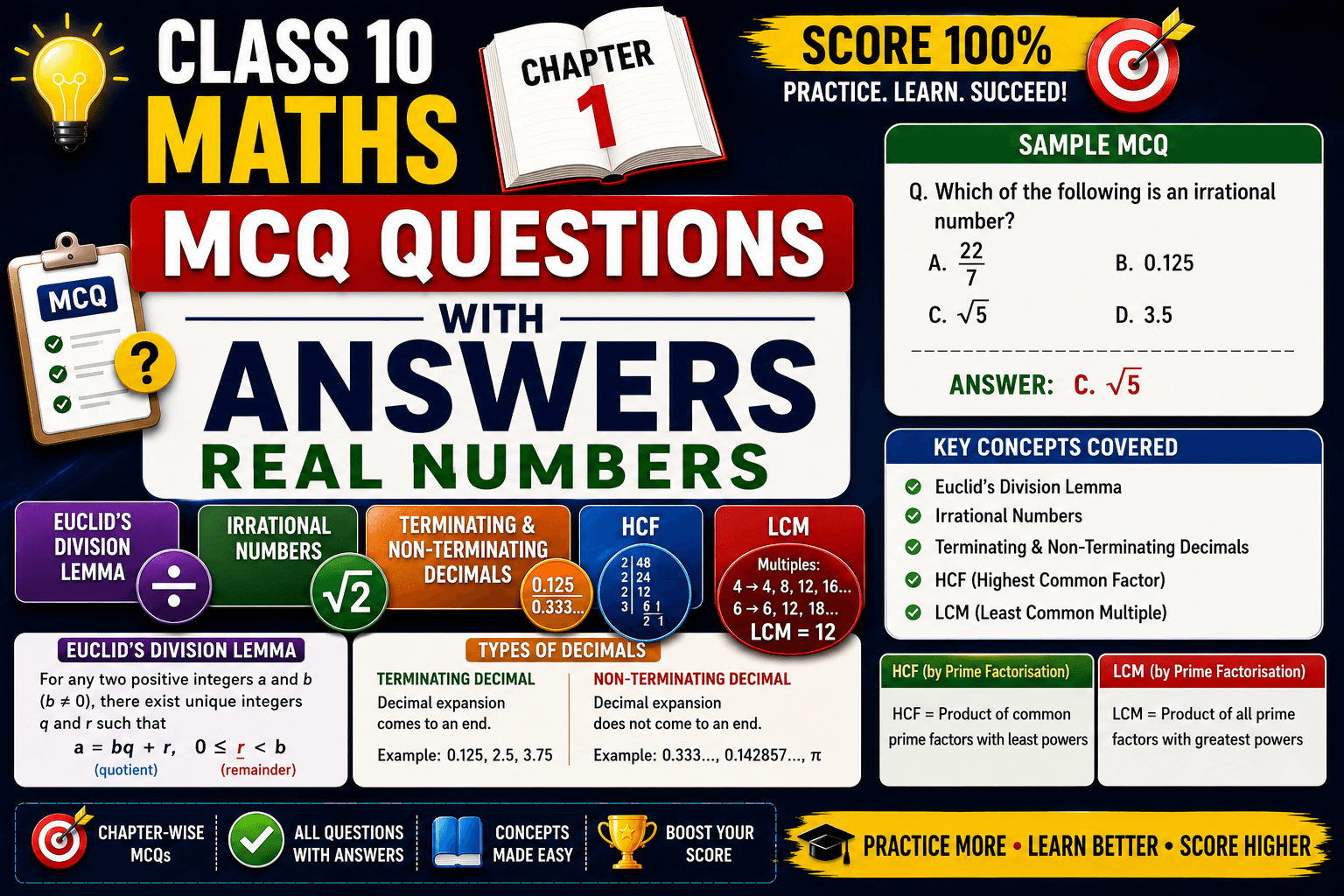
Practice Class 10 Maths Chapter 1 Real Numbers MCQ Questions with Answers based on NCERT syllabus. Learn Euclid’s Division Lemma, irrational numbers, terminating and non-terminating decimals, HCF, LCM, and prime factorization with detailed solutions and useful formulas for CBSE and state board exams.
Do You Know
Introduction:
Chapter 1 Real Numbers is one of the most important chapters in Class 10 Mathematics. This chapter introduces students to Euclid’s Division Lemma, Fundamental Theorem of Arithmetic, HCF, LCM, irrational numbers, and decimal expansions of rational numbers. Understanding these concepts is essential because they form the foundation for many advanced mathematical topics. The following MCQ questions are based on the NCERT syllabus and are designed to help students prepare for school examinations, board exams, scholarship tests, and competitive examinations. Each question includes a detailed solution and a useful formula section to improve conceptual understanding.
Q1. Which of the following numbers is a composite number?
A) $$11$$
B) $$13$$
C) $$19$$
D) $$21$$
Answer:
$$21$$
Useful Formula for this Question:
A prime number has exactly two factors:
$$1$$ and itself.
A composite number has more than two factors.
Solution:
Factors of $$21$$ are:
$$1, 3, 7, 21$$
Since $$21$$ has more than two factors, it is a composite number.
The numbers $$11$$, $$13$$, and $$19$$ have only two factors:
$$1$$ and the number itself.
Therefore, the correct answer is:
$$21$$
————————————————–
Q2. The denominator of a rational number in simplest form is:
$$2^3 \times 5^2$$
Its decimal expansion will be:
A) Non-terminating
B) Irrational
C) Terminating
D) Non-terminating non-recurring
Answer:
Terminating
Useful Formula for this Question:
A rational number has a terminating decimal expansion if the denominator contains only the prime factors:
$$2$$ and/or $$5$$
Solution:
Given denominator:
$$2^3 \times 5^2$$
The denominator contains only:
$$2$$ and $$5$$
Therefore, its decimal expansion will terminate.
Hence, the correct answer is:
Terminating
————————————————–
Q3. The HCF of $$24$$ and $$36$$ is:
A) $$6$$
B) $$8$$
C) $$12$$
D) $$18$$
Answer:
$$12$$
Useful Formula for this Question:
HCF is the greatest common factor of two or more numbers.
Solution:
Factors of $$24$$:
$$1, 2, 3, 4, 6, 8, 12, 24$$
Factors of $$36$$:
$$1, 2, 3, 4, 6, 9, 12, 18, 36$$
The greatest common factor is:
$$12$$
Therefore, the correct answer is:
$$12$$
————————————————–
Q4. Which of the following fractions has a non-terminating recurring decimal expansion?
A) $$\frac{3}{8}$$
B) $$\frac{7}{20}$$
C) $$\frac{5}{16}$$
D) $$\frac{2}{9}$$
Answer:
$$\frac{2}{9}$$
Useful Formula for this Question:
A rational number has a non-terminating recurring decimal expansion if the denominator contains prime factors other than:
$$2$$ and $$5$$
Solution:
For:
$$\frac{2}{9}$$
Denominator:
$$9 = 3^2$$
Since the denominator contains the prime factor:
$$3$$
the decimal expansion is non-terminating recurring.
In fact:
$$\frac{2}{9}=0.222222\ldots$$
Therefore, the correct answer is:
$$\frac{2}{9}$$
————————————————–
Q5. The smallest prime number is:
A) $$0$$
B) $$1$$
C) $$2$$
D) $$3$$
Answer:
$$2$$
Useful Formula for this Question:
A prime number has exactly two factors:
$$1$$ and itself.
Solution:
$$2$$ has exactly two factors:
$$1$$ and $$2$$
Therefore, $$2$$ is a prime number.
Also, it is the smallest prime number.
Note:
$$1$$ is neither prime nor composite.
Therefore, the correct answer is:
$$2$$
————————————————–
Important Concepts and Formulas:
Euclid’s Division Lemma:
$$a=bq+r$$
where
$$0 \le r < b$$
Relationship between HCF and LCM:
$$HCF \times LCM = Product\ of\ two\ numbers$$
A rational number has a terminating decimal expansion if the denominator contains only:
$$2$$ and/or $$5$$
A rational number has a non-terminating recurring decimal expansion if the denominator contains prime factors other than:
$$2$$ and $$5$$
————————————————–
FAQs:
Q. What is a composite number?
Answer:
A composite number has more than two factors.
Q. What is the smallest prime number?
Answer:
$$2$$
Q. When does a rational number have a terminating decimal expansion?
Answer:
When the denominator contains only the prime factors:
$$2$$ and/or $$5$$
————————————————–
Conclusion:
These Class 10 Maths Chapter 1 Real Numbers MCQs with detailed solutions and useful formulas help students build a strong foundation in number systems. Regular practice of HCF, LCM, prime factorization, irrational numbers, and decimal expansion questions can significantly improve exam performance and mathematical understanding.
Related links
- Class 10 SST: Liberalism, Agriculture, Constitution, GDP
- Class 10 Maths Chapter 1 Real Numbers MCQ for Board Exams
- Class 10-Maths Chapter 1–Real Numbers NCERT
- Class 10 Science MCQs with Answers | Biology & Physics
- Class 10 SST MCQs with Answers | Federalism & Freedom
- Class 10 SST MCQs with Detailed Black Soil, Sri Lanka
- Quiz Class 10th Social Science NCERT 26-05-2026
- Quiz Class 10th Social Science, NCERT MCQs 23-05-2026
- Quiz Class 10th Social Science, NCERT MCQs , 22-05-2026
Latest Posts
- NCERT Class 7 Maths Chapter 1 Integers,addition, subtraction
- Class 10 Maths Chapter-1 Real Numbers-Rational numbers-MCQ
- Class9 Maths- Number Systems, decimal expansion, exponents
- Class 8 Maths Chapter 1 Rational Numbers, multiplicative
- Class 10 Maths Chapter 1 Real Numbers MCQ Questions with Solutions
Join Our Other Communities
Instagram , Youtube , Facebook