

Welcome To My School Study
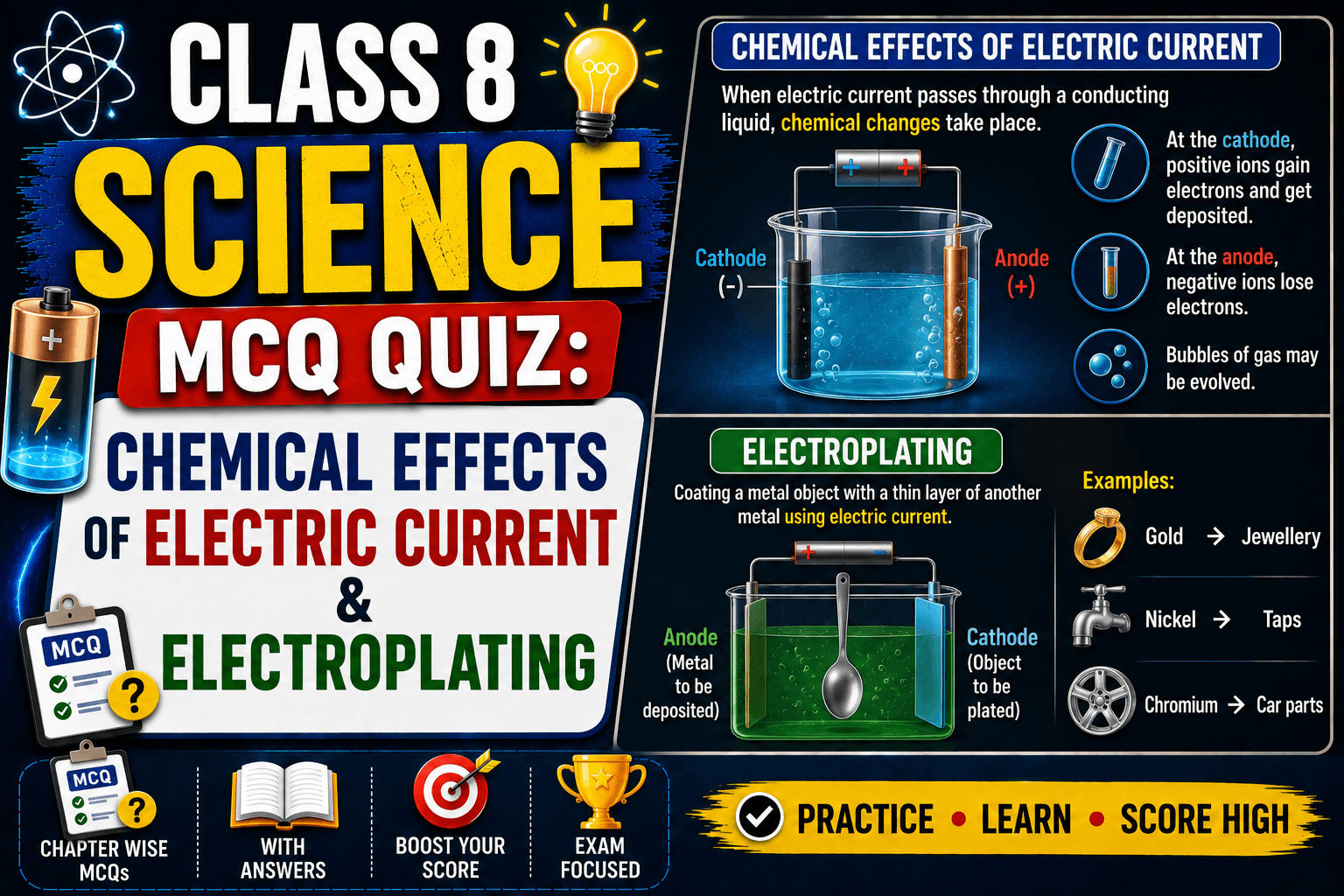
Practice Class 8 Science MCQs on electrolytes, electroplating, galvanization, chromium plating, conducting solutions, chemical effects of electric current, NCERT science, and exam preparation with detailed explanations.
Do You Know
Q1. An electrolyte is?
Correct Answer: A liquid that conducts electricity
Detailed Explanation:
An electrolyte is a liquid or solution that allows electric current to pass through it. This happens because electrolytes contain charged particles called ions. When certain substances dissolve in water, they break into positive and negative ions. These ions move freely within the solution and carry electric charge from one point to another.
Pure water is a poor conductor of electricity because it contains very few ions. However, when substances such as salt, acids, or bases are dissolved in water, the resulting solution becomes a good conductor. Examples of electrolytes include salt solution, lemon juice, vinegar, and copper sulphate solution.
Electrolytes play an important role in many scientific and industrial processes. They are used in batteries, electroplating, metal purification, and electrolysis. The human body also contains electrolytes such as sodium, potassium, and chloride ions that help regulate nerve signals and muscle function.
In Class 8 Science, electrolytes are studied to understand how electricity can pass through liquids. This concept helps students learn about the chemical effects of electric current and the practical applications of conducting solutions.
Understanding electrolytes is important because many everyday substances around us can conduct electricity due to the presence of ions.
Real-Life Examples:
- Salt water conducts electricity.
- Lemon juice acts as an electrolyte.
- Batteries contain electrolyte solutions.
Important NCERT Points:
- Electrolytes contain ions.
- Ions carry electric current.
- Many acids, bases, and salt solutions are electrolytes.
- Electrolytes are used in electroplating and batteries.
Exam-Oriented Fact:
A solution conducts electricity only when it contains free-moving ions.
Quick Revision Line:
An electrolyte is a liquid or solution that conducts electricity through ions.
Q2. Chromium plating is done on objects like car parts and taps because?
Correct Answer: It does not corrode and resists scratches
Detailed Explanation:
Chromium plating is a process in which a thin layer of chromium metal is deposited on the surface of another metal through electroplating. Chromium is highly resistant to corrosion and provides a shiny, attractive appearance.
Many objects such as car bumpers, bicycle handlebars, bathroom taps, kitchen fittings, and machine parts are coated with chromium. Although chromium itself is expensive, only a thin layer is required to protect the surface underneath.
One of the major advantages of chromium plating is that it prevents rusting and corrosion. It also makes the surface harder and more resistant to scratches. In addition, chromium plating improves the appearance of objects by giving them a bright and polished finish.
The process uses electric current and an electrolyte containing chromium ions. These ions are deposited on the object that needs protection.
Chromium plating demonstrates how science is used to increase the durability and lifespan of metal products. It combines chemistry, electricity, and engineering to solve practical problems in everyday life.
Real-Life Examples:
- Chrome-plated bathroom taps.
- Car bumpers with shiny coatings.
- Bicycle parts protected from corrosion.
Important NCERT Points:
- Chromium plating is a form of electroplating.
- Chromium resists corrosion.
- It protects surfaces from scratches.
- It improves appearance and durability.
Exam-Oriented Fact:
Chromium is commonly used for plating because it is shiny and corrosion-resistant.
Quick Revision Line:
Chromium plating protects metals from rust and scratches while improving their appearance.
Q3. Which of the following does not conduct electricity?
Correct Answer: Honey
Detailed Explanation:
Electricity passes through liquids when they contain free ions that can move and carry electric charge. Solutions such as vinegar, lemon juice, and tap water contain ions and therefore conduct electricity.
Honey, however, is a poor conductor of electricity. It mainly contains sugars and very little free water or ions. Since it lacks sufficient charged particles, electric current cannot pass through it easily.
Conductivity in liquids depends on the presence of dissolved salts, acids, or bases. Liquids rich in ions conduct electricity well, while liquids lacking ions conduct poorly.
This concept helps explain why some liquids are used in batteries and electrochemical cells while others are not. Scientists often test liquids using simple electrical circuits to determine whether they are conductors or insulators.
Understanding conducting and non-conducting liquids is an important part of the chapter on the chemical effects of electric current.
Real-Life Examples:
- Lemon juice conducts electricity.
- Vinegar acts as a conductor.
- Honey is a poor conductor.
Important NCERT Points:
- Conducting liquids contain ions.
- Honey contains very few free ions.
- Acids and salt solutions conduct electricity.
- Not all liquids are conductors.
Exam-Oriented Fact:
Honey generally does not conduct electricity because it lacks sufficient free ions.
Quick Revision Line:
Honey is a poor conductor of electricity compared to acidic or salt solutions.
Q4. The coating of zinc on iron to protect it from corrosion is called?
Correct Answer: Galvanization
Detailed Explanation:
Galvanization is the process of coating iron or steel with a layer of zinc to protect it from rusting and corrosion. Iron reacts with oxygen and moisture in the atmosphere to form rust, which weakens metal structures over time.
Zinc acts as a protective barrier between the iron surface and the environment. Even if the zinc coating gets slightly damaged, zinc continues to protect the iron because it reacts more readily with oxygen than iron does.
Galvanization is widely used in industries because it increases the lifespan of metal products. It is commonly applied to water pipes, roofing sheets, electric poles, fences, bridges, and construction materials.
This process helps reduce maintenance costs and improves safety by preventing metal structures from weakening due to corrosion.
Galvanization is different from electroplating because its primary purpose is corrosion protection rather than decoration.
Real-Life Examples:
- Galvanized iron pipes.
- Zinc-coated roofing sheets.
- Electric poles protected from rust.
Important NCERT Points:
- Zinc coating prevents rusting.
- The process is called galvanization.
- Zinc protects iron from corrosion.
- Galvanized products last longer.
Exam-Oriented Fact:
Galvanization is one of the most common methods used to prevent rusting of iron.
Quick Revision Line:
Galvanization is the coating of iron with zinc to prevent corrosion.
Q5. When electric current passes through a conducting solution, it causes?
Correct Answer: Chemical effect
Detailed Explanation:
When electric current passes through a conducting solution, it can produce chemical changes in the solution. This phenomenon is known as the chemical effect of electric current.
The current causes ions present in the solution to move toward oppositely charged electrodes. During this movement, chemical reactions occur. These reactions may produce gases, deposit metals, change the color of the solution, or form new substances.
The chemical effect of electric current forms the basis of many industrial applications. Electroplating, metal purification, battery charging, and extraction of metals all depend on this principle.
Scientists use these chemical effects to manufacture products, improve metal quality, and perform various laboratory experiments. The study of these effects helps students understand the connection between electricity and chemistry.
This topic is one of the most important concepts in the Class 8 Science chapter on Chemical Effects of Electric Current and is frequently asked in examinations.
Real-Life Examples:
- Electroplating of jewelry.
- Purification of copper.
- Charging rechargeable batteries.
Important NCERT Points:
- Electric current can cause chemical reactions.
- Conducting solutions contain moving ions.
- New substances may be formed.
- Electroplating is based on this effect.
Exam-Oriented Fact:
Electroplating is a direct application of the chemical effect of electric current.
Quick Revision Line:
Electric current passing through a conducting solution produces chemical effects.
Chapter Summary:
Electrolytes are conducting liquids that contain ions. Chromium plating protects metals from corrosion and scratches. Honey is a poor conductor because it lacks free ions. Galvanization protects iron by coating it with zinc. When electric current passes through a conducting solution, it produces chemical effects that are useful in electroplating, batteries, and metal purification. These concepts are important for Class 8 Science exams and practical applications in everyday life.
Related links
- Class 8 Science MCQ Quiz: Reproduction & Hormones
- Class 8 MCQ Questions Answers – History, Civics, Geography
- Class 8 MCQ Questions with Answers– History, Civics, Geography
Latest Posts
- Class 8 Maths Chapter 1 Properties of Rational Numbers
- Class7 Maths Chapter1 positive and negative integers
- Class10 Maths Chapter 1 Real Numbers Euclid Division Lemma
- Class 9 Maths Decimal Expansion, Exponents
- NCERT Class 7 Maths Chapter 1 Integers,addition, subtraction
Join Our Other Communities