

Welcome To My School Study
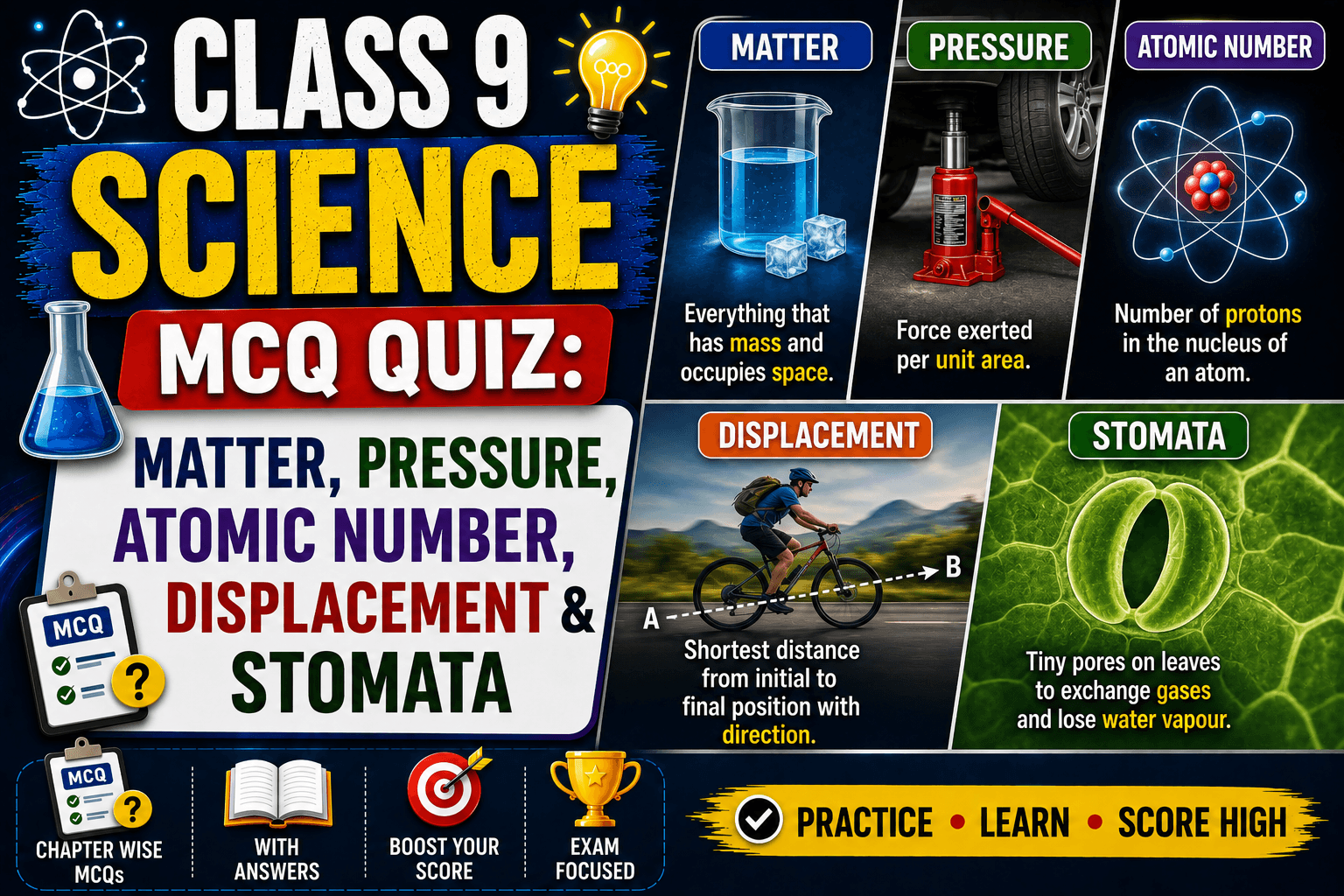
Practice Class 9 Science MCQs on matter, mass and volume, pressure formula, atomic number, protons, displacement, vectors, stomata, gas exchange, NCERT science, and exam preparation with detailed explanations.
Do You Know
Q1. Matter has:
Correct Answer: Both
Detailed Explanation:
Matter is anything that occupies space and has mass. Every object around us, whether it is a solid, liquid, or gas, is made up of matter. According to the basic definition given in NCERT Science, matter has two important properties: mass and volume.
Mass refers to the amount of substance present in an object. It is measured in kilograms (kg) or grams (g). Volume refers to the amount of space occupied by an object and is measured in cubic meters (m³), liters (L), or milliliters (mL).
For example, a book has mass because it contains matter, and it also occupies space on a table. Similarly, water in a bottle has mass and occupies volume. Even air, which cannot be seen easily, has both mass and volume. A balloon expands when filled with air because air occupies space.
The concept of matter is one of the most fundamental topics in science. Everything that we touch, see, smell, or use in daily life is composed of matter. Scientists classify matter into solids, liquids, and gases based on the arrangement and movement of particles.
Understanding the properties of matter helps students learn advanced topics such as states of matter, density, pressure, and chemical reactions. This concept forms the foundation of chemistry and physics.
Real-Life Examples:
- A school bag has mass and occupies space.
- Water in a bottle has volume and mass.
- Air inside a balloon occupies space.
Important NCERT Points:
- Matter has mass.
- Matter occupies space.
- Solids, liquids, and gases are forms of matter.
- Everything around us is made of matter.
Exam-Oriented Fact:
Anything that has mass and occupies space is called matter.
Quick Revision Line:
Matter possesses both mass and volume.
Q2. Pressure =
Correct Answer: Force/Area
Detailed Explanation:
Pressure is defined as the force acting per unit area of a surface. It tells us how much force is applied over a particular area. The mathematical formula for pressure is:
where:
- P = Pressure
- F = Force
- A = Area
The SI unit of pressure is Pascal (Pa). One Pascal is equal to one Newton of force acting on one square meter of area.
Pressure depends on both force and area. If the same force acts on a smaller area, pressure increases. If the area increases, pressure decreases. This principle explains many situations in daily life.
For example, a sharp knife cuts easily because the force is concentrated over a very small area, producing high pressure. Similarly, needles have pointed tips to increase pressure and penetrate materials easily.
Snow shoes are designed with a large surface area so that a person’s weight is spread over a larger area, reducing pressure on snow and preventing sinking.
Pressure is an important concept used in engineering, construction, medicine, and fluid mechanics.
Real-Life Examples:
- Sharp knives cut more easily.
- Needles have pointed tips.
- Snow shoes reduce pressure on snow.
Important NCERT Points:
- Pressure = Force ÷ Area.
- SI unit is Pascal (Pa).
- Smaller area produces greater pressure.
- Pressure depends on force and area.
Exam-Oriented Fact:
Pressure increases when the same force acts on a smaller area.
Quick Revision Line:
Pressure is the force acting per unit area.
Q3. Atomic number is equal to:
Correct Answer: Protons
Detailed Explanation:
The atomic number of an element is the number of protons present in the nucleus of an atom. It is represented by the symbol Z and helps identify an element uniquely.
Every element has a fixed atomic number. For example, hydrogen has an atomic number of 1 because it contains one proton. Carbon has an atomic number of 6 because it contains six protons. Oxygen has an atomic number of 8 because it contains eight protons.
The atomic number determines the identity and chemical properties of an element. If the number of protons changes, the element itself changes into a different element.
In a neutral atom, the number of electrons is equal to the number of protons. Therefore, atomic number is also equal to the number of electrons in a neutral atom. However, the formal definition of atomic number is based on protons.
Scientists arrange elements in the modern periodic table according to increasing atomic numbers. This arrangement helps explain patterns in chemical properties and atomic structure.
Understanding atomic number is essential for studying atomic models, electronic configuration, chemical bonding, and periodic classification.
Real-Life Examples:
- Hydrogen has atomic number 1.
- Carbon has atomic number 6.
- Oxygen has atomic number 8.
Important NCERT Points:
- Atomic number equals number of protons.
- It is represented by Z.
- It identifies an element uniquely.
- Elements are arranged according to atomic number.
Exam-Oriented Fact:
The atomic number never changes for a particular element.
Quick Revision Line:
Atomic number is equal to the number of protons in the nucleus.
Q4. Displacement is:
Correct Answer: Vector
Detailed Explanation:
Displacement is the shortest distance between the initial position and final position of an object along with the direction. Since displacement has both magnitude and direction, it is a vector quantity.
Many students confuse displacement with distance. Distance is the total path traveled by an object and is a scalar quantity because it has only magnitude. Displacement, however, considers direction as well.
For example, if a student walks 5 meters east and then returns 5 meters west to the starting point, the total distance traveled is 10 meters. However, the displacement is zero because the initial and final positions are the same.
Displacement can be positive, negative, or zero depending on the direction of motion. It helps scientists and engineers accurately describe movement.
Vector quantities are important in physics because direction often affects the result. Other examples of vector quantities include velocity, force, acceleration, and momentum.
Understanding displacement is essential for learning motion, velocity, and graphical representation of movement.
Real-Life Examples:
- Returning to the starting point gives zero displacement.
- GPS navigation uses displacement concepts.
- Aircraft navigation considers direction and displacement.
Important NCERT Points:
- Displacement has magnitude and direction.
- It is a vector quantity.
- It represents the shortest path.
- Displacement can be zero even when distance is not zero.
Exam-Oriented Fact:
Displacement depends on both distance and direction.
Quick Revision Line:
Displacement is the shortest distance between two points along with direction.
Q5. Stomata are for:
Correct Answer: Gas exchange
Detailed Explanation:
Stomata are tiny pores present mainly on the surface of leaves. They play an important role in the exchange of gases between plants and the atmosphere. Each stoma is surrounded by two guard cells that regulate its opening and closing.
During photosynthesis, plants take in carbon dioxide through stomata and release oxygen into the atmosphere. During respiration, oxygen enters the plant while carbon dioxide is released. Thus, stomata help in both photosynthesis and respiration.
Stomata also play a crucial role in transpiration, the process by which water vapor escapes from plant leaves. Transpiration helps cool the plant, maintain water movement, and transport minerals from roots to different parts of the plant.
The opening and closing of stomata depend on environmental conditions such as light, humidity, and water availability. When water is scarce, stomata may close to reduce water loss.
Without stomata, plants would not be able to exchange gases efficiently, and essential processes such as photosynthesis would be severely affected.
This topic is one of the most important concepts in plant physiology and frequently appears in school examinations.
Real-Life Examples:
- Plants absorb carbon dioxide through stomata.
- Oxygen is released through stomata during photosynthesis.
- Water vapor escapes through stomata during transpiration.
Important NCERT Points:
- Stomata are tiny pores on leaves.
- They help in gas exchange.
- They regulate transpiration.
- Guard cells control opening and closing.
Exam-Oriented Fact:
Stomata are often called the breathing pores of plants.
Quick Revision Line:
Stomata are tiny pores that help plants exchange gases with the atmosphere.
Chapter Summary:
Matter has both mass and volume. Pressure is defined as force per unit area. Atomic number represents the number of protons in an atom. Displacement is a vector quantity because it has both magnitude and direction. Stomata are tiny pores that help plants exchange gases and regulate transpiration. These concepts form the foundation of Class 9 Science and are important for school exams and future scientific studies.
Related Links
- Class 9 Science MCQs with Answers | Force & Motion
- Class 9 MCQ Q&A– Civics, Economics, History
- Class 9 MCQ Questions Answers– History, Geography, Civics
- Class 9 MCQ Questions Answers– History, Geography, Civics
- Class 9 SST MCQs with Detailed Explanations
Latest Posts
- Class 8 Maths Chapter 1 Properties of Rational Numbers
- Class7 Maths Chapter1 positive and negative integers
- Class10 Maths Chapter 1 Real Numbers Euclid Division Lemma
- Class 9 Maths Decimal Expansion, Exponents
- NCERT Class 7 Maths Chapter 1 Integers,addition, subtraction
Join Our Other Communities