

Welcome To My School Study
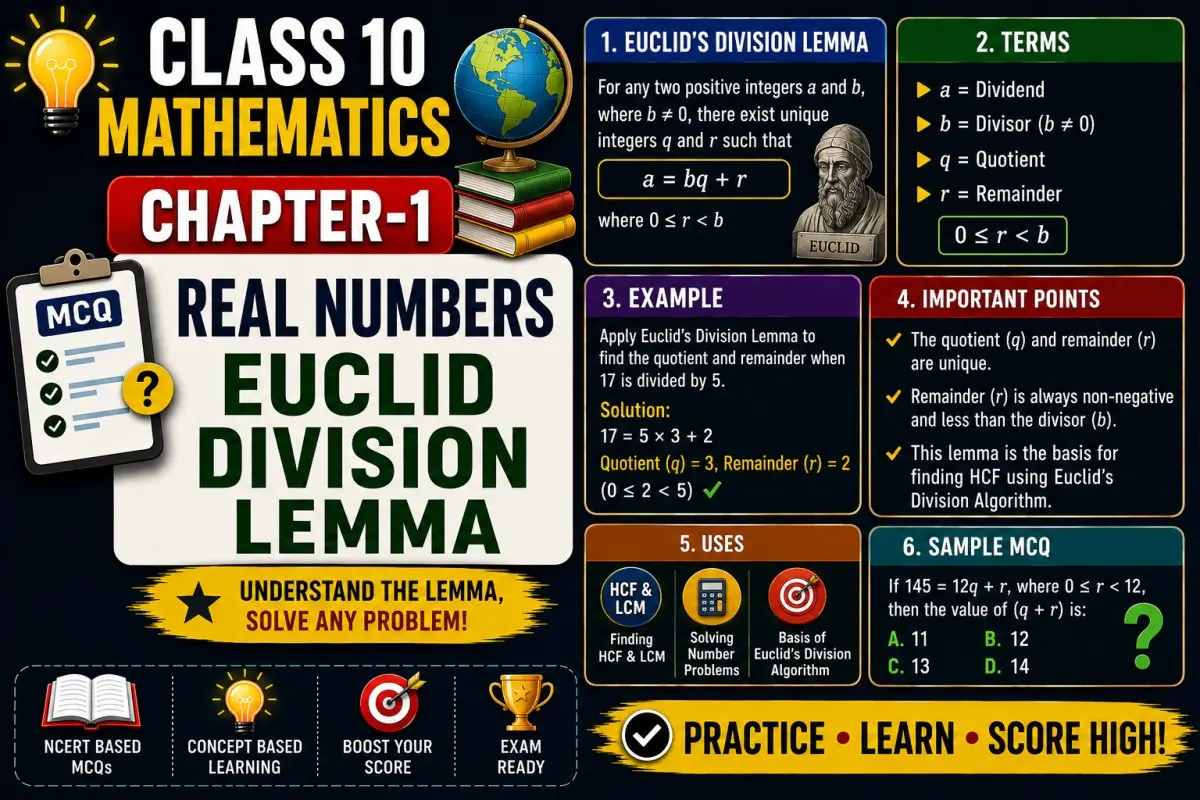
Practice Class 10 Maths Chapter 1 Real Numbers MCQ Questions with Answers and detailed solutions. Learn HCF, LCM, irrational numbers, Euclid Division Lemma, prime factorization, and decimal expansion based on NCERT syllabus.
Do You Know
Chapter Information
Subject: Mathematics
Class: 10
Chapter: Real Numbers
Question Type: Multiple Choice Questions (MCQs)
Difficulty Level: Easy to Moderate
Based On: NCERT Latest Syllabus
Introduction:
The chapter Real Numbers introduces students to important mathematical concepts such as Euclid’s Division Lemma, HCF, LCM, prime factorization, irrational numbers, and decimal expansions. These concepts help students understand the structure of numbers and their properties. Questions from this chapter are frequently asked in school examinations and board exams. Practicing MCQs with detailed solutions helps improve conceptual clarity and problem-solving skills.
What You Will Learn?
✔ Euclid’s Division Lemma
✔ Prime Numbers
✔ Composite Numbers
✔ HCF and LCM
✔ Irrational Numbers
✔ Decimal Expansions
✔ Prime Factorization
Why This Topic Is Important?
Real Numbers forms the foundation of algebra and number theory. Understanding this chapter helps students solve advanced mathematical problems in later classes and perform better in board examinations.
Exam Relevance
These questions are useful for:
✔ CBSE Board Exams
✔ State Board Exams
✔ School Tests
✔ Half-Yearly Exams
✔ Annual Exams
✔ Scholarship Examinations
Q1. Which of the following is a prime number?
A) $$27$$
B) $$39$$
C) $$41$$
D) $$51$$
Answer:
$$41$$
Useful Formula for this Question:
A prime number has exactly two factors:
$$1$$ and itself.
Solution:
$$41$$ is divisible only by:
$$1$$ and $$41$$
The remaining numbers have more than two factors.
Therefore, the correct answer is:
$$41$$
Q2. The HCF of $$54$$ and $$72$$ is:
A) $$12$$
B) $$18$$
C) $$24$$
D) $$36$$
Answer:
$$18$$
Useful Formula for this Question:
HCF is obtained using common prime factors.
Solution:
$$54 = 2 \times 3^3$$
$$72 = 2^3 \times 3^2$$
Common prime factors:
$$2 \times 3^2$$
$$= 18$$
Therefore:
$$HCF = 18$$
Q3. Which of the following numbers is irrational?
A) $$0.125$$
B) $$\frac{9}{11}$$
C) $$\sqrt{13}$$
D) $$0.6666\ldots$$
Answer:
$$\sqrt{13}$$
Useful Formula for this Question:
An irrational number cannot be written as:
$$\frac{p}{q}$$
Solution:
$$\sqrt{13}$$ is non-terminating and non-recurring.
Therefore, it is irrational.
Hence, the correct answer is:
$$\sqrt{13}$$
Q4. The LCM of $$14$$ and $$21$$ is:
A) $$28$$
B) $$42$$
C) $$56$$
D) $$84$$
Answer:
$$42$$
Useful Formula for this Question:
Take highest powers of all prime factors.
Solution:
$$14 = 2 \times 7$$
$$21 = 3 \times 7$$
LCM:
$$2 \times 3 \times 7$$
$$= 42$$
Therefore:
$$LCM = 42$$
Q5. Which fraction has a terminating decimal expansion?
A) $$\frac{3}{25}$$
B) $$\frac{5}{27}$$
C) $$\frac{7}{18}$$
D) $$\frac{11}{21}$$
Answer:
$$\frac{3}{25}$$
Useful Formula for this Question:
The denominator should contain only:
$$2$$ and/or $$5$$
Solution:
$$25 = 5^2$$
Since only factor $$5$$ is present, the decimal expansion terminates.
$$\frac{3}{25}=0.12$$
Therefore, the correct answer is:
$$\frac{3}{25}$$
Important Formulas and Concepts
$$a = bq + r$$
where
$$0 \le r < b$$
$$HCF \times LCM = Product\ of\ two\ numbers$$
A rational number is of the form:
$$\frac{p}{q}$$
where $$q \ne 0$$
FAQs
Q. What is the smallest prime number?
Answer:
$$2$$
Q. What is an irrational number?
Answer:
A number that cannot be written in the form:
$$\frac{p}{q}$$
Q. What is the HCF?
Answer:
The greatest common factor of two or more numbers.
Common Mistakes Students Make
❌ Treating 1 as a prime number.
❌ Confusing HCF and LCM.
❌ Ignoring repeated prime factors.
❌ Assuming every decimal is rational.
Quick Revision Notes
✔ 2 is the smallest prime number.
✔ 1 is neither prime nor composite.
✔ HCF uses common factors.
✔ LCM uses highest powers.
✔ Irrational numbers cannot be written as:
$$\frac{p}{q}$$
Conclusion:
These Class 10 Maths Chapter 1 MCQs with answers and solutions help students improve conceptual understanding and exam preparation. Regular practice of Real Numbers questions strengthens mathematical reasoning and problem-solving skills.
Related links
- Class 10 Maths Chapter-1 Real Numbers-Rational numbers-MCQ
- Class 10 Maths Chapter 1 Real Numbers MCQ Questions with Solutions
- Class 10 Maths Chapter 1 Real Numbers MCQs with Solutions
- Class 10 SST: Liberalism, Agriculture, Constitution, GDP
- Class 10 Maths Chapter 1 Real Numbers MCQ for Board Exams
- Class 10-Maths Chapter 1–Real Numbers NCERT
- Class 10 Science MCQs with Answers | Biology & Physics
- Class 10 SST MCQs with Answers | Federalism & Freedom
- Class 10 SST MCQs with Detailed Black Soil, Sri Lanka
- Quiz Class 10th Social Science NCERT 26-05-2026
Latest Posts
- Class 8 Maths Chapter 1 Properties of Rational Numbers
- Class7 Maths Chapter1 positive and negative integers
- Class10 Maths Chapter 1 Real Numbers Euclid Division Lemma
- Class 9 Maths Decimal Expansion, Exponents
- NCERT Class 7 Maths Chapter 1 Integers,addition, subtraction
Join Our Other Communities
Instagram , Youtube , Facebook