

Welcome To My School Study
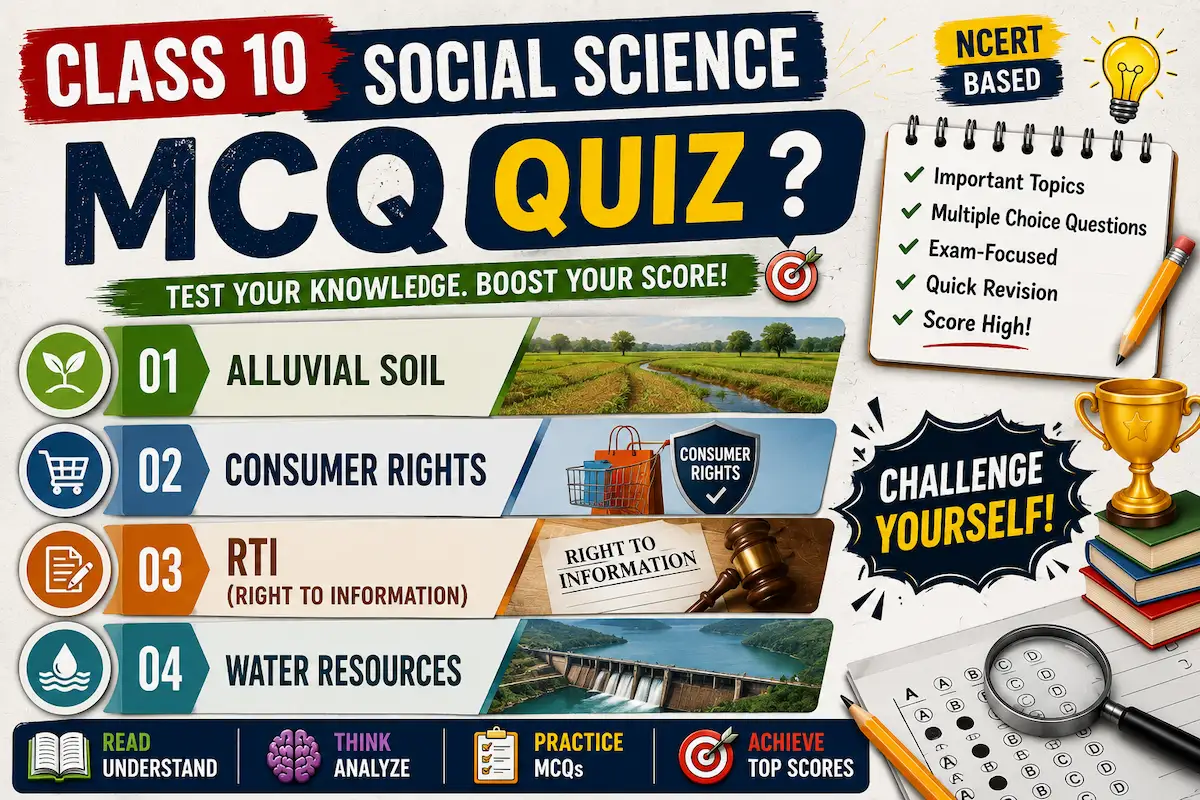
Practice Class 10 Social Science MCQs on alluvial soil, Consumer Protection Act 1986, Right to Information Act 2005, water crisis, Hind Swaraj, and Indian geography with detailed explanations, NCERT notes, memory tricks, revision facts, FAQs, and exam-oriented preparation.
Do You Know
Introduction
Class 10 Social Science helps students understand India’s geography, economics, political system, and history. Topics such as soil resources, consumer rights, transparency laws, water management, and freedom struggle literature are important not only for board examinations but also for various competitive exams. Understanding these concepts develops awareness about citizens’ rights, environmental sustainability, and national development. This MCQ quiz provides detailed explanations, real-life examples, NCERT-based concepts, memory tricks, exam-oriented facts, and revision notes to strengthen conceptual understanding and improve examination performance.
Q1. Which soil is found in the northern plains of India?
Correct Answer: B) Alluvial Soil (जलोढ़ मिट्टी)
Detailed Explanation
Alluvial soil is the most widespread and agriculturally productive soil found in India. It is formed by the deposition of sediments carried by rivers such as the Ganga, Yamuna, Brahmaputra, Indus, and their tributaries. Over thousands of years, these rivers transported fine particles of sand, silt, clay, and organic matter from mountainous regions and deposited them across the northern plains.
The Northern Plains, stretching across Punjab, Haryana, Uttar Pradesh, Bihar, West Bengal, and Assam, are largely covered with alluvial soil. Because of its high fertility, this soil supports intensive agriculture and contributes significantly to India’s food production.
Alluvial soil contains adequate amounts of potash, lime, and phosphoric acid, which are beneficial for crop growth. Crops such as wheat, rice, sugarcane, maize, pulses, and vegetables grow exceptionally well in this soil.
NCERT classifies alluvial soil into two categories:
Bhangar: Older alluvial soil found in elevated areas.
Khadar: Newer alluvial soil deposited annually by floodwaters and generally more fertile.
The fertility of alluvial soil has played a major role in the development of civilizations and agriculture in the Indo-Gangetic Plains. Even today, many of India’s most productive agricultural regions depend upon this soil.
Because it is easy to cultivate and highly fertile, alluvial soil remains one of India’s most valuable natural resources. Farmers often prefer this soil because it responds well to irrigation and fertilizers, leading to high agricultural yields.
Real-Life Examples
- Wheat farming in Punjab and Haryana.
- Rice cultivation in Bihar and Uttar Pradesh.
- Sugarcane production in the Ganga plains.
Important NCERT Points
- Formed by river deposits.
- Most fertile soil in India.
- Found mainly in Northern Plains.
- Suitable for intensive agriculture.
Why Other Options Are Wrong
A) Black Soil
Found mainly in the Deccan Plateau and suitable for cotton cultivation.
C) Red Soil
Commonly found in southern and eastern India.
D) Laterite Soil
Found in high-rainfall regions and less fertile naturally.
Exam-Oriented Fact
Nearly 40% of India’s total land area is covered by alluvial soil.
Memory Trick
“Alluvial = Along Rivers”
Quick Revision Line
Northern Plains of India are mainly covered with fertile alluvial soil.
Related Questions
- What is Khadar soil?
- Which crops grow best in alluvial soil?
- Which rivers deposit alluvial soil?
Q2. When was the Consumer Protection Act (COPRA) passed in India?
Correct Answer: B) 1986
Detailed Explanation
The Consumer Protection Act, popularly known as COPRA, was enacted in India in 1986 to protect consumers from exploitation and unfair trade practices. Before this legislation, consumers often faced problems such as defective products, misleading advertisements, poor services, overcharging, and lack of legal remedies.
The main objective of COPRA was to provide consumers with an effective and inexpensive system for resolving disputes. The Act empowered consumers by granting them legal rights and establishing consumer courts at different levels.
The Act introduced a three-tier redressal system:
- District Consumer Forum
- State Consumer Commission
- National Consumer Commission
Under this law, consumers received several important rights:
- Right to Safety
- Right to Information
- Right to Choose
- Right to Be Heard
- Right to Seek Redressal
- Right to Consumer Education
Consumer awareness has increased significantly since the introduction of COPRA. Today, customers can file complaints regarding defective goods, poor services, false advertisements, and unfair business practices.
With the rapid growth of online shopping and digital marketplaces, consumer protection has become even more important. The Consumer Protection Act 2019 further strengthened consumer rights by addressing issues related to e-commerce and digital transactions.
The law encourages businesses to maintain quality standards and ethical practices. It also promotes accountability among manufacturers, service providers, and sellers.
For students, COPRA is an important topic because it connects economics with everyday life and helps individuals understand their rights as consumers.
Real-Life Examples
- Returning defective mobile phones.
- Complaining against misleading advertisements.
- Seeking compensation for poor service quality.
Important NCERT Points
- Passed in 1986.
- Protects consumer interests.
- Provides legal remedies.
- Promotes consumer awareness.
Why Other Options Are Wrong
A) 1980
Consumer Protection Act had not been enacted.
C) 1990
Incorrect year.
D) 1995
Incorrect year.
Exam-Oriented Fact
The abbreviation COPRA is frequently asked in CBSE board examinations.
Memory Trick
Consumer Protection = COPRA = 1986
Quick Revision Line
Consumer Protection Act was passed in India in 1986.
Related Questions
- What are consumer rights?
- What is the role of consumer courts?
- What is consumer awareness?
Q3. Right to Information (RTI) was enacted in which year?
Correct Answer: B) 2005
Detailed Explanation
The Right to Information (RTI) Act was enacted in India in 2005 to promote transparency, accountability, and openness in government functioning. It empowers citizens to request information from public authorities and government departments regarding their activities, decisions, expenditures, and policies.
Before the RTI Act, obtaining government information was often difficult. Many administrative processes lacked transparency, making it hard for citizens to monitor public institutions. RTI was introduced to strengthen democracy by ensuring that government actions remain accountable to the people.
Under the RTI Act, any Indian citizen can submit an application seeking information from government offices. The concerned department is generally required to provide the requested information within a specified period.
RTI has played a significant role in exposing corruption, improving governance, and increasing public participation in administration. It enables citizens to monitor the use of public funds and understand how government decisions are made.
The law applies to central, state, and local government bodies, as well as institutions substantially funded by the government. However, certain sensitive information related to national security and personal privacy may be exempt from disclosure.
RTI is often referred to as a powerful tool for democratic accountability because it gives ordinary citizens direct access to information that affects their lives. It encourages transparency and helps build trust between citizens and public institutions.
Students should understand RTI because it highlights the importance of informed citizenship and responsible governance.
Real-Life Examples
- Requesting details about road construction projects.
- Seeking information on government welfare schemes.
- Asking for expenditure records of public projects.
Important NCERT Points
- Enacted in 2005.
- Promotes transparency.
- Strengthens democracy.
- Enhances government accountability.
Why Other Options Are Wrong
A) 2002
RTI Act had not been implemented.
C) 2008
The Act was already operational.
D) 2010
Incorrect year.
Exam-Oriented Fact
RTI is considered one of India’s most important transparency laws.
Memory Trick
RTI → Right To Information → 2005
Quick Revision Line
The Right to Information Act was enacted in India in 2005.
Related Questions
- What is transparency in governance?
- Who can file an RTI application?
- Why is RTI important in democracy?
Q4. What is the main cause of the water crisis in many cities?
Correct Answer: D) All of the above (Over-exploitation, Low Rainfall, Pollution)
Detailed Explanation
Water is one of the most important natural resources required for drinking, agriculture, industries, sanitation, and daily life. Despite covering a large part of the Earth, usable freshwater is limited. Today, many cities in India and around the world face serious water shortages. The water crisis is not caused by a single factor but by several interconnected reasons, which is why the correct answer is “All of the above.”
One major cause is over-exploitation of groundwater. As urban populations grow, the demand for water increases rapidly. People, industries, and agricultural activities extract large amounts of groundwater through wells and tube wells. When groundwater is withdrawn faster than it is naturally replenished, water tables begin to decline, leading to shortages.
Another important factor is low rainfall and irregular monsoons. Many regions depend heavily on seasonal rainfall for replenishing rivers, lakes, reservoirs, and groundwater. Climate change and changing weather patterns have made rainfall less predictable in many areas, resulting in water scarcity.
Water pollution is also a major contributor to the crisis. Industrial waste, untreated sewage, agricultural chemicals, and plastic waste contaminate rivers, lakes, and groundwater sources. Even when water is available, it may not be safe for drinking or domestic use due to pollution.
Rapid urbanization further worsens the situation. As cities expand, natural water bodies are often encroached upon or destroyed. Concrete roads and buildings reduce groundwater recharge because rainwater cannot easily seep into the soil.
Poor water management, leakage in distribution systems, wastage of water, and lack of rainwater harvesting also contribute significantly to water shortages. Sustainable solutions such as water conservation, efficient irrigation, wastewater treatment, and rainwater harvesting are essential for addressing the growing crisis.
Understanding the causes of water scarcity helps students appreciate the importance of conserving water for future generations.
Real-Life Examples
- Water shortages in cities like Chennai and Bengaluru.
- Falling groundwater levels in many urban areas.
- Pollution of rivers due to untreated sewage.
Important NCERT Points
- Water is a renewable but limited resource.
- Overuse causes depletion of groundwater.
- Pollution reduces the availability of usable water.
- Rainwater harvesting helps conserve water.
Why Other Options Are Wrong
A) Over-exploitation
This is a major cause but not the only cause.
B) Low Rainfall
It contributes significantly but does not explain the entire crisis.
C) Pollution
Pollution is important but not the sole reason.
D) All of the Above
Correct because all listed factors contribute to water scarcity.
Exam-Oriented Fact
Many Indian cities now depend heavily on groundwater due to increasing water demand.
Memory Trick
“Water Crisis = OLP”
O → Over-exploitation
L → Low Rainfall
P → Pollution
Quick Revision Line
Water crisis is caused by over-exploitation, low rainfall, pollution, and poor water management.
Related Questions
- What is rainwater harvesting?
- How does groundwater depletion occur?
- What are the effects of water pollution?
Q5. Who was the author of the book ‘Hind Swaraj’?
Correct Answer: C) Mahatma Gandhi
Detailed Explanation
Hind Swaraj is one of the most influential books written by Mahatma Gandhi. It was written in 1909 during his journey from London to South Africa. The book is considered a foundational text of Gandhi’s political and social philosophy and played an important role in shaping India’s freedom movement.
The term “Swaraj” means self-rule or self-governance. In Hind Swaraj, Gandhi explained his vision of an independent India based on truth, non-violence, moral values, self-discipline, and village-based development. He believed that true freedom meant not only political independence from British rule but also social, economic, and moral self-reliance.
The book criticizes the negative aspects of modern industrial civilization, excessive materialism, and blind imitation of Western models of development. Gandhi argued that genuine progress should be based on ethical values and the welfare of all people rather than merely economic growth.
Hind Swaraj also emphasizes the importance of non-violent resistance (Satyagraha) as a means of achieving political change. Gandhi believed that violence creates further conflict, whereas non-violence promotes justice and lasting peace.
The ideas expressed in Hind Swaraj later became central to India’s independence movement. Gandhi’s emphasis on truth, simplicity, self-reliance, and peaceful resistance inspired millions of Indians to participate in the struggle for freedom.
Today, Hind Swaraj continues to be studied by scholars, historians, and political thinkers because it provides valuable insights into Gandhi’s vision of society, governance, and sustainable development.
For Class 10 students, understanding Hind Swaraj is important because it helps explain Gandhi’s ideology and its influence on India’s national movement.
Real-Life Examples
- Gandhian philosophy influenced the freedom struggle.
- Non-violent protests inspired movements across the world.
- Village self-reliance remains an important development concept.
Important NCERT Points
- Written by Mahatma Gandhi.
- Published in 1909.
- Discusses Swaraj and self-rule.
- Promotes non-violence and self-reliance.
Why Other Options Are Wrong
A) Jawaharlal Nehru
He wrote The Discovery of India, not Hind Swaraj.
B) Subhash Chandra Bose
He was a nationalist leader but not the author.
D) Sardar Patel
Important freedom fighter but not the author of Hind Swaraj.
C) Mahatma Gandhi
Correct answer.
Exam-Oriented Fact
Hind Swaraj is one of Gandhi’s most important political writings and is frequently mentioned in NCERT History chapters.
Memory Trick
“Hind Swaraj = Gandhi’s Swaraj”
Quick Revision Line
Mahatma Gandhi wrote Hind Swaraj in 1909.
Related Questions
- What is Satyagraha?
- What does Swaraj mean?
- How did Gandhi influence the freedom movement?
Final Revision Notes
Geography
- Northern Plains → Alluvial Soil
- Water Crisis → Over-exploitation + Pollution + Low Rainfall
Economics
- Consumer Protection Act (COPRA) → 1986
- Consumer Rights protect buyers from exploitation.
Political Science
- RTI Act → 2005
- RTI promotes transparency and accountability.
History
- Hind Swaraj → Mahatma Gandhi (1909)
- Swaraj means self-rule.
FAQ Section
Q1. Which soil is most common in the Northern Plains?
Alluvial soil is the dominant soil type found in the Northern Plains of India.
Q2. What is the purpose of the Consumer Protection Act?
It protects consumers from unfair trade practices and provides legal remedies.
Q3. Why is RTI important?
RTI promotes transparency, accountability, and citizen participation in governance.
Q4. What are the main causes of water scarcity?
Over-exploitation of groundwater, pollution, low rainfall, urbanization, and poor water management.
Q5. Who wrote Hind Swaraj and when?
Mahatma Gandhi wrote Hind Swaraj in 1909.
Q6. What is the meaning of Swaraj?
Swaraj means self-rule or self-governance.
Q7. Which Act empowers citizens to seek information from government departments?
The Right to Information (RTI) Act, 2005.
Q8. Why is alluvial soil considered fertile?
It contains nutrient-rich river deposits and supports the cultivation of many crops.
Related links
- Class 10 Social Science: Project Tiger, Green Revolution
- Class 10 Maths Chapter 1 Real Numbers, HCF, LCM,
- Class 10 Maths Chapter 1 Real Numbers prime factorization
- Class 10 Maths Chapter 1 Real Numbers Euclid Division Lemma
- Class 10 Maths Chapter-1 Real Numbers-Rational numbers-MCQ
- Class 10 Maths Chapter 1 Real Numbers MCQ Questions with Solution
- Class 10 Maths Chapter 1 Real Numbers MCQ for Board Exams
- Class 10 SST MCQs with Answers | Federalism & Freedom
Latest Posts
- Class 7 Maths Chapter 1 Integers, number line, subtraction
- Class 8 Maths additive inverse, multiplicative inverse MCQ
- Class 9 Maths Chapter 1 Number Systems laws of exponents
- Class 10 Maths Chapter 2 Polynomials MCQ linear polynomial
- Class 10 Maths Chapter 2 Polynomials, linear polynomial
Join Our Other Communities
Instagram , Youtube , Facebook