

Welcome To My School Study
Do You Know
Q1. Which of the following is a leading producer of Rice in the world?
Comprehensive Description
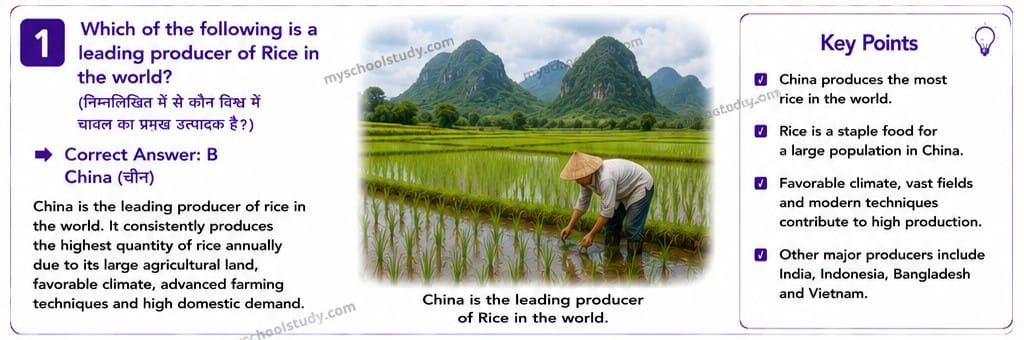
Rice is the staple food crop for a majority of the world’s population, especially in Asia. China is the leading producer of rice globally, accounting for approximately 30% of the total world production.
Rice is a tropical and subtropical crop that requires specific environmental conditions often referred to as “wet-foot” cultivation because the plants grow best when submerged in water during most of the growing season.
Step-by-Step Solution & Geography
- Climate: Rice requires high temperature (above 25°C) and high humidity.
- Rainfall: It needs heavy annual rainfall (above 100 cm). In areas with less rain, it is grown with the help of irrigation.
- Soil: Deep fertile clayey or alluvial soil, which can retain water, is ideal for rice cultivation.
Options Analysis
- A) India: India is the second-largest producer of rice in the world. It leads the world in the export of Basmati rice.
- B) China: The Correct Answer. China has consistently held the top rank due to advanced high-yield varieties and intensive farming.
- C) Japan: Produces high-quality rice (like Sushi rice) but lacks the massive land area to be a “leading” world producer compared to China or India.
- D) Sri Lanka: Rice is a major crop there, but its total production is small on a global scale.
Key Points to Remember
- The International Rice Research Institute (IRRI) is located in the Philippines.
- In India, West Bengal is the leading state for rice production.
Q2. The first rebellion against the British in 1857 started from which city?
Comprehensive Description
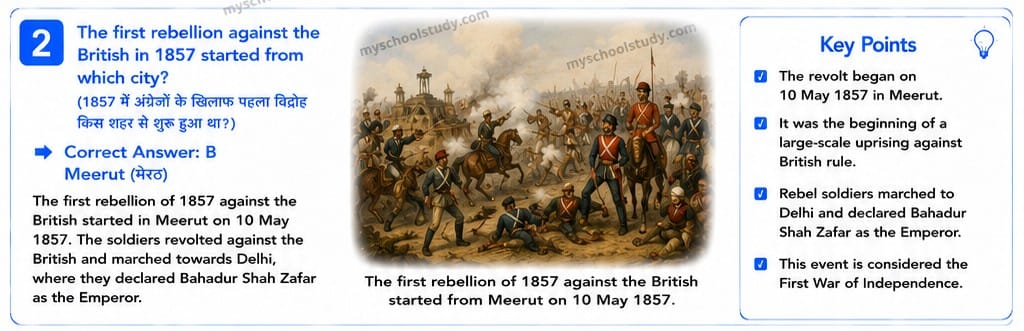
The Revolt of 1857, also known as the “Sepoy Mutiny” or the “First War of Independence,” officially broke out on May 10, 1857, in the garrison town of Meerut.
While there were earlier incidents of unrest (like Mangal Pandey in Barrackpore in March 1857), the large-scale organized rebellion where soldiers disobeyed their British officers, liberated their comrades, and marched toward Delhi started in Meerut.
The Chain of Events
- The Cause: Introduction of the “Enfield Rifle” with cartridges rumored to be greased with cow and pig fat.
- The Outbreak: 85 sepoys in Meerut refused to use the cartridges and were sentenced to 10 years in jail.
- The Rebellion: On May 10, their fellow soldiers revolted, killed British officers, and set the prisoners free.
- The March: That night, the sepoys rode to Delhi to declare the Mughal Emperor Bahadur Shah Zafar as the leader of India.
[Image map of centers of the 1857 revolt in India]
Options Analysis
- A) Delhi: This was the symbolic center of the revolt where the sepoys gathered, but it was not where it started.
- B) Meerut: The Correct Answer. This was the starting point of the mass rebellion.
- C) Jhansi & D) Kanpur: These became major centers of the revolt later, led by Rani Lakshmi Bai and Nana Saheb respectively.
Q3. How many fundamental rights are currently provided by the Indian Constitution?
Comprehensive Description
Currently, the Indian Constitution provides 6 Fundamental Rights to its citizens. These are enshrined in Part III (Articles 12 to 35).
Originally, the Constitution provided 7 fundamental rights. However, the Right to Property was removed from the list of Fundamental Rights by the 44th Amendment Act in 1978. It is now only a legal right under Article 300A.
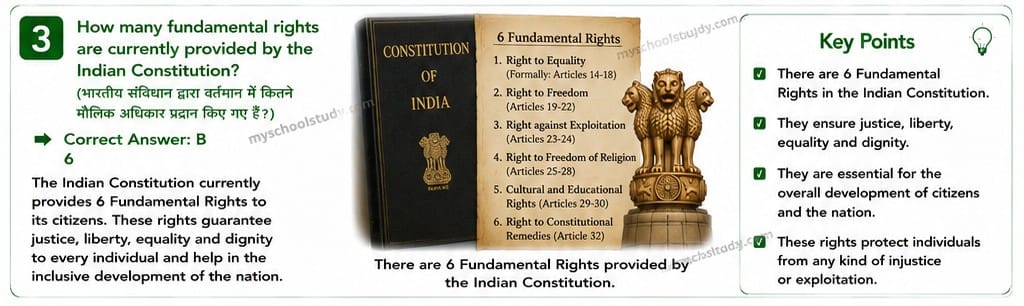
The 6 Fundamental Rights
- Right to Equality (Articles 14–18)
- Right to Freedom (Articles 19–22)
- Right against Exploitation (Articles 23–24)
- Right to Freedom of Religion (Articles 25–28)
- Cultural and Educational Rights (Articles 29–30)
- Right to Constitutional Remedies (Article 32)
Options Analysis
- A) 5: Incorrect.
- B) 6: The Correct Answer.
- C) 7: This was the original number before 1978.
- D) 8: Incorrect.
Key Points to Remember
- Dr. B.R. Ambedkar called the Right to Constitutional Remedies (Article 32) the “Heart and Soul of the Constitution” because it allows citizens to go to court if their rights are violated.
Q4. Silicon Valley is located in which part of the world?
Comprehensive Description
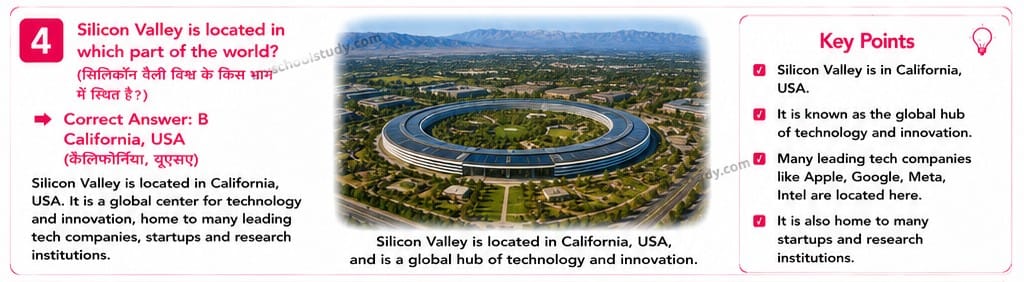
Silicon Valley is a global center for high technology and innovation. It is located in the southern part of the San Francisco Bay Area in California, USA.
It is called “Silicon” Valley because of the large number of silicon chip (semiconductor) innovators and manufacturers that started there. Today, it is home to the headquarters of the world’s biggest tech companies like Google, Apple, Meta (Facebook), and Intel.
Why did it develop there?
- Educational Hub: Presence of Stanford University provided talented engineers.
- Climate: Pleasant weather attracted skilled professionals.
- Venture Capital: Availability of investors willing to put money into new technology.
Options Analysis
- A) Bangalore, India: Known as the “Silicon Valley of India” because it is India’s leading IT hub, but the original “Silicon Valley” is in the US.
- B) California, USA: The Correct Answer.
- C) Tokyo, Japan: A major tech city, but known more for robotics and electronics hardware.
- D) London, UK: A global financial hub, but not “Silicon Valley.”
Real-Life Examples
- Example (Tech Birthplace): If you are using a smartphone or a computer right now, the operating system (like Android or Windows) or the chips inside were likely designed or conceived in the offices of Silicon Valley.
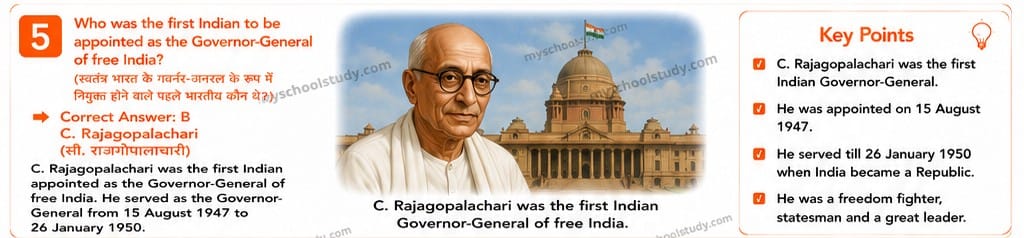
Q5. Who was the first Indian to be appointed as the Governor-General of free India?
Comprehensive Description
Chakravarti Rajagopalachari (popularly known as Rajaji) was the first and only Indian to hold the office of the Governor-General of independent India.
After India gained independence on August 15, 1947, Lord Mountbatten continued as the Governor-General for a short transition period. When he left in June 1948, Rajagopalachari was appointed to the post. He served until January 26, 1950, when India became a Republic and the post of Governor-General was replaced by the President of India.
Options Analysis
- A) Dr. Rajendra Prasad: He was the first President of India, not the Governor-General.
- B) C. Rajagopalachari: The Correct Answer. He was a great statesman, lawyer, and writer.
- C) Sardar Patel: He was India’s first Deputy Prime Minister and Home Minister.
- D) B.R. Ambedkar: He was India’s first Law Minister and the chairman of the Drafting Committee.
Key Points to Remember
- Rajaji was awarded the Bharat Ratna in 1954 (one of the first recipients).
- He was also known for the “CR Formula” to solve the political deadlock between the Congress and the Muslim League.
Real-Life Examples
- Example (The Handover): In a relay race, the baton is passed from one runner to another. In Indian history, the “Power Baton” passed from the British (Mountbatten) to an Indian (Rajagopalachari) before the post was permanently changed to the President.
