

Welcome To My School Study
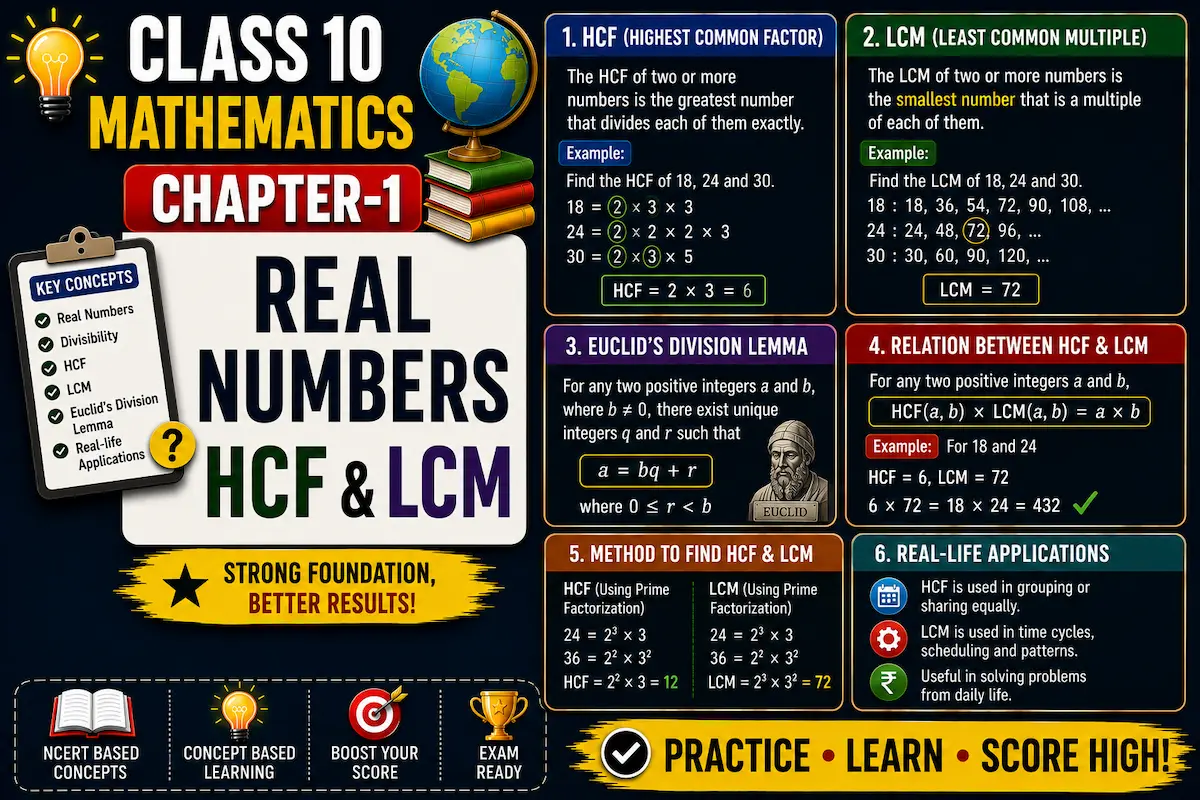
Practice Class 10 Maths Chapter 1 Real Numbers MCQ Questions with Answers based on NCERT syllabus. Learn prime factorization, Euclid Division Lemma, HCF, LCM, irrational numbers, terminating and non-terminating decimals with detailed solutions for CBSE and state board exams.
Do You Know
Chapter Information
Subject: Mathematics
Class: 10
Chapter: Real Numbers
Question Type: Multiple Choice Questions (MCQs)
Difficulty Level: Easy to Moderate
Based On: NCERT Latest Syllabus
Introduction:
Real Numbers is an important chapter that helps students understand the properties and applications of numbers in mathematics. Concepts such as prime factorization, Euclid’s Division Lemma, HCF, LCM, irrational numbers, and decimal expansions form the foundation of many advanced topics in algebra and number theory. A strong understanding of these concepts not only helps students perform better in board examinations but also improves logical thinking and problem-solving abilities. This practice set contains fresh and unique MCQs with detailed explanations to help students master the chapter effectively.
What You Will Learn?
✔ Prime Factorization
✔ Euclid’s Division Lemma
✔ HCF and LCM
✔ Rational Numbers
✔ Irrational Numbers
✔ Decimal Expansions
✔ Board Exam Preparation
Why This Topic Is Important?
Real Numbers is one of the most frequently tested chapters in Class 10 Mathematics. Questions from HCF, LCM, irrational numbers, and decimal expansions regularly appear in school exams and board examinations. A clear understanding of these concepts also helps students in higher mathematics.
Exam Relevance
These questions are useful for:
✔ CBSE Board Exams
✔ State Board Exams
✔ School Unit Tests
✔ Half-Yearly Exams
✔ Annual Exams
✔ Scholarship Tests
Q1. The prime factorization of $$126$$ is:
A) $$2 \times 3^2 \times 7$$
B) $$2^2 \times 3 \times 7$$
C) $$2 \times 3 \times 7$$
D) $$3^2 \times 7$$
Answer:
$$2 \times 3^2 \times 7$$
Useful Formula for this Question:
Prime factorization means expressing a number as a product of prime numbers only.
Solution:
$$126 = 2 \times 63$$
$$63 = 3 \times 21$$
$$21 = 3 \times 7$$
Therefore:
$$126 = 2 \times 3 \times 3 \times 7$$
$$= 2 \times 3^2 \times 7$$
Hence, the correct answer is:
$$2 \times 3^2 \times 7$$
————————————————–
Q2. Using Euclid’s Division Lemma, when $$47$$ is divided by $$8$$, the remainder is:
A) $$5$$
B) $$6$$
C) $$7$$
D) $$8$$
Answer:
$$7$$
Useful Formula for this Question:
$$a = bq + r$$
where
$$0 \le r < b$$
Solution:
Divide:
$$47 \div 8$$
We get:
$$47 = 8 \times 5 + 7$$
Therefore:
$$r = 7$$
Hence, the correct answer is:
$$7$$
————————————————–
Q3. Which of the following numbers is irrational?
A) $$\frac{5}{12}$$
B) $$0.875$$
C) $$\sqrt{17}$$
D) $$0.272727\ldots$$
Answer:
$$\sqrt{17}$$
Useful Formula for this Question:
An irrational number cannot be expressed in the form:
$$\frac{p}{q}$$
where $$q \ne 0$$.
Solution:
$$\sqrt{17}$$ cannot be written as:
$$\frac{p}{q}$$
Its decimal expansion is non-terminating and non-recurring.
Therefore, it is irrational.
Hence, the correct answer is:
$$\sqrt{17}$$
————————————————–
Q4. The HCF of $$63$$ and $$84$$ is:
A) $$7$$
B) $$14$$
C) $$21$$
D) $$28$$
Answer:
$$21$$
Useful Formula for this Question:
HCF is obtained by taking the common prime factors with the smallest powers.
Solution:
Prime factorization:
$$63 = 3^2 \times 7$$
$$84 = 2^2 \times 3 \times 7$$
Common prime factors:
$$3 \times 7$$
$$= 21$$
Therefore:
$$HCF = 21$$
Hence, the correct answer is:
$$21$$
————————————————–
Q5. Which of the following fractions has a non-terminating recurring decimal expansion?
A) $$\frac{7}{20}$$
B) $$\frac{9}{25}$$
C) $$\frac{11}{30}$$
D) $$\frac{13}{40}$$
Answer:
$$\frac{11}{30}$$
Useful Formula for this Question:
A rational number has a non-terminating recurring decimal expansion if the denominator contains prime factors other than:
$$2$$ and $$5$$
Solution:
For:
$$\frac{11}{30}$$
Denominator:
$$30 = 2 \times 3 \times 5$$
Since factor $$3$$ is present, the decimal expansion will be non-terminating recurring.
Therefore, the correct answer is:
$$\frac{11}{30}$$
————————————————–
Important Formulas and Concepts
Euclid’s Division Lemma:
$$a = bq + r$$
where
$$0 \le r < b$$
Relationship between HCF and LCM:
$$HCF \times LCM = Product\ of\ two\ numbers$$
A rational number is of the form:
$$\frac{p}{q}$$
where $$q \ne 0$$
A rational number has a terminating decimal expansion if the denominator contains only:
$$2$$ and/or $$5$$
————————————————–
FAQs
Q. What is prime factorization?
Answer:
Expressing a number as a product of prime numbers only is called prime factorization.
Q. What is an irrational number?
Answer:
A number that cannot be written in the form:
$$\frac{p}{q}$$
is called an irrational number.
Q. How can we identify a terminating decimal?
Answer:
The denominator should contain only the prime factors:
$$2$$ and/or $$5$$
————————————————–
Common Mistakes Students Make
❌ Forgetting repeated prime factors during factorization.
❌ Confusing terminating and recurring decimals.
❌ Taking the divisor as the remainder.
❌ Assuming all square roots are irrational.
————————————————–
Quick Revision Notes
✔ Prime factorization uses only prime numbers.
✔ Euclid’s Division Lemma is:
$$a = bq + r$$
✔ HCF uses common factors.
✔ Irrational numbers cannot be written as:
$$\frac{p}{q}$$
✔ Denominators containing factors other than $$2$$ and $$5$$ produce recurring decimals.
————————————————–
Conclusion:
These Class 10 Maths Chapter 1 Real Numbers MCQs with answers and detailed solutions help students strengthen their understanding of prime factorization, HCF, LCM, irrational numbers, and decimal expansions. Regular practice of these questions improves confidence and board exam performance.
Related links
- Class10 Maths Chapter 1 Real Numbers Euclid Division Lemma
- Class 10 Maths Chapter-1 Real Numbers-Rational numbers-MCQ
- Class 10 Maths Chapter 1 Real Numbers MCQ Questions with Solutions
- Class 10 Maths Chapter 1 Real Numbers MCQs with Solutions
- Class 10 SST: Liberalism, Agriculture, Constitution, GDP
- Class 10 Maths Chapter 1 Real Numbers MCQ for Board Exams
- Class 10-Maths Chapter 1–Real Numbers NCERT
- Class 10 Science MCQs with Answers | Biology & Physics
- Class 10 SST MCQs with Answers | Federalism & Freedom
- Class 10 SST MCQs with Detailed Black Soil, Sri Lanka
- Quiz Class 10th Social Science NCERT 26-05-2026
Latest Posts
- Class 7 Maths Chapter 1 Integers, number line, subtraction
- Class 8 Maths additive inverse, multiplicative inverse MCQ
- Class 9 Maths Chapter 1 Number Systems laws of exponents
- Class 10 Maths Chapter 2 Polynomials MCQ linear polynomial
- Class 10 Maths Chapter 2 Polynomials, linear polynomial
Join Our Other Communities
Instagram , Youtube , Facebook